
Temple Culture in Taiwan | Intermediate ESL Worksheet

Reading Passage
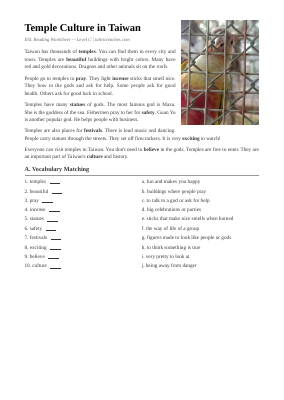
Taiwan is home to over twelve thousand temples, making it one of the most spiritual places in Asia. These magnificent buildings serve as centers for worship, community gatherings, and cultural celebrations throughout the year. Temples display stunning architecture with curved roofs decorated with colorful dragons, phoenixes, and other mythical creatures. The walls feature intricate carvings and paintings that tell stories from ancient Chinese legends and history. Walking into a Taiwanese temple is like stepping into a living museum of traditional art.
The religious traditions practiced in Taiwanese temples blend Buddhism, Taoism, and folk beliefs together. Visitors light incense and place offerings of fruit, flowers, and sometimes meat before statues of various gods. Many people use crescent-shaped wooden blocks called jiaobei to communicate with the gods directly. They throw the blocks on the ground and read the pattern to receive answers to their questions. Fortune sticks are another popular way to seek guidance about important life decisions and challenges.
Mazu, the goddess of the sea, is perhaps the most revered deity in all of Taiwan today. Every spring, millions of people join the Dajia Mazu Pilgrimage, walking over three hundred kilometers across Taiwan. This nine-day journey is one of the largest religious processions in the entire world each year. Participants carry Mazu’s statue through towns while firecrackers explode and traditional music fills the streets loudly. UNESCO has recognized this pilgrimage as an important piece of intangible cultural heritage worth preserving.
Temple festivals play a vital role in keeping Taiwanese communities connected and culturally strong together. During celebrations, neighborhoods organize puppet shows, opera performances, and elaborate feasts for everyone nearby. Young people learn traditional dances and rituals that have been passed down for many generations already. Local businesses often sponsor these events, contributing food and decorations to honor the temple gods generously. These festivals strengthen social bonds and give people a sense of shared identity and belonging.
Modern Taiwanese temples have adapted to contemporary life while preserving their ancient traditions carefully. Some temples now offer online prayer services and digital fortune-telling for younger generations worldwide. Environmental awareness has led many temples to reduce incense burning and use eco-friendly materials instead. Despite these changes, temples remain essential gathering places where people find comfort and community support. Whether you are religious or simply curious, visiting a Taiwanese temple offers a window into the island.
Level: Level F
A. Vocabulary Matching
Match each word with its definition.
1. spiritual ______
2. worship ______
3. architecture ______
4. traditions ______
5. offerings ______
6. guidance ______
7. revered ______
8. processions ______
9. intangible ______
10. contemporary ______
a. large organized marches or parades
b. customs passed down through generations
c. gifts given to honor gods or spirits
d. deeply respected and admired
e. to show love and respect to a god
f. relating to the present time
g. connected to religion or the soul
h. the design and style of buildings
i. advice or direction to help make decisions
j. cannot be touched or held physically
B. True or False
- Taiwan has over twelve thousand temples. ______
- Taiwanese temples only follow Buddhism. ______
- Jiaobei blocks are used to communicate with gods. ______
- The Dajia Mazu Pilgrimage covers over 300 kilometers. ______
- Mazu is the god of mountains. ______
- UNESCO recognized the Mazu pilgrimage. ______
- Temple festivals are only for religious people. ______
- Some temples now offer online prayer services. ______
- Temples have reduced incense burning for the environment. ______
C. Fill in the Blanks
Word Bank: spiritual | worship | architecture | offerings | revered | processions | contemporary
- Taiwan is one of the most _______________ places in Asia with over twelve thousand temples.
- Temples display stunning _______________ with curved roofs and colorful decorations.
- Visitors place _______________ of fruit and flowers before statues of the gods.
- Mazu is the most _______________ deity in Taiwan, honored by millions each spring.
- Modern temples have adapted to _______________ life while preserving ancient traditions.
D. Comprehension Questions
- How many temples does Taiwan have?
- What are jiaobei blocks used for?
- How far do people walk during the Dajia Mazu Pilgrimage?
- What role do temple festivals play in communities?
- How have modern temples adapted to contemporary life?
E. Discussion Questions
- Why do you think temple culture remains so strong in modern Taiwan?
- Have you ever participated in a religious or cultural festival? What was it like?
- Should temples change their traditions to be more environmentally friendly? Why or why not?
Answer Key
A. Vocabulary: 1-g, 2-e, 3-h, 4-b, 5-c, 6-i, 7-d, 8-a, 9-j, 10-f
B. True/False: 1-T, 2-F, 3-T, 4-T, 5-F, 6-T, 7-F, 8-T, 9-T
C. Fill in the Blanks: 1-spiritual, 2-architecture, 3-offerings, 4-revered, 5-contemporary
D. Comprehension: 1. Over twelve thousand; 2. To communicate with gods by throwing them and reading the pattern; 3. Over 300 kilometers; 4. They keep communities connected, preserve traditions, and strengthen social bonds; 5. Online prayer services, digital fortune-telling, reduced incense burning, eco-friendly materials
Browse our complete collection of free ESL worksheets and learning resources.
 Bahasa Indonesia
  English
  繁體中文
繁體中文  日本語
日本語  한국어
한국어  ไทย
ไทย  Tiếng Việt
  Français