
Quantifiers in English: Much, Many, Some, Any | 英文數量詞完整指南
Chinese speakers have a natural edge with some English grammar points, but quantifiers are not one of them. In Mandarin, 一些 covers “some” in any sentence type, 很多 handles “a lot,” and context fills the gaps — you rarely need to separate “much” from “many.” English forces that distinction, and it catches even advanced Taiwan learners off guard. This guide covers every major quantifier with clear rules, real examples, comparison tables, and the five mistakes that show up most often in Taiwanese writing and speech.
什麼是數量詞?[What Are Quantifiers in English?]

Understanding quantifiers is one of the highest-return grammar skills for Taiwan English learners.
A quantifier is a word placed before a noun to express quantity — how much or how many. Words like much, many, some, any, a little, a few, lots of, 、 そして plenty of all belong to this group. They slot between the determiner position and the noun: “I have some time” or “There are many students in class.”
The right quantifier depends first on the noun type. English nouns split into two categories:
- Countable nouns 可數名詞 — things you can count individually: apples, students, emails, chairs, ideas
- Uncountable nouns 不可數名詞 — things treated as a mass or substance: water, rice, advice, traffic, music, information
A fast test: if you can put a number directly in front of the noun, it is countable. “Three books” works. “Three water” does not — so water is uncountable. Get the noun type right and most quantifier decisions follow automatically. Skip this step and sentences like “I have much books” or “There isn’t many water” appear — errors native speakers catch instantly.
Much 和 Many 的差別 [Much vs Many: Countable vs Uncountable]

Coffee, water, and milk are all uncountable nouns — always use “much,” never “many,” to describe their quantity.
This is the most common quantifier error in Taiwan, and the fix comes down to one rule: much goes with uncountable nouns; many goes with countable nouns.
| Quantifier | Use With | Example |
|---|---|---|
| Much | Uncountable nouns | どうやって much water do you drink each day? |
| 多くの | Countable nouns (plural) | どうやって many students are in your class? |
Much sounds natural in questions and negative sentences: “I don’t have much time.” “Do you have much homework tonight?” In positive statements, native speakers almost always swap much for a lot of: “There is a lot of traffic today” sounds completely natural; “There is much traffic today” sounds stiff and formal, like a legal document.
多くの works freely in all sentence types — positive, negative, and question. “Many students struggled with the test.” “Are there many good noodle shops nearby?” “I didn’t see many familiar faces at the party.” Both formal essays and casual conversations accept many without issue.
One word of caution: uncountable nouns sometimes masquerade as countable ones. “Coffee” is uncountable when you mean the substance — “I drink too much coffee.” But when ordering at a café, “three coffees, please” is perfectly correct because you are counting cups, not the liquid itself. Context decides.
If you find yourself mixing up words with similar-but-different meanings, our full guide on commonly confused English words covers dozens of these pairs in detail.
Some 和 Any 怎麼用 [Some vs Any: Positive, Negative, and Questions]

“I bought some apples” works in a positive sentence. “I didn’t buy any apples” is the correct negative form.
Both some そして any work with countable and uncountable nouns, so noun type does not drive this decision. The rule is about sentence type.
| Quantifier | Use In | Example |
|---|---|---|
| いくつかの | Positive sentences; offers and requests | I have some ideas. / Would you like some tea? |
| Any | Negative sentences and open questions | I don’t have any ideas. / Do you have any questions? |
The exception that trips people up: use some in questions when you expect a “yes” answer or when making an offer. “Would you like some coffee?” uses some because the speaker anticipates a positive response. Compare that with “Is there any coffee left?” — here the speaker genuinely does not know, so any is correct.
In negatives, any is always the choice. “There isn’t any milk.” “She doesn’t have any experience in this field.” “I didn’t buy any vegetables.” Never use some after a negative verb — “I don’t have some money” is a direct translation from Mandarin that sounds immediately wrong to native ears.
A Little 和 A Few 的用法 [A Little vs A Few: Small Quantities]

A little daily practice makes a big difference — and yes, “a little” is correct here because “practice” is uncountable.
A little そして a few both describe small quantities, but they follow the same countable/uncountable split as much そして many.
- A little → uncountable nouns: “I have a little money saved.” / “Add a little salt to the soup.”
- A few → countable nouns (plural): “I have a few ideas.” / “She’s visited Taiwan a few times.”
Here is where the nuance gets important. Drop the article a and the meaning flips negative — signaling “almost none” and carrying a pessimistic tone.
- “There is a little hope.” → Some hope exists. Situation is manageable.
- “There is little hope.” → Almost no hope. Situation is serious.
- “I have a few friends in Taipei.” → Good — I know some people.
- “I have few friends in Taipei.” → Unfortunate — I’m fairly isolated.
Taiwan learners frequently drop the article by accident — often because Chinese does not use articles — and end up sounding far more negative than intended. “I have few ideas” reads as discouraging. “I have a few ideas” is confident. Unless you genuinely want to emphasize scarcity, keep the a.
大量的英文說法 [Lots Of, A Lot Of, and Plenty Of]
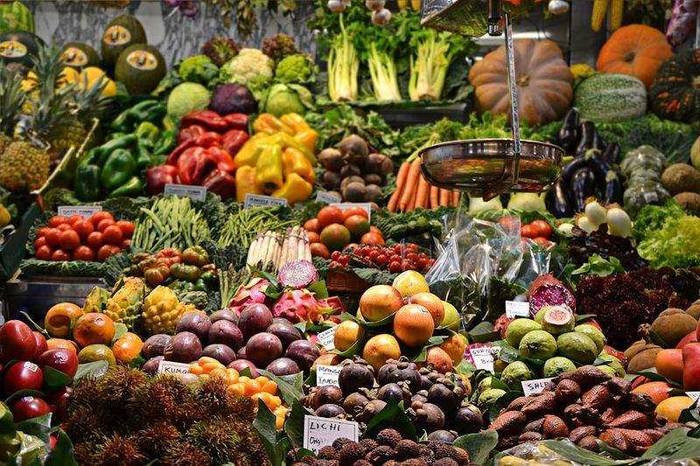
A market full of produce is a natural image for “lots of” and “plenty of” — large quantities of both countable and uncountable nouns.
A lot of, lots of, 、 そして plenty of all express large quantities. The advantage here: all three work with both countable and uncountable nouns, so there is no extra noun-type decision.
- “There are a lot of good cafés near the station.” (countable)
- “She drinks a lot of green tea every morning.” (uncountable)
- “We have plenty of time before the deadline.” (uncountable)
- “There are lots of things to do in Tainan.” (countable)
A lot of そして lots of are interchangeable and appropriate in both speaking and writing. Plenty of carries a warmer, more reassuring tone — it implies “more than enough” rather than simply “a large amount.” “Don’t worry, we have plenty of food” is more reassuring than “we have a lot of food.”
One register note: in formal or academic writing, a lot of can sound informal. Replace it with many または much depending on the noun. “Many participants completed the survey” reads more professionally than “A lot of participants completed the survey.”
台灣學習者的常見錯誤 [Common Quantifier Mistakes Taiwan Learners Make]

These five errors appear repeatedly in Taiwan — recognize them now and they stop appearing in your writing.
After two decades of teaching English in Taiwan, the same quantifier errors show up across age groups and proficiency levels. All of them are fixable once you understand the pattern behind the mistake.
1. “I have much books.”
Books are countable — you need many または a lot of. Reserve much exclusively for uncountable nouns. No exceptions.
2. “There isn’t some milk.”
Negative sentences require any, not some. “There isn’t any milk.” This error comes directly from treating Mandarin 一些 as a direct swap — it is not.
3. “I have few time.”
Two errors in one sentence: time is uncountable, so you need little, not few. And dropping the article changes the meaning to “almost no time.” Correct forms: “I have a little time” (some time) or “I have little time” (almost no time, used intentionally).
4. “Do you have some questions?”
In a neutral question where the answer is unknown, use any: “Do you have any questions?” Save some for offers and questions where “yes” is the expected answer: “Would you like some help?”
5. “He gave me many advices.”
“Advice” is uncountable in English — even though 建議 feels countable in Chinese. The same applies to “information,” “news,” “homework,” “furniture,” and “equipment.” Never pluralize these, never use many with them. Use “much advice,” “a piece of advice,” or “some advice.”
試試看![Practice: Fill in the Blank]

The fastest way to internalize quantifier rules is repeated practice with sentences close to real situations.
Choose the correct quantifier for each sentence. Answers follow.
- There isn’t _______ sugar left in the jar. (much / many)
- How _______ students passed the IELTS exam last month? (much / many)
- I need _______ advice before I make this decision. (a few / a little)
- Do you have _______ questions about the assignment? (some / any)
- She bought _______ new clothes during the sale. (lots of / much)
- Would you like _______ more coffee? (some / any)
- There were _______ people at the night market — it was packed. (many / much)
- I have _______ homework tonight, so I can go out. (a little / a few)
Answers: 1. much 2. many 3. a little 4. any 5. lots of 6. some 7. many 8. a little
If number 8 caught you off guard, remember: “homework” is uncountable in English (like “advice” and “information”), so you need a little, never a few. These uncountable nouns are worth memorizing as a list — they are among the most common sources of quantifier errors.
Quantifiers are one of those grammar topics that reward pattern recognition over memorization. Once the countable/uncountable split clicks, much vs many and a little vs a few become automatic. If you want to keep building your grammar toolkit, the same pattern-recognition approach works well for phrasal verbs with GET — another high-frequency area where a few core rules unlock dozens of expressions.
Video Lesson: Quantifiers in English 英文數量詞教學
This grammar lesson walks through all the major quantifiers — much, many, some, any, a little, a few, a lot of — with clear explanations and examples:
情報源
- Cambridge Grammar: Quantifiers — Reference guide covering all major English quantifiers with examples and rules.
- British Council: Quantifiers — Grammar reference and interactive exercises for English learners.
- Test-English: Much, Many, Little, Few, Some, Any — Practice exercises and grammar explanations at A2 level.





 日本語
日本語  English
  繁體中文
繁體中文  한국어
한국어  ไทย
ไทย  Bahasa Indonesia
  Tiếng Việt
  Français