閒聊英文:30 Small Talk Phrases at Work (2026) | 辦公室英文
Walk into any Taipei office on a Monday morning and you will hear the same English exchange roughly forty times: “Hi, how are you?” “Fine. And you?” “Fine, thanks.” That is not small talk. That is two people running a script so they can stop talking. Real 閒聊英文 (small talk in English) sounds different — looser, more specific, with actual content about the weekend or the weather or the meeting that just ended. This guide gives Taiwan professionals 30 small talk phrases that sound natural at the elevator, the coffee station, and the post-meeting hallway, organised by situation so you can grab the right one in three seconds.

Two Taipei office colleagues using 閒聊英文 between meetings.
Small Talk 中文:What It Actually Means | Small Talk 的意思
Small talk 的意思 in Chinese is closest to 寒暄 or 閒聊 — short, low-stakes conversation that fills space and builds relationships. It is not about exchanging important information. It is about signalling “I see you, I am friendly, I am safe to work with.” In Taiwan office culture, small talk often happens in the elevator, while waiting for the coffee machine, or for the first ninety seconds of a video call before the boss joins. Westerners use it the same way, but they expect more variety in the response. “Fine, thanks” is a closed door. “Pretty good — busy week, but I got the proposal out last night” is an open one.
The mistake I see most often with Taiwan professionals is treating small talk like a TOEIC listening question — searching for the “correct” answer. There is no correct answer. There is only a response that gives the other person something to grab onto. Specific beats generic every time.
打招呼英文:Office Greetings That Open Small Talk

打招呼英文 — the first three seconds set the tone for the entire exchange.
Strong 打招呼英文 (English greetings) do two things at once: they acknowledge the other person and they open a door for them to respond with more than one word. The standard “How are you?” closes the door because the expected answer is “Fine.” Try these instead.
- “Morning! How was your weekend?” — 早安!週末過得怎麼樣?
- “Hey, good to see you. How’s everything going?” — 嗨,很高興見到你。最近怎麼樣?
- “Hi! Busy morning so far?” — 嗨!今天早上忙嗎?
- “Long time no see — how have you been?” — 好久不見,最近還好嗎?
- “Hey [name], what’s new on your end?” — 嘿 [姓名],你那邊有什麼新鮮事?
Notice that none of them is “How are you?” Native English speakers use “How are you?” as a verbal handshake — they say it without expecting a real answer. If you want a real conversation, ask a question that invites a real answer. “How was your weekend?” forces the other person to give you a sentence with content in it, which gives you something to react to.
電梯英文:Elevator Small Talk in 30 Seconds
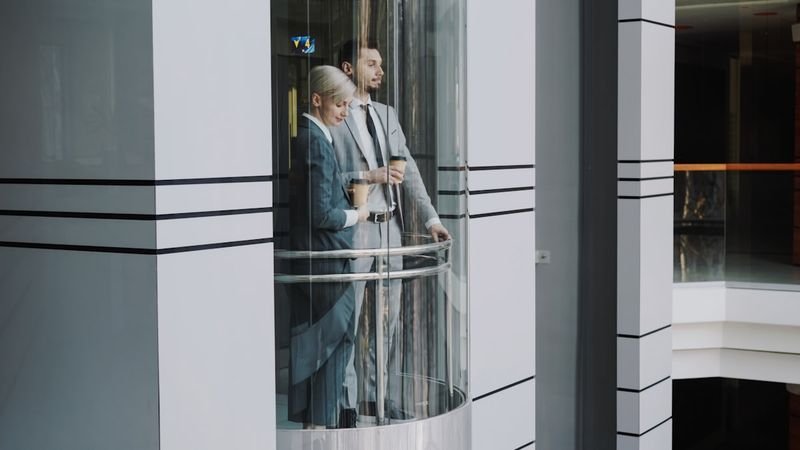
電梯英文 — you have about 30 seconds. Make them count.
The elevator is the toughest setting for English small talk because the clock is running. You have one stop or maybe three to fill, and you cannot start a long story you cannot finish. The trick with 電梯英文 (elevator English) is to use phrases that work as both opener and closer — short comments that land cleanly and do not need a follow-up if the doors open early.
- “Looks like a busy day for you.” — 你今天看起來很忙。
- “Heading to lunch?” — 要去吃午餐嗎?
- “Working from this floor today?” — 今天在這層上班嗎?
- “Has it been crazy in your team this week?” — 你們這週很忙嗎?
- “Catch you at the next meeting.” — 下個會議見。
The exit lines matter more than the openers. If the doors open at your floor and you have not closed the loop, the silence feels awkward. “Catch you later” or “Have a good one” gives you a clean way out. Save the deeper conversations for the coffee station, where you actually have time to follow up.
天氣英文:Weather Small Talk That Doesn’t Feel Forced

天氣英文 works because everyone outside has an opinion about it.
Westerners genuinely talk about the weather. It is not a stalling tactic. They do it because the weather is the one experience everyone in the room actually shares, which makes it the lowest-risk conversation opener in human history. Good 天氣英文 (weather English) is not “It’s hot today” — that is a fact, not a conversation. Good weather small talk is opinionated: you like it, hate it, are surprised by it, or have a plan around it.
- “This rain is brutal — did you get soaked coming in?” — 雨好大,你過來的時候有沒有淋濕?
- “It’s beautiful out today. Hard to focus, right?” — 今天天氣超好,很難專心對吧?
- “I can’t believe how humid it is — and it’s only June.” — 才六月就這麼悶,真誇張。
- “Did you see the typhoon warning for this weekend?” — 有看到這週末的颱風警報嗎?
- “I keep forgetting to bring an umbrella. Classic.” — 我又忘了帶傘,超經典。
The Taipei summer gives you endless material — humidity, surprise downpours, typhoon season, the air-con war in every office. Use it. A specific complaint about the weather builds rapport faster than any compliment about a co-worker’s outfit.
週末英文:Weekend Plans Small Talk

週末英文 — Friday afternoons and Monday mornings are prime small talk territory.
The two highest-value small talk windows of the week are Friday afternoon (“any plans?”) and Monday morning (“how was it?”). Master these and you will be ahead of 80% of Taiwan professionals on small talk alone. The pattern in 週末英文 (weekend English) is simple: ask a specific question, give a specific answer, react to the other person’s answer with one short follow-up. Then stop.
- “Any fun plans for the weekend?” — 週末有什麼好玩的計畫嗎?
- “How was your weekend? Did you do anything fun?” — 週末過得如何?有做什麼有趣的事嗎?
- “I’m thinking about going up to Yangmingshan. You been recently?” — 我在考慮去陽明山,你最近有去嗎?
- “Just stayed in and caught up on sleep — needed it after last week.” — 我就在家補眠,上週太累了。
- “Oh nice, how was it?” — 喔不錯,怎麼樣?
Notice phrase 20 — “Oh nice, how was it?” That four-word follow-up is the single most underused small talk move in Taiwan offices. When someone tells you they went to Tainan for the weekend, the correct response is not “Oh.” It is “Oh nice, how was it?” That one question is the difference between sounding polite and sounding interested.
下午茶英文 and 午餐英文:Coffee Break and Lunch Small Talk

下午茶英文 — the coffee station is where most workplace relationships actually get built.
Coffee breaks and lunch are when small talk gets longer and more comfortable. You are not on a clock, the other person is not running to a meeting, and food gives you a built-in topic. The phrases for 下午茶英文 (afternoon tea English) and 午餐英文 (lunch English) are softer and more open-ended than elevator phrases.
- “Where do you usually grab lunch around here?” — 你通常在這附近哪裡吃午餐?
- “Have you tried that new place across the street?” — 你有試過對面那家新開的店嗎?
- “Mind if I join you?” — 我可以一起坐嗎?
- “That smells incredible — what did you get?” — 好香!你買了什麼?
- “I needed this coffee. Long morning.” — 我超需要這杯咖啡,早上太累了。

午餐英文 — lunch is when most cross-team relationships actually form.
If you only memorise one phrase from this section, make it phrase 23: “Mind if I join you?” It is the single fastest way to break into a group conversation without seeming pushy, and it works in every English-speaking office on the planet. The response will be “Sure, sit down” 95% of the time, and you have just earned 30 minutes of small talk practice with zero work.
回應英文:How to React Like a Native

辦公室英文 listening responses keep the other person talking.
Native English speakers fill small talk with short reaction phrases that signal “I’m listening, keep going.” Taiwan professionals often skip these and end up sounding flat or uninterested — even when they are actually paying close attention. These are not real sentences. They are conversational nudges, and you should use them every two or three lines the other person says.
- “Oh really?” — 是喔?
- “That sounds amazing.” — 聽起來超讚。
- “Wait, seriously?” — 等等,真的假的?
- “Oh man, that’s rough.” — 哎,真辛苦。
- “Good for you!” — 太棒了!
Phrase 29 — “Oh man, that’s rough” — is the right response when a coworker complains about workload, traffic, in-laws, or weather. Do not try to solve the problem. Do not say “you should…” Just register that you heard the complaint and you sympathise. Westerners are not always asking for advice. Most of the time they just want acknowledgement.
結束閒聊英文:How to Politely Exit Small Talk
This is the half of 閒聊英文 nobody teaches in Taiwan English class, and it is the half that causes the most awkwardness. Knowing how to start a conversation is useless if you do not know how to end one. The honest truth is that most Taiwan professionals stay in small talk longer than they want to because they do not have a graceful exit line. Borrow one of these.
- “Anyway, I should get back to it — good talking to you.”
- “Alright, I’ll let you get back to work.”
- “Let’s catch up properly soon — coffee next week?”
- “Hey, I have a call in two minutes — talk soon!”
The pattern is: signal the close, offer a reason, leave a small open door. “Good talking to you” is the verbal equivalent of bowing slightly before you walk away. It is short, it is warm, and it does not require a response. For a deeper guide to professional refusal language, see our breakdown of 30 polite ways to say no at work.
Topics to Avoid in Taiwan-Western Workplace Small Talk
The fastest way to torpedo small talk with a Western coworker is to ask a question that feels normal in Taipei but lands hard in their cultural frame. Western workplace small talk has tighter taboos than Taiwan small talk. Three categories are the usual landmines.
Money and salary. Asking “How much do you earn?” or “How much was your apartment?” is standard small talk among friends in Taiwan. To most Western colleagues it sounds invasive. Skip it. Career growth, industry trends, and cost of living in general are fine. Specific dollar amounts are not.
Marital status, age, and weight. “Are you married?” “How old are you?” “Did you lose weight?” all read as polite curiosity in Mandarin. In English-language workplace settings — especially in the US, UK, and Australia — they read as borderline harassment. Compliments about clothes or hairstyle are safer than compliments about bodies. The British Council’s small talk topics guide covers the safe list well.
Politics, religion, and immigration status. Even if the other person brings it up, you are usually safer letting them carry the topic without sharing your own view. The career risk is asymmetric — there is almost no upside to going on record, and significant downside if your view does not match the office majority. Save these for after work, off Slack, and only with people you actually trust.
For more nuanced workplace English on the formal end of the spectrum, see our guide on 30 office abbreviations Taiwan pros use daily and the conference call English phrase library. Both pair well with small talk fluency for round-trip workplace communication.
Watch: Small Talk Practice for the Workplace
DC Fluency’s three-phrase framework for avoiding awkward silence is the best short video on workplace small talk I have seen — useful as listening practice and a sanity check on your own delivery.
How to Practice This Week
Pick three phrases from the list above — one greeting, one weather or weekend opener, and one reaction phrase. Use only those three this week, on every English exchange you have, and pay attention to how your coworkers respond. By next Monday you will know which ones feel natural in your voice and which ones sound forced. Drop the forced ones and add three new ones. This is how small talk fluency actually builds — not from memorising lists, but from running the same five phrases until they stop feeling like phrases and start feeling like things you say.
출처
- British Council English Online — Guide to Small Talk Topics, Phrases and Openers — Authority reference for safe small talk topics across English-speaking cultures.
- engVid — How to Make Small Talk at Work: What to Say — Practical breakdown of opening, middle, and exit phrases for workplace small talk.
- DC Fluency — How to Do Small Talk at Work in English (YouTube) — Three-phrase framework for breaking awkward silence in office settings.
Looking for free ESL worksheets for your classroom? Browse our free worksheet library →
Are you a teacher? Find lesson resources and worksheets at TahricTeaches.com.



 한국어
한국어  English
  繁體中文
繁體中文  日本語
日本語  ไทย
ไทย  Bahasa Indonesia
  Tiếng Việt
  Français