
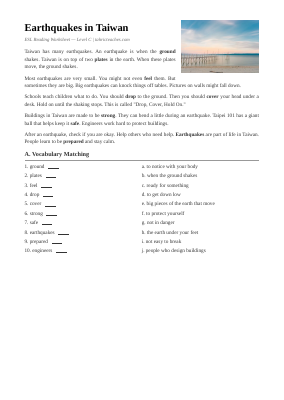
Earthquakes in Taiwan | Intermediate ESL Worksheet

Reading Passage
Taiwan experiences hundreds of earthquakes every year because of its unique geological position on Earth. The island sits directly on the boundary where the Philippine Sea Plate pushes beneath the Eurasian Plate constantly. This process, called subduction, creates enormous pressure deep underground that must eventually be released as energy. Most of these earthquakes are too small for people to notice during their daily activities or routines. However, Taiwan’s location makes it one of the most seismically active places anywhere on the entire planet.
The most devastating earthquake in modern Taiwanese history struck on September twenty-first, nineteen ninety-nine completely. Known as the Chi-Chi earthquake, it measured seven point six on the Richter magnitude scale enormously. Over two thousand four hundred people lost their lives, and fifty thousand buildings were damaged or totally destroyed. Entire communities were flattened, and the disaster caused billions of dollars in damage across central Taiwan entirely. This tragedy became a turning point that changed how Taiwan approaches building safety and earthquake preparedness forever.
After the Chi-Chi earthquake, Taiwan invested heavily in making its buildings and infrastructure much stronger overall. New building codes require structures to withstand powerful earthquakes using reinforced concrete and steel framing methods. Taipei one-oh-one, once the world’s tallest building, features a giant tuned mass damper that reduces swaying. Bridges, highways, and hospitals were all upgraded to resist earthquake damage more effectively than ever before. Taiwan’s commitment to engineering excellence has made its modern buildings among the safest in any earthquake zone.
Earthquake preparedness is taught extensively in schools and workplaces throughout Taiwan to all citizens regularly. Students practice the “Drop, Cover, and Hold On” drill multiple times each year in organized emergency exercises. The government sends earthquake early warning alerts to every mobile phone seconds before strong shaking actually begins. Emergency supply kits with water, food, and flashlights are recommended for every household across the island nation. Taiwan’s advanced warning systems give people precious seconds to protect themselves before an earthquake strikes hard.
Living with earthquakes has shaped Taiwanese culture and resilience in remarkable and inspiring ways entirely. Communities come together quickly after disasters to help rebuild homes and support affected families and neighbors. Taiwan now shares its earthquake engineering knowledge with other countries facing similar seismic risks worldwide. The nation has transformed its vulnerability into expertise that saves lives both domestically and internationally every year. Taiwan’s story shows how a society can learn from tragedy and become stronger through preparation and unity.
수준: Level F
A. Vocabulary Matching
Match each word with its definition.
1. geological ______
2. subduction ______
3. seismically ______
4. devastating ______
5. magnitude ______
6. infrastructure ______
7. reinforced ______
8. preparedness ______
9. systems ______
10. resilience ______
a. made stronger with additional materials
b. the ability to recover quickly from difficulties
c. causing great damage or destruction
d. roads, bridges, and systems a society needs
e. related to the structure of the earth
f. the size or strength of an earthquake
g. related to or caused by earthquakes
h. when one plate slides under another
i. the state of being ready for something
j. organized sets of connected things working together
B. True or False
- Taiwan sits on the boundary of two tectonic plates. ______
- The Chi-Chi earthquake happened in 2001. ______
- The Chi-Chi earthquake measured 7.6 on the Richter scale. ______
- Over two thousand people died in the Chi-Chi earthquake. ______
- Taipei 101 has a tuned mass damper. ______
- Taiwan does not send earthquake warning alerts to phones. ______
- Students practice earthquake drills in schools. ______
- Taiwan’s building codes were not changed after Chi-Chi. ______
- Taiwan shares its earthquake engineering knowledge with other countries. ______
C. Fill in the Blanks
Word Bank: geological | subduction | devastating | magnitude | infrastructure | reinforced | resilience
- Taiwan experiences many earthquakes because of its unique _______________ position.
- The process called _______________ creates enormous pressure underground.
- The Chi-Chi earthquake was the most _______________ in modern Taiwanese history.
- The earthquake measured seven point six on the Richter _______________ scale.
- Taiwan invested heavily in making its _______________ much stronger.
D. Comprehension Questions
- Why does Taiwan have so many earthquakes?
- When did the Chi-Chi earthquake happen and how strong was it?
- What changes did Taiwan make to buildings after the Chi-Chi earthquake?
- How does Taiwan warn people about earthquakes?
- What is the ‘Drop, Cover, and Hold On’ drill?
E. Discussion Questions
- How would you prepare your home and family for an earthquake?
- Why is it important for countries to share disaster knowledge with each other?
- Do you think living in an earthquake zone makes people stronger? Why or why not?
Answer Key
A. Vocabulary: 1-e, 2-h, 3-g, 4-c, 5-f, 6-d, 7-a, 8-i, 9-j, 10-b
B. True/False: 1-T, 2-F, 3-T, 4-T, 5-T, 6-F, 7-T, 8-F, 9-T
C. Fill in the Blanks: 1-geological, 2-subduction, 3-devastating, 4-magnitude, 5-infrastructure
D. Comprehension: 1. It sits on the boundary of two tectonic plates; 2. September 21, 1999, magnitude 7.6; 3. New building codes, reinforced concrete, steel framing; 4. Early warning alerts sent to mobile phones; 5. An earthquake safety drill practiced in schools
Browse our complete collection of free ESL worksheets and learning resources.


 한국어
한국어  English
  繁體中文
繁體中文  日本語
日本語  ไทย
ไทย  Bahasa Indonesia
  Tiếng Việt
  Français