

多益準備: 9 Proven TOEIC Steps Taiwan Pros Use (2026)
Hitting 多益滿分 in Taiwan starts with one boring fact: ETS reports the global average TOEIC Listening & Reading score sits around 584, while Taiwan’s average hovers in the low 540s — meaning most candidates who walk into the test cold finish below the 550 cutoff their HR department actually cares about. Effective 多益準備 is the difference between a 600 that gets ignored and a 750+ that lands the interview. This guide walks through 9 steps that Taiwan professionals — engineers, marketers, fresh graduates — use to push past 800, with the parts of the test most learners skip until it’s too late.

Taipei skyline — TOEIC scores still drive hiring across Taiwan’s white-collar sector. 多益分數仍是台灣白領職場錄取的關鍵指標.
1. Why a Smart 多益準備 Plan Beats Brute Force [為什麼策略勝過硬背]
Most Taiwanese test-takers approach 多益準備 the same way they once approached 大學指考: buy a thick book, grind chapters in order, hope for the best. That strategy stalls around 650 because TOEIC is not a knowledge test — it’s a pattern-recognition test. The question types repeat. The traps repeat. Knowing the patterns is worth more than knowing 5,000 extra words.
The truth is, most candidates who score below 700 aren’t short on English; they’re short on test-format familiarity. Two months of structured 多益準備 — diagnostic, vocabulary system, daily listening, weekly mocks — routinely beats six months of unstructured reading. Treat this article as the structure, not as another textbook to bookmark.
2. The TOEIC Test in Plain English [TOEIC 考試結構]
The TOEIC Listening & Reading test runs 2 hours, 200 multiple-choice questions, 990 maximum score. The split is fixed and worth memorizing before you study anything else: 45 minutes of Listening (100 questions, Parts 1–4) followed by 75 minutes of Reading (100 questions, Parts 5–7). According to ETS, the test is delivered in over 160 countries, and Taiwan accounts for one of the largest TOEIC test populations in Asia.
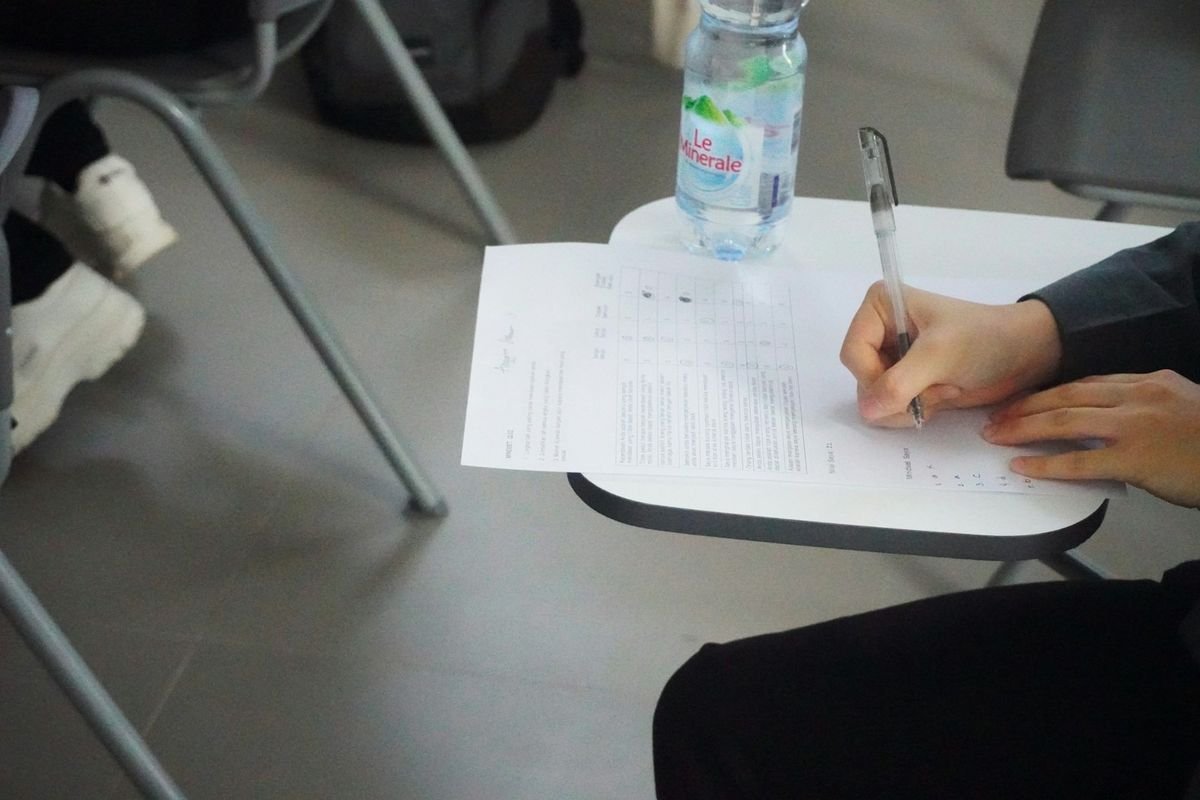
200 questions, 7 parts, 120 minutes — TOEIC is a stamina test as much as an English test. 多益是英文力與耐力的雙重考驗.
Here’s the part most 多益準備 guides skim: each section weights equally toward your final score (495 Listening + 495 Reading), but the time pressure is brutal in Reading. You have roughly 75 seconds per question in Part 5 (single-sentence grammar), but only about 60 seconds per question across Part 7’s long passages. Whichever section you’re weaker in, that’s where your prep time should concentrate — not the section you enjoy more.
3. How Long Should 多益準備 Take? [備考時間規劃]
The most common question on Dcard and PTT’s TOEIC board: 多益要準備多久? A realistic answer depends on baseline, not motivation. After a cold diagnostic test, work backward from your target score using these benchmarks pulled from cram-school internal data:
- Baseline 400 → target 600: 2 months at 1 hour/day, or 6 weeks at 2 hours/day.
- Baseline 550 → target 750: 3 months at 1 hour/day, including 8 full mock tests.
- Baseline 700 → target 860+ (金色證照): 6–10 weeks of targeted Part 7 drilling and high-frequency 多益單字 review.
- Baseline 800 → target 990 (多益滿分): Highly variable. Expect 4–6 months of full mocks every week and obsessive error-log review.

Sketch your 多益準備 schedule on paper before opening any textbook. 開始念書前,先把計畫寫下來.
One detail Taiwanese learners under-estimate: register first, study second. The official Taiwan TOEIC website lists exam dates roughly monthly, and seats in Taipei fill 4–6 weeks ahead. Picking a date forces commitment. Without a date on the calendar, “I’ll study more first” turns into a year of nothing.
4. Build a 多益單字 Habit, Not a Word List [單字學習法]
多益單字 has roughly 2,500 high-frequency words and another 1,500 mid-frequency words that appear in business contexts: meetings, invoices, schedules, project updates, travel logistics. Almost every published TOEIC vocabulary book covers the same core — what separates a 700 from a 900 isn’t more words, it’s faster retrieval under time pressure.

Daily 多益單字 reps beat marathon weekend cramming. 每天背 30 字勝過週末塞 300 字.
The system that actually works is dull and unsexy: spaced-repetition flashcards (Anki, Quizlet) loaded with one new card stack every day, reviewed every morning, no exceptions. Pair that with example sentences from real TOEIC Part 5 questions, not isolated dictionary entries — the word “implement” appears in TOEIC almost exclusively as part of implement the policy 또는 implement the changes, so the collocation is the actual unit of memory.
For a broader system to anchor your daily vocabulary work, this 8-method vocabulary building guide is the closest companion piece to a TOEIC vocabulary routine. The categorized list in our topic vocabulary reference also maps neatly to TOEIC’s business contexts.
5. 多益聽力 Training That Survives Daily Life [聽力訓練]
多益聽力 is where most Taiwanese candidates pick up easy points — IF the daily training is built around exposure, not lectures. The single biggest mistake: studying listening in 90-minute weekend blocks. The TOEIC listening section runs 45 minutes straight at native speed; a brain trained on 90-minute weekend reps does not hold focus at minute 38 of the real exam.

Headphones-on daily reps are the fastest path to 多益聽力 gains. 每天 20 分鐘耳機練習比週末塞題更有效.
A working drill set: 20 minutes daily of slow-then-normal-speed practice. Listen once at 0.75x without subtitles, once at 1.0x without subtitles, then check the transcript and listen again at 1.0x while reading. The third listen is where retention actually forms. Source material doesn’t need to be TOEIC-branded — BBC 6 Minute English, NPR’s Up First, and ETS’s free TOEIC sample audio all train the same comprehension muscle. Pronunciation matters: a quick KK音標 refresher closes the gap between hearing and recognizing a word in time to answer.
For Part 1 (photo descriptions), train yourself to predict what could be said before the audio plays. Look at the picture, name the objects in English in your head, run through the verbs that could describe the action. That 8-second pre-load is worth 3–4 points on its own.
6. 多益閱讀 Drills That Beat the Clock [閱讀技巧]
多益閱讀 is the section that breaks 700-level candidates. The reading is not hard; the timing is. Part 7 alone is 54 questions across 15+ passages, including dreaded triple-passage sets where you cross-reference an email, a schedule, and a memo for one answer. Most Taiwanese test-takers run out of time and bubble in the last 8–12 answers blind.

Part 7 timing drills decide whether you finish the 多益閱讀 section. Part 7 寫不完就是分數天花板.
The fix is non-negotiable: time every reading drill from day one. Aim for Part 5 in 10 minutes (75 questions in your head — that’s about 8 seconds per question), Part 6 in 8 minutes, Part 7 in 55 minutes. Read the question first, then scan the passage for the answer, then verify. Linear top-to-bottom reading is what kills the clock. For triple-passage sets, locate the question’s keyword in passage 1, then chase the cross-reference into passage 2 — never read all three passages before looking at the questions.
Skipping is a skill, not a failure. If a Part 5 question stalls past 30 seconds, mark it, bubble a guess, move on. Every minute spent on a stuck question is a minute stolen from a question you could have answered correctly.
7. Part-by-Part Strategy for All 7 Sections [Part 1–7 解題技巧]
Each TOEIC part has its own traps. A quick map of the strategies that move scores the fastest:
- Part 1 (Photos, 6 Qs): Eliminate options with the wrong tense first. “Is being repaired” vs “has been repaired” decides half the answers.
- Part 2 (Question-Response, 25 Qs): The right answer is rarely the obvious echo word. If a question contains “where,” the answer with the place-name is often a trap.
- Part 3 (Conversations, 39 Qs): Read the three questions before the audio starts. The 8 seconds between sets matter.
- Part 4 (Short Talks, 30 Qs): Speaker, purpose, location — these are the three question types that repeat. Pre-tag each set in your mind.
- Part 5 (Incomplete Sentences, 30 Qs): 60% grammar (verb tense, prepositions, agreement), 40% vocabulary. Identify type at a glance.
- Part 6 (Text Completion, 16 Qs): Don’t pick the local answer — pick the one that fits the surrounding paragraph context.
- Part 7 (Reading Passages, 54 Qs): Inference questions (“What is most likely true about…”) are the hardest. Save them for last in each set.
One position worth defending: drilling Parts 2, 3, 5 returns more points per study hour than any other section. They have the cleanest patterns and the smallest reading load. If your timeline is tight, weight those three heavily and accept slightly lower Part 7 returns.
8. Mock Tests Done Right [模考方法]
A mock test you don’t review is just wasted time. The standard advice — “take one full mock per week” — is correct but incomplete. The actual rule is 1 mock = 1 day to take + 2 days to review. The error log is where the score gain comes from, not the test itself.
Build a one-page error log per mock: question number, part, correct answer, your answer, error type (grammar gap, vocab gap, misread question, timing pressure, careless). After 4 mocks, the pattern becomes obvious — almost everyone has 2 or 3 dominant error types. Fixing those 2 or 3 patterns is worth more than another 20 hours of fresh practice.
Take mocks under real conditions: full 2 hours, no pauses, no phone, in the morning if your real exam is in the morning. Your brain rehearses what you train, including the stamina curve.
9. 多益自學 vs Cram School: Real Cost vs Real Time [補習與自學]
The honest answer most cram schools won’t tell you: 多益自學 works perfectly well for candidates above a 500 baseline who can stay disciplined for 8 weeks. Cram school adds value mainly for candidates below 500, or for anyone whose self-discipline reliably collapses after week 3.

Cram school vs 多益自學 — the right call depends on baseline, not budget. 補習與自學的選擇要看程度,不是預算.
Cram school in Taipei runs roughly NT$15,000–35,000 for a 3-month intensive course. The same money buys you 2 official ETS workbooks, an Anki Pro subscription, 6 mock test books, and 12 official TOEIC exam registrations. For a self-motivated learner, that’s a year of high-quality 多益準備. The decision isn’t budget — it’s whether you’ll show up at your own desk on Sunday morning without someone calling roll.
One more career angle: TOEIC scores still gate promotions and pay bumps in many Taiwanese companies. The internal jump from a 600 to an 800 often correlates with a 5–15% salary lift on the next role change, particularly in industries that emphasize presentation English — finance, tech, foreign trade. The investment pays back fast.
Watch: 多益準備 Strategy Overview
This Taiwanese-language overview from 英文易開罐 walks through the test structure, scoring, and a baseline study plan in under 15 minutes — a good companion to the steps above:
10. Mistakes That Stall 多益滿分 Attempts [常見錯誤]
The error patterns that keep candidates stuck at 800–860, just short of the 金色證照 mark, are remarkably consistent. The first is over-studying vocabulary while under-practicing Part 7 — 多益滿分 candidates are typically vocabulary-saturated and reading-bottlenecked, not the other way around. The second is treating mock tests as proof of progress instead of as diagnostic tools; a 900 on a mock that wasn’t timed properly tells you nothing.
The third — and the one ETS examiners point out most often — is letting one bad section sabotage the next. A rough Listening section produces a defensive Reading attempt; a stuck Part 7 passage poisons the four sets that follow. Recover by treating every section as independent. The test doesn’t care how the last 45 minutes went.
A small final detail: bring a watch with a clear second hand. Taiwan TOEIC test rooms restrict phones, and the clock at the front isn’t always visible from every seat. A NT$200 plastic Casio buys you 15 minutes of pacing certainty during Part 7.
Your Next Move
Pick a TOEIC date in the next 60–90 days. Register today. Take a cold diagnostic this weekend. Then come back to step 4 (多益單字) and step 5 (多益聽力) with a real score to anchor every decision. Without those three actions, every other step in this guide is theory. With them, 多益準備 stops being a vague intention and starts being a deadline-driven project — which is the only kind that actually delivers a 多益滿分 result.
출처
- ETS TOEIC Official Site — test structure, scoring scale, and global score distribution data.
- Taiwan TOEIC (Chun Shin) — official Taiwan TOEIC registration, exam dates, and venue information.
- ETS Official TOEIC L&R Preparation — free sample tests, official guide, and practice question sets.
Looking for free ESL worksheets for your classroom? Browse our free worksheet library →
Are you a teacher? Find lesson resources and worksheets at TahricTeaches.com.




 한국어
한국어  English
  繁體中文
繁體中文  日本語
日本語  ไทย
ไทย  Bahasa Indonesia
  Tiếng Việt
  Français