

English Pronunciation: 7 Rules Taiwan Learners Need | 英文發音 KK音標
English spelling lies. The word “colonel” sounds like “kernel,” “Wednesday” hides a silent D, and “comfortable” has nothing to do with the way most learners say it. For a Taiwanese learner who grew up reading words off a page, that gap between spelling and sound is where confidence goes to die. The fix isn’t talent — it’s a system. Taiwan already teaches one (KK音標), and once you pair it with targeted practice on the sounds Mandarin lacks, your การออกเสียงภาษาอังกฤษ stops being a guessing game.

發音不是天份問題,而是系統問題 — Pronunciation is a system, not a gift.
為什麼台灣人的英文發音這麼難?(Why English Pronunciation Trips Up Taiwan Learners)
The short answer: your first language sets the rules your mouth already follows, and Mandarin’s rules collide with English’s. Mandarin is a tonal, syllable-timed language — every syllable gets roughly equal weight, and meaning rides on tone. English is stress-timed: one syllable in a word gets punched harder, and the rest get swallowed. So when a Taiwanese speaker says “ba-na-na” with three even beats instead of “buh-NA-nuh,” it sounds off even when every sound is technically correct.
There’s also a simple inventory problem. Several English sounds don’t exist in Mandarin at all, so the brain quietly swaps in the nearest local sound. The voiced TH in “this” becomes a Z or D. The V in “very” drifts toward W. Final consonants — the hard stop at the end of “cat” or “bag” — get dropped, because Mandarin syllables rarely end on those sounds. None of this means you have a “bad ear.” It means nobody ever drilled the specific gaps. That’s the good news: a gap you can name is a gap you can close.
KK音標:台灣人的發音地圖 (KK音標 — Your Pronunciation Map)
Taiwan adopted the KK system — named after American linguists John Kenyon and Thomas Knott — back in 1969, and it has been the backbone of English dictionaries and textbooks here ever since. KK音標 is essentially a phonetic alphabet: one symbol, one sound, no exceptions. The whole point is to break the link between unreliable spelling and actual sound. When you see /ˈkɝnəl/ next to “colonel,” you no longer have to wonder.
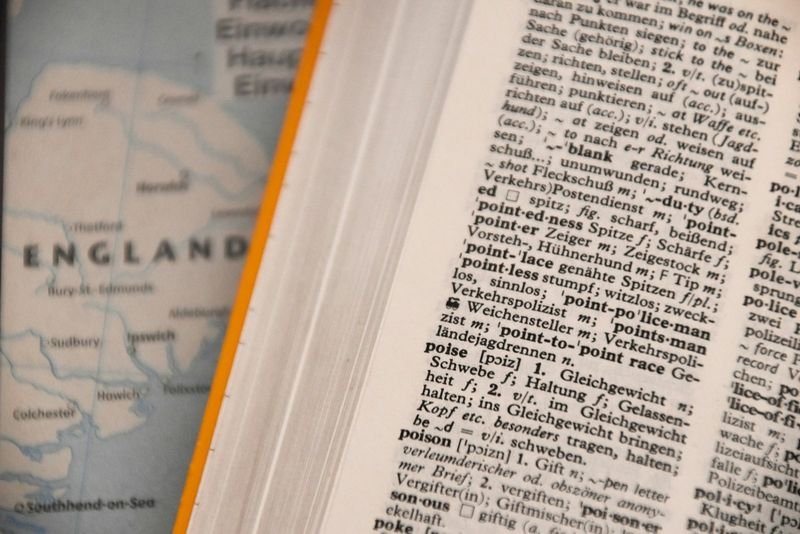
字典裡的音標就是你的發音地圖 — The symbols in the dictionary are your pronunciation map.
Here’s a mild opinion that goes against the grain: KK音標 gets a bad rap online, usually from people pushing pure listening apps. But for an adult learner who already reads English fluently, the symbols are the fastest route to independence. Once you can decode them, every dictionary entry teaches you the correct sound without a teacher in the room. Start with the trickiest vowels — /ɪ/ (as in “ship”) versus /i/ (as in “sheep”), and /æ/ (as in “cat”) versus /ɛ/ (as in “bed”). Those four symbols alone fix a huge share of everyday การออกเสียงภาษาอังกฤษ mistakes. The Cambridge Dictionary lists the KK-friendly transcription next to every word, so you can check any word’s symbols for free.
台灣人最常念錯的 7 個英文發音 (7 Sounds Taiwanese Speakers Get Wrong)
You don’t need to fix every sound in English. You need to fix the seven that change meaning and instantly mark an accent. Drill these in front of a mirror, watching where your tongue and lips go — most of these are physical habits, not hearing problems.
| Sound 音 | Common error 常見錯誤 | The fix 怎麼修正 |
|---|---|---|
| TH /θ/ /ð/ | “think” → “sink”, “this” → “dis” | Tongue tip between your teeth, then push air |
| V /v/ | “very” → “wery” | Top teeth touch bottom lip, add voice |
| Z /z/ | “zip” → “sip” | Same mouth as S, but switch your voice on (buzz) |
| Final consonants | “bag” → “ba”, “hard” → “har” | Finish the word — let the last sound land |
| /ɪ/ vs /i/ | “ship” = “sheep”, “fill” = “feel” | /ɪ/ is short and relaxed; /i/ is long and tense |
| L vs N | “light” / “night” blur | For L, tongue tip taps behind your top teeth |
| Consonant clusters | “desk” → “des- kuh” | Blend the consonants; don’t add an extra vowel |

每個音都是肌肉動作,照鏡子練最快 — Every sound is a muscle movement; a mirror is your best tool.
The cluster problem is worth a second look because it’s the one most learners don’t notice they’re doing. English packs consonants together — “strengths” has three in a row at the start and three at the end. Mandarin almost never does this, so the instinct is to insert a tiny “uh” to smooth the path: “s-tuh-rong.” Train yourself to glide straight from one consonant to the next, even if it feels rushed at first. FluentU’s breakdown of the most common errors for Chinese speakers covers the same clusters in detail.
重音放對,發音就對一半 (Word Stress Does Half the Work)
If you fix only one thing this week, fix stress. English listeners rely on the stressed syllable to recognize a word, and putting it in the wrong place confuses them more than a mispronounced sound does. Say “PHO-to-graph,” “pho-TO-gra-pher,” and “pho-to-GRAPH-ic” out loud — same root, three different stress points, and native speakers track the word entirely by that beat.

重音就是英文的節奏 — Stress is the rhythm English runs on.
A few patterns cover most cases. Two-syllable nouns usually stress the first syllable (TA-ble, WIN-dow), while two-syllable verbs often stress the second (re-LAX, de-CIDE). Watch the noun-verb pairs that flip: you give someone a PRE-sent (noun) but you pre-SENT a report (verb); a RE-cord (noun) versus to re-CORD (verb). When you learn a new word, learn where the beat falls at the same time — it’s far harder to unlearn later. This rhythm carries straight into real conversation, the same way it does when you handle small talk at work.
不發音的字母:英文的陷阱 (Silent Letters)
English keeps letters around long after it stopped pronouncing them, and those silent letters trap learners who read words exactly as written. The B in “comb,” “thumb,” and “doubt” is silent. The K in “knee,” “know,” and “knife” disappeared centuries ago but stayed in the spelling. The L vanishes in “would,” “calm,” and “salmon,” and the whole first syllable of “Wednesday” collapses into “WENZ-day.”
There’s no shortcut here except exposure — but a short list of high-frequency offenders covers most of what you’ll meet day to day: silent B (climb, debt), silent K (knock, knit), silent W (write, wrong, answer), silent H (hour, honest), and silent T (listen, castle, often for many speakers). Flag these when you meet them and they stop surprising you. This is also where building real vocabulary helps — the more words you collect with their correct sounds, the fewer traps remain, which is why it pays to upgrade the words you already use.
自然發音 vs KK音標:該學哪一個?(Phonics or Phonetic Symbols?)
This debate runs hot in Taiwanese cram schools, so let’s settle it plainly. 自然發音 (phonics) teaches the common sound patterns of letter combinations — that “igh” usually sounds like the “i” in “night,” or that “tion” sounds like “shun.” It’s fast, intuitive, and brilliant for reading new words at a glance. KK音標 is precise: it tells you the exact sound, including the exceptions phonics can’t predict.

自然發音求快,KK音標求準 — Phonics is for speed, KK音標 is for accuracy.
The honest answer is that you want both, and they’re not rivals. Use 自然發音 as your default reading engine so you can sound out unfamiliar words on the fly. Reach for KK音標 when phonics fails — and it fails constantly in English, because the language borrowed words from everywhere. “Bologna,” “queue,” and “yacht” laugh at phonics rules but surrender instantly to phonetic symbols. Lean on phonics for 80% of words and let the symbols rescue the stubborn 20%.
每天 10 分鐘英文發音練習 (A 10-Minute Daily Practice Routine)
Pronunciation improves through reps, not theory — and ten honest minutes a day beats a three-hour weekend cram. The single most effective method is shadowing: play a short clip of a native speaker, then speak along a half-second behind them, copying their rhythm and melody exactly, not just the words. Your mouth learns the shape by imitation, the same way you learned Mandarin as a kid.

每天十分鐘的跟讀,勝過週末三小時 — Ten minutes of shadowing daily beats a weekend marathon.
Here’s a routine you can run anywhere: spend two minutes warming up on your problem sounds from the table above, four minutes shadowing one short video clip line by line, three minutes recording yourself reading a paragraph aloud, and one minute playing it back to compare against the original. Recording is the part everyone skips and the part that works — you can’t fix what you can’t hear yourself doing. This British English walk-through from English with Lucy is a clean clip to shadow:
For app-based drilling, free tools like the BBC’s pronunciation videos or any speech-to-text feature on your phone work well — read a sentence aloud and see whether the phone transcribes it correctly. If it writes “sink” when you said “think,” you just found your next rep. The British Council also keeps a solid free pronunciation library sorted by sound.
常見問題 (Common Questions)

把練過的音記下來,進步看得見 — Track the sounds you drill and progress becomes visible.
多久才能改善英文發音?(How long until my pronunciation improves?) With ten focused minutes a day on the specific sounds you struggle with, most learners hear a clear difference in four to six weeks. Accent change is gradual but the early wins — fixing TH and final consonants — come fast because they’re physical fixes, not slow ear training.
我需要完全沒有口音嗎?(Do I need to lose my accent completely?) No. The goal is clarity, not a flawless American or British accent. A Taiwanese accent that lands every sound clearly is far more useful than chasing native perfection. Once people understand you on the first try, you’ve won. That clarity matters most in high-stakes moments like a self-introduction.
KK音標還是 IPA?(KK or IPA?) They overlap heavily, and Taiwan’s dictionaries lean KK. Learn whichever your textbook uses — the symbols for the sounds that trip you up are nearly identical in both systems, so you’re not choosing wrong either way.
Clear pronunciation is the difference between speaking English and being understood in English — and unlike grammar, it’s almost entirely a matter of focused, physical practice. Pick your two worst sounds from the table, drill them for ten minutes tomorrow morning, and record yourself. The accent you’ve had for twenty years will start moving inside a month. For the grammar side of the same goal, work through our complete English grammar guide next.
แหล่งที่มา
- FluentU — 10 Most Common Pronunciation Mistakes for Chinese Speakers — sound-by-sound breakdown of L1 interference errors.
- พจนานุกรมเคมบริดจ์ — free phonetic transcriptions and audio for every English word.
- British Council LearnEnglish — free pronunciation lessons sorted by individual sound.
- English Phonology (overview) — background on stress-timing and the English sound inventory.
Looking for free ESL worksheets for your classroom? Browse our free worksheet library →
Are you a teacher? Find lesson resources and worksheets at TahricTeaches.com.




 ไทย
ไทย  English
  繁體中文
繁體中文  日本語
日本語  한국어
한국어  Bahasa Indonesia
  Tiếng Việt
  Français