

描述圖表英文:30 Essential Phrases for Charts & Trends | TOEIC Business
Taiwan professionals deal with data constantly — quarterly reports, client presentations, TOEIC Writing Section, analyst briefings. The numbers are never the problem. The problem is saying what the data shows in English without sounding mechanical or repetitive. This guide gives you the vocabulary, sentence patterns, and a complete sample paragraph so you can describe any chart with precision.
上升趨勢英文 | Upward Trend Vocabulary

When data goes up, “increase” works — but it’s flat. Match the verb to the size and speed of the move:
| Verb | Nuance | Intensity |
|---|---|---|
| rise / increase | general upward movement | neutral |
| เติบโต | expand over time | neutral |
| climb | steady upward movement | moderate |
| surge / soar | dramatic, fast rise | แข็งแกร่ง |
| spike / jump | sudden sharp increase | sudden |
| recover / rebound | rise after a previous drop | context-specific |
Pair each verb with an adverb to show the rate of change: sharply (快速大幅), steadily (穩定地), gradually (逐漸地), slightly (略微地), dramatically (大幅地).
- Revenue rose sharply by 32% in Q3. (快速上升)
- Online sales grew steadily throughout the year. (穩定成長)
- User numbers surged after the product launch. (激增)
- Market share climbed gradually over three years. (逐漸攀升)
One note on “soar” vs “surge”: soar suggests something moving effortlessly upward over time; surge implies a more sudden, concentrated burst of growth. Use surge for single-quarter spikes, and soar for sustained strong climbs across several periods.
下降趨勢英文 | Downward Trend Vocabulary

Downward movement has its own hierarchy. The right verb tells your audience not just that something went down, but how fast and how far.
| Verb | Nuance | Intensity |
|---|---|---|
| fall / decrease / decline | general downward movement | neutral |
| หยด | significant, sometimes sudden | moderate |
| dip | slight or temporary decrease | mild |
| plunge / plummet | steep, fast crash | แข็งแกร่ง |
| slump | extended decline, often economic | sustained |
- Exports fell by 8% in the second quarter. (下降)
- The stock price plunged after the earnings report. (暴跌)
- Website traffic dipped slightly over the holiday weekend before recovering. (小幅下滑)
- Manufacturing output slumped for three consecutive quarters. (持續下滑)
“A temporary dip” is useful in presentations specifically because it signals to your audience that the drop is short-term — say it before you show the recovery data and you control how they read the chart.
穩定與波動英文 | Stable and Fluctuating Trends

Not every line moves dramatically. Some data stays flat; some bounces around without a clear direction. You need vocabulary for both.
Stability phrases (穩定):
- remained stable / constant (保持穩定)
- stayed the same (維持不變)
- leveled off (平穩,通常在一段上升或下降後)
- plateaued (達到高峰後停止成長)
- showed little change (幾乎沒有變化)
Fluctuation phrases (波動):
- fluctuated between X and Y (在X和Y之間波動)
- varied considerably (變化明顯)
- was volatile (波動劇烈,金融類常用)
- showed no clear trend (沒有明顯趨勢)
ตัวอย่าง:
- The exchange rate remained stable at around NT$30 to the dollar. (穩定維持)
- Growth leveled off after the initial surge in Q1. (趨於平穩)
- Monthly sales fluctuated between NT$800,000 and NT$1.2 million. (在…之間波動)
- Market share plateaued in mid-2025 before declining. (高原期後下滑)
時間句型 | Time Period Phrases

A messy timeline kills an otherwise good chart description. TOEIC Writing examiners notice immediately when test-takers repeat the same phrase (“in 2023… in 2024… in 2025…”). Use these patterns to vary your sentence openings:
| Pattern | Example |
|---|---|
| From [year] to [year]… | From 2022 to 2025, revenue grew steadily. |
| Between [year] and [year]… | Between 2021 and 2024, sales nearly doubled. |
| Over the period from X to Y… | Over the period from Q1 to Q3, growth accelerated. |
| During the first quarter of [year]… | During the first quarter of 2025, exports surged. |
| By the end of [year]… | By the end of 2024, users had reached 500,000. |
| Over the following [time]… | Over the following six months, the trend reversed. |
One technique worth using in business presentations in English: open with the overall trend first (“Revenue grew every year from 2020 to 2025”), then zoom in on the key turning points. Your audience follows more easily when you give them the big picture before the details.
比較與對比句型 | Comparison Language

Most TOEIC graphs show two or more datasets side by side. Comparison language is what ties them together.
- Compared to [X], [Y] grew faster. (與…相比)
- In comparison with last year, this quarter shows improvement.
- While Taiwan’s exports rose, domestic consumption remained flat.
- Unlike 2023, 2024 saw a steady recovery in tourism revenue.
- In contrast to the US market, Asian markets performed strongly.
- [Y] outperformed [X] by a significant margin.
The most practical structure is the while / whereas contrast clause. It delivers two data points in one sentence:
“Online orders grew by 40%, while in-store sales declined slightly.”
Put the stronger number first — it leads with the good news and makes the contrast land harder. This is the structure that Woodward English’s IELTS framework recommends, and it applies equally to TOEIC and business writing.
動詞 + 副詞 vs 名詞 + 形容詞 | Two Core Sentence Patterns

This is the single most underused technique in Taiwan learners’ graph descriptions — and the one TOEIC examiners grade on directly.
You can describe the same trend two ways:
Pattern A: Verb + Adverb
- Sales rose sharply.
- Exports declined gradually.
- Revenue increased significantly in Q4.
Pattern B: Noun + Adjective
- There was a sharp rise in sales.
- We saw a gradual decline in exports.
- The data shows a significant increase in Q4 revenue.
Both are correct. The difference is sentence variety. Writing “rose sharply… grew steadily… increased dramatically” three times in a row feels repetitive. Switching to Pattern B — “a sharp rise… a period of steady growth… a dramatic increase” — sounds more sophisticated and reads more naturally. TOEIC Writing graders are explicitly looking for sentence variety.
This noun + adjective pattern also pairs directly with the business English collocations you already know — “a sharp increase,” “a gradual decline,” and “a dramatic rise” are all standard business collocations that examiners recognise immediately.
完整範例段落 | Full Sample Paragraph (TOEIC/Business Ready)
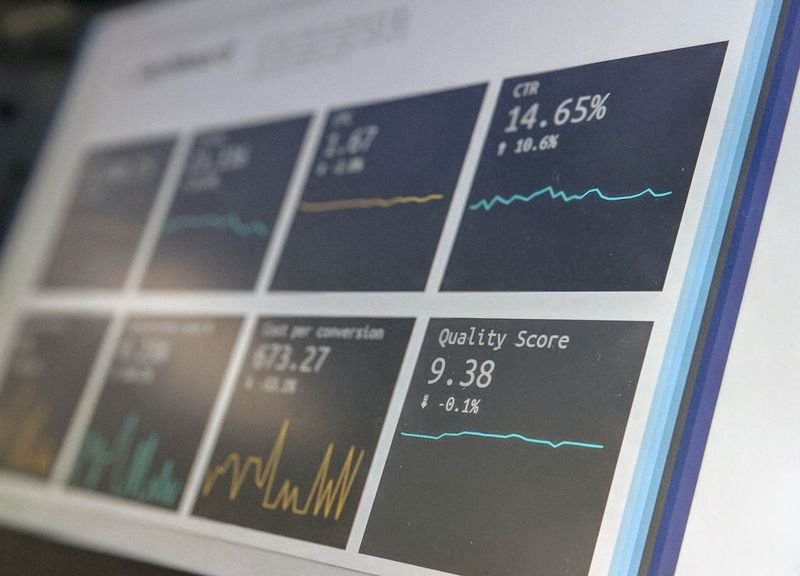
Here is a complete chart description using all the patterns above. This is TOEIC Writing Section format — roughly 150 words, formal register, no opinions or speculation. Read it once, then write your own version with a different fictional dataset.
“The line graph shows the number of monthly active users for a Taiwan-based e-commerce platform from January 2024 to December 2025.
From January to March 2024, user numbers rose gradually from 120,000 to 140,000. This was followed by a sharp surge in April, when the figure climbed to 210,000 — a 50% increase in a single month, driven by a major promotional campaign.
Between May and August 2024, growth leveled off and fluctuated between 195,000 and 215,000. By the end of the year, users had plateaued at around 200,000.
In contrast, the first quarter of 2025 saw a dramatic increase, with numbers soaring to 280,000 by March. Compared to the same period in 2024, this represented a 100% year-on-year rise.
Overall, the platform experienced strong, sustained growth over the two-year period, with monthly users more than doubling.”
Count the trend expressions as you read: rise gradually, sharp surge, climbed, leveled off, fluctuated, plateaued, dramatic increase, soaring. That is eight different expressions in one short paragraph — with zero repetition and two sentence patterns alternated. That is the target.
常見錯誤 | 5 Mistakes Taiwan Learners Make
These errors appear in TOEIC Writing practice tests and English business reports from Taiwan professionals constantly.
1. “Increased up” / “rose up”
Redundant. “Rise” already means upward. Say “rose” or “increased” — never both.
2. “There were a rise in…”
Wrong number. “Rise” is singular: there was a rise. “There were rises” only works if you mean multiple separate instances.
3. Confusing “rise” (intransitive) with “raise” (transitive)
Sales rise on their own. You raise prices intentionally. “The company raised its prices” is correct. “The company rised its prices” does not exist in English.
4. Using one verb for the whole description
Writing “increased” six times in one paragraph. Rotate: rise, grow, climb, surge — or switch to noun pattern.
5. Forgetting the adverb
“Sales increased.” tells an examiner almost nothing. “Sales increased sharply by 30% in Q3.” earns points for precision and vocabulary range. The MyEnglishPages graph vocabulary guide has exercises specifically for building this habit before your test.
影片教學 | Watch: Describing Graphs in English
This video covers graph description with real IELTS, TOEFL, and business examples. Watch it after reading this guide — every pattern here will be familiar.
The 30 phrases in this guide cover every trend type a graph can show — upward, downward, stable, fluctuating, and everything in between. Practice writing descriptions of charts you encounter at work or in TOEIC prep materials. After ten descriptions, these patterns will come automatically.
แหล่งที่มา
- Woodward English — IELTS Writing Task 1: Describing Trends — vocabulary and word order framework for academic and business writing
- MyEnglishPages — Describing Graphs and Trends in English — vocabulary lists and interactive exercises
- IDP IELTS — Key Language for Reporting Figures and Trends — official guidance on academic writing vocabulary for Task 1





 ไทย
ไทย  English
  繁體中文
繁體中文  日本語
日本語  한국어
한국어  Bahasa Indonesia
  Tiếng Việt
  Français