

Telephone English: 40 Phrases for Confident Work Calls | 電話英文
Ask any office worker in Taipei what part of their job triggers the most anxiety, and a surprising number will say the same thing: the phone ringing when the caller might be speaking English. Email gives you time to think and a dictionary tab. A phone call gives you neither. There is no eye contact, no gestures, and no “let me check that word” — just a voice, often a fast one, waiting for your answer. That pressure is exactly why 電話英文 (telephone English) deserves its own practice, separate from general speaking. The good news: real work calls are far more scripted than they feel. This guide breaks down the phrases for every stage of a call — answering, calling out, transferring, holding, taking messages, spelling names, conference calls, and customer complaints — plus a full sample dialogue and the mistakes that trip up Taiwanese professionals most.

為什麼電話英文比面對面難?(Why Telephone English Feels Harder)
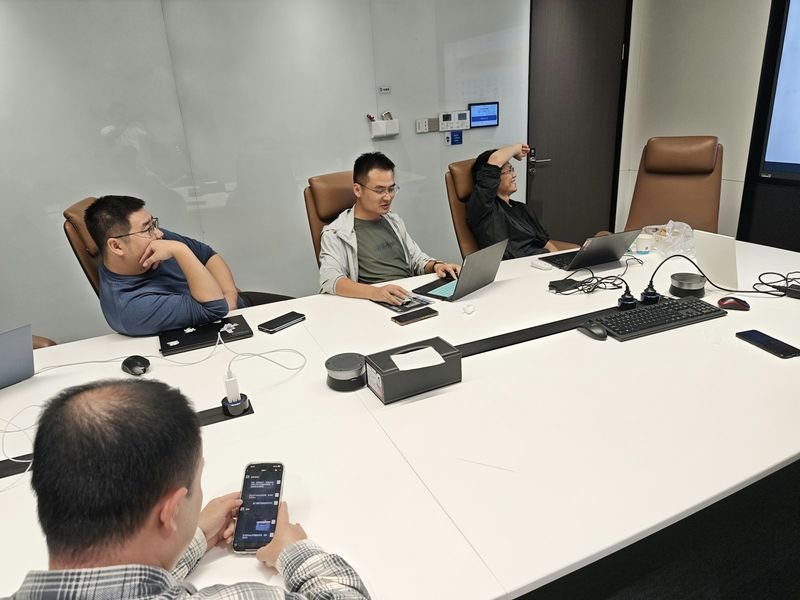
The phone strips away roughly half of how we normally understand a conversation. In person, you read lips, facial expressions, and hand gestures — your brain fills gaps automatically. On a call, all of that disappears, and you are left decoding sound alone, often through a slightly distorted line. That is why a person who handles English meetings reasonably well can still freeze the moment the receiver goes to their ear.
The second problem is connected speech. Native speakers rarely say “Can I help you?” as four separate words; it comes out closer to “Kanai-help-you?” Sounds blend, drop, and link together, and without lips to watch, your ear has to do all the work. This is a listening problem, not a vocabulary problem — and it is trainable. If fast speech is your main barrier, spend time on improving your English listening and on English pronunciation and connected speech alongside the phrases below. The phrases give you something to say; the listening practice helps you understand what comes back.
Here is the part most courses skip: you are allowed to control the pace. A caller cannot see that you are nervous. A simple “Sorry, could you repeat that a little more slowly?” is completely professional, and using it makes you sound careful rather than weak. The phrases that buy you time are the most valuable ones in this entire article.
Telephone English lesson — Crown Academy of English
接電話英文:開場白與自我介紹 (Answering the Phone)
Answering a work call in English follows a fixed three-part pattern: a greeting, your company name, and your name. Once you internalise that order, the opening becomes automatic and you stop scrambling for the first few seconds. The standard professional opener sounds like this:
- “Good morning, ABC Company, Lily speaking. How can I help you?”
- “Thank you for calling ABC Trading. This is David. How may I help you?”
- “Hello, Marketing Department, Anna speaking.”
Notice “speaking” after your name — it is the natural telephone signal for “this is me.” When someone asks for you by name, you reply “Speaking” or “This is she/he” rather than “I am.” If you need to confirm who is calling, the polite forms are “May I ask who’s calling?” or “Who’s calling, please?” Avoid the blunt “Who are you?” — grammatically fine, but it lands as rude.
One small habit makes a big difference: state your name slowly and clearly. Taiwanese callers often rush their own name, and the person on the other end never catches it. Slow your opener by twenty percent and the whole call starts smoother.

打電話英文:撥號、找人、說明來意 (Making a Call)
When you make the call, lead with who you are and who you want, then state your reason. Burying your purpose at the end of a long sentence is the most common way Taiwanese callers lose the listener. The clean structure is: identify yourself, ask for the person, give the reason.
- “Hi, this is Kevin Lin from ABC Company. May I speak to Mr. Chen, please?”
- “Hello, could I speak to someone in the sales department?”
- “I’m calling about the invoice you sent last week.”
- “I’m calling to follow up on our meeting on Tuesday.”
“This is Kevin” is correct on the phone — not “I am Kevin.” It feels strange to Chinese-speaking learners, but “this is” is simply the telephone convention for introducing yourself. If you reach a voicemail or the wrong person, “I must have the wrong number, sorry to bother you” gets you out gracefully. For a follow-up after the call, a short email helps; our guide to business English for meetings and emails covers the phrasing that pairs naturally with phone work.
轉接、請稍等與留言 (Transferring, Holding & Taking Messages)
Three situations come up on almost every business line: putting someone on hold, transferring them, and taking a message when the person they want is out. Each has a tiny set of fixed phrases, and mixing them up is rarely a problem as long as you sound calm.
To ask someone to wait, use “Could you hold on a moment, please?” or “Hold the line, please — I’ll put you through.” When you transfer, “I’ll put you through to Mr. Wang now” or “Let me transfer you to the right department” both work. The verb is “put through” or “transfer” — never “change you to,” which is a direct translation that confuses listeners.
When the person is unavailable, you have two moves — offer to take a message, or offer a callback:
- “I’m afraid she’s not available right now. Can I take a message?”
- “He’s in a meeting at the moment. Would you like to leave a message?”
- “Can I have her call you back?”
- “Could you spell your name for me, please?”
If you are the one leaving the message, keep it to three things: your name, your number, and one sentence about why. “This is Sarah Wu, my number is 0912-345-678, and I’m calling about the Friday delivery” gives the other person everything they need to call you back without a second round of phone tag.

聽不清楚時怎麼辦?爭取時間的萬用句 (When You Can’t Hear or Need a Moment)
This is the section to memorise first, because it rescues every other situation. When you do not understand, you do not have to panic or pretend — you ask. Doing so is normal even between two native speakers on a bad line. The key is to ask in a way that sounds composed:
- “Sorry, could you repeat that, please?”
- “Could you speak up a little? The line is bad.”
- “Would you mind speaking a bit more slowly?”
- “Let me make sure I’ve got that right — you said Thursday at 3, correct?”
- “Could you give me a moment to check that?”
The truth is, most callers respect you more, not less, when you confirm details. A misheard date or quantity costs everyone an apology email and a re-do; a ten-second check prevents it. That last phrase — “let me make sure I’ve got that right” — followed by repeating the key detail back is the single most useful professional habit on the phone. Use it for numbers, dates, and names every time.
在電話上拼名字與 Email:用 NATO 字母 (Spelling Names & Emails on the Phone)
Half of all phone confusion comes down to two letters that sound identical down a line: “B” and “P,” “M” and “N,” “S” and “F.” The professional fix is the NATO phonetic alphabet — saying “B as in Bravo” so there is zero ambiguity. Most Taiwanese learners have never been taught it, and it instantly makes you sound like a seasoned caller.
| Letter | Code Word | Letter | Code Word |
|---|---|---|---|
| A | Alpha | N | November |
| B | Bravo | O | Oscar |
| C | Charlie | P | Papa |
| D | Delta | Q | Quebec |
| E | Echo | R | Romeo |
| F | Foxtrot | S | Sierra |
| G | Golf | T | Tango |
| M | Mike | Z | Zulu |
You do not need to memorise all 26 — just the ones in your own name, your company, and your email. To spell out an address, say “kevin dot lin at gmail dot com,” and use “all lowercase” or “capital K” when it matters. For a name like “Hsieh,” try “H as in Hotel, S as in Sierra, I, E, H” and watch the confusion disappear.
電話會議英文 (Conference Call & Online Meeting Phrases)
Conference calls and video meetings add their own layer: you cannot see who wants to speak, and people talk over each other. A few phrases keep things orderly and let you join without awkward silences.
- “Can everyone hear me okay?”
- “Sorry, you’re breaking up. Could you say that again?”
- “I think you’re on mute.”
- “Can I jump in here for a second?”
- “Let’s bring in Jenny on this — Jenny, what do you think?”
- “Just to confirm the action items before we wrap up…”
“You’re on mute” and “you’re breaking up” are now everyday office English; using them naturally signals that you are comfortable in this format. If you want to speak but the call is busy, “Can I jump in here?” is the polite way to claim the floor without interrupting rudely.

客服英文:處理客訴與道歉 (Customer Service & Handling Complaints)
If your role involves 客服英文 (customer service English), the calls follow a clear arc: acknowledge, apologise, act. An upset customer wants to feel heard before they want a solution, so the first thing out of your mouth should validate the problem, not defend the company.
- “I’m sorry to hear that. Let me look into it right away.”
- “I completely understand your frustration.”
- “Let me check what I can do for you.”
- “I’ll get this sorted out and call you back within the hour.”
- “Thank you for your patience.”
Notice none of these promise something impossible — they promise attention and a next step. The phrase “Let me look into it” buys you time and signals action at once. Avoid “It’s not my fault” or “It’s our policy,” even when both are true; on the phone, tone carries everything, and a calm, warm voice defuses more anger than any perfect sentence.

結束通話的禮貌說法 (Ending the Call Politely)
A good call needs a clean exit, or it drifts into an awkward loop of “okay… okay… bye… okay.” Signal the end clearly, confirm any next step, then close warmly. The standard wind-down runs: summarise, thank, sign off.
- “So, just to confirm, I’ll send the quote by Friday.”
- “Thanks so much for your help.”
- “It was nice talking to you.”
- “Have a great day. Bye now.”
“Bye now” or “Take care” both close a call naturally. If you started the call, you generally end it — that is the unwritten rule, and it stops the two-people-waiting silence at the finish.
完整電話英文對話範例 (A Full Sample Phone Call)
Phrases in isolation are easy; stringing them together under pressure is the real test. Here is how a complete, ordinary business call sounds from “hello” to “bye” — read it aloud a few times so the rhythm becomes familiar.
A: Good morning, Sunrise Trading, Amy speaking. How can I help you?
B: Hi Amy, this is Mark Chen from Delta Electronics. Could I speak to Mr. Wang in purchasing?
A: May I ask what it’s regarding?
B: It’s about the order we placed last Tuesday.
A: Of course. Hold on a moment, please — I’ll put you through. … I’m sorry, he’s on another line right now. Can I take a message?
B: Sure. Could you ask him to call me back? It’s Mark, M as in Mike, and my number is 0922-118-330.
A: Let me read that back — Mark, 0922-118-330, about last Tuesday’s order. Is that right?
B: That’s right. Thanks so much for your help.
A: No problem at all. I’ll pass the message along. Have a great day!
B: You too. Bye now.
Read it again and count how few “hard” words there are. Almost the entire call runs on the fixed phrases from the sections above. That is the whole secret: work calls reward a clean script far more than a big vocabulary.

台灣人最常犯的 5 個電話英文錯誤 (5 Common Mistakes)
After years of coaching professionals in Taipei, the same handful of mistakes show up again and again — and four of the five are habits, not English-level problems.
1. Saying “I am Kevin” instead of “This is Kevin.” On the phone, the convention is “this is.” It is a tiny fix that instantly sounds more natural.
2. Apologising for your English up front. “Sorry, my English is not good” lowers the listener’s confidence before you have even started. Skip it — just speak, and ask for a repeat when you need one.
3. Speaking too fast to “sound fluent.” Rushing makes you harder to understand and harder to follow. Slowing down by twenty percent makes you sound more in control, not less capable.
4. Not confirming numbers and dates. A misheard “fifteen” versus “fifty” turns into a costly mistake. Always read key details back.
5. Going silent when stuck. Dead air is the most stressful sound on a call. Fill it with “Let me check that for you” or “Could you give me one second?” — silence reads as a lost connection; a holding phrase reads as competence.
電話英文速查表 (Quick Cheat Sheet)
Keep this table near your desk. When the phone rings, glance at the column you need and the first phrase will come.
| สถานการณ์ 情境 | Phrase |
|---|---|
| Answering 接電話 | “Good morning, ABC Company, Lily speaking.” |
| Calling out 打電話 | “Hi, this is Kevin from ABC. May I speak to Mr. Chen?” |
| Hold 請稍等 | “Could you hold on a moment, please?” |
| Transfer 轉接 | “I’ll put you through now.” |
| Take a message 留言 | “Can I take a message?” |
| Didn’t hear 沒聽清楚 | “Sorry, could you repeat that, please?” |
| Buy time 爭取時間 | “Let me check that for you.” |
| Confirm 確認 | “Let me read that back to you…” |
| End the call 結束通話 | “Thanks for your help. Have a great day!” |
常見問題 (FAQ)
接電話時要說「This is she」還是「I am」? When someone asks for you by name, the natural reply is “Speaking” or “This is he/she.” “I am” sounds like a translation. “Speaking” alone is the safest and most common answer.
電話英文一定要很標準的口音嗎? No. Clarity beats accent every time. A clear, slightly slow Taiwanese-accented voice is far easier to understand than a fast attempt at a “native” accent. Focus on pacing and clear consonants, not on sounding American.
聽不懂對方在說什麼,一直「Pardon?」很尷尬怎麼辦? Vary your repair phrases so you are not repeating the same word: “Sorry, could you say that again?”, “Could you speak up a bit?”, or repeat back the part you did catch — “You said the meeting is on… ?” — and let them fill the gap. Asking is always more professional than guessing.
怎麼練習電話英文最有效? Record yourself reading the sample dialogue above aloud, then practise the “buy time” and “confirm” phrases until they are automatic. Pair that with regular listening practice so the replies you hear stop sounding too fast.
แหล่งที่มา
- British Council — Telephone English — practical phrases and etiquette for business calls.
- บีบีซี เลิร์นนิ่ง อิงลิช — listening practice and connected-speech lessons for understanding fast speakers.
- NATO Phonetic Alphabet (ICAO) — the standard spelling alphabet used to spell names clearly on the phone.
- พจนานุกรมเคมบริดจ์ — pronunciation reference for checking how individual phrases sound.
Looking for free ESL worksheets for your classroom? Browse our free worksheet library →
Are you a teacher? Find lesson resources and worksheets at TahricTeaches.com.




 ไทย
ไทย  English
  繁體中文
繁體中文  日本語
日本語  한국어
한국어  Bahasa Indonesia
  Tiếng Việt
  Français