
Job Interview English: 35 Phrases Taiwan Pros Use to Get Hired (2026) | 英文面試用語
Job interview English is the single biggest variable between landing a role at Taipei 101’s MNC floor and getting passed over for a candidate with weaker experience but smoother phrasing. The lines below — 35 phrases pulled from real first-round interviews at international banks, semis, and SaaS firms hiring in Taiwan — are the ones that hiring managers consistently react well to. Memorize them, adapt the nouns, and you walk in already two questions ahead.
Why Phrases Beat Vocabulary in 英文面試 (English Interviews)
Most Taiwan candidates who lose English interviews don’t lose on vocabulary. They lose on cadence. A hiring manager at a Tianmu-based fintech told me last March that she has rejected three otherwise qualified product managers in a single quarter because they spent so long building a sentence that the answer felt rehearsed. Phrases solve that problem. A phrase is a pre-built sentence frame your brain doesn’t have to assemble live — you just slot in the specifics.
The Taiwan twist matters too. Local hiring culture rewards modesty in a way Western hiring does not. The American “I’m the best candidate you’ll see today” line lands flat with a Taiwanese hiring panel and lands awkwardly even with foreign managers who have hired locally for years. The phrases below are calibrated for that middle lane — confident without bragging, specific without boasting.
Stage 1 — Greeting and Opening (5 Phrases | 開場白)
The first 60 seconds set the temperature. If you stumble here, the interviewer spends the rest of the call quietly downgrading you. These five lines carry almost any opening:
- “Thank you for taking the time to meet with me today.” — Standard, warm, never overplayed.
- “I’ve been looking forward to this conversation.” — Better than “I’m excited” because it implies you prepared.
- “Before we begin, would you mind telling me a bit about how this interview will run?” — Shifts you from interviewee to professional. Used well, it buys you the rough format.
- “I read your recent post on LinkedIn about [topic] — it shaped how I thought about this role.” — One specific reference outperforms ten generic compliments.
- “Please let me know if I should slow down or rephrase anything.” — Confidence dressed as politeness. Hiring managers love it.

First impressions in a job interview English exchange are made in the opening handshake.
Stage 2 — Talking About Strengths (5 Phrases | 自我介紹優勢)
Here is where most Taiwan candidates get stuck. The fluent answer isn’t “I am very hardworking and detail-oriented.” That sentence has been said ten thousand times this week alone. The fluent answer pairs a trait with a specific moment that proves it. Frame your strengths through these five phrasings:
- “What I’d point to first is…” — Cleaner than “My biggest strength is.”
- “A concrete example would be the time I…” — Signals you’re about to give evidence, which interviewers reward.
- “What I think I do better than most people in my role is…” — Mild positioning, not a brag.
- “Colleagues have told me I’m the person they come to when…” — Third-party validation lands harder than self-claims.
- “I’ve been told this is unusual, but I…” — Lets you mention a sharp skill without sounding boastful.
The “I’ve been told this is unusual” line is the secret weapon for Taiwan candidates. It satisfies modesty culture and Western directness at the same time.

Boardroom-style English interviews are common at MNC offices in Xinyi and Neihu.
Stage 3 — The Weakness Question (5 Phrases | 缺點問題)
The “perfectionist” answer should be deleted from the Taiwan job seeker’s playbook. Interviewers have heard it 50 times this month. The good answer is a real weakness paired with a real fix.
- “Something I’m actively working on is…” — Active voice, present tense. You’re improving, not stuck.
- “I used to struggle with X, and what I did about it was…” — Past tense + resolution. Best structure.
- “I’ve gotten feedback that I tend to…” — Naming feedback shows self-awareness.
- “This is something I check myself on regularly.” — A nice closer for the weakness section.
- “I don’t think I’ve fully solved this, but my current approach is…” — Honest, not weak. Senior interviewers especially respect this line.
Stage 4 — Behavioral Questions and the STAR Method (5 Phrases)
Behavioral questions (“Tell me about a time when…”) want a story with structure. The STAR method — Situation, Task, Action, Result — is still the cleanest frame, and these phrases mark each beat so the interviewer can follow:
- “To set the scene…” — Opens the Situation. Cleaner than “So basically, what happened was…”
- “The challenge on the table was…” — Defines the Task without “my responsibility was.”
- “What I decided to do was…” — Owns the Action. Use “I” not “we” here.
- “The result, in numbers, was…” — Pulls the interviewer into specifics. Always have a number ready.
- “Looking back, what I’d do differently is…” — Optional but powerful. Shows growth without prompting.

Behavioral questions land well when answers follow the STAR structure.
Stage 5 — Asking Smart Questions Back (5 Phrases | 反問面試官)
The “Do you have any questions?” moment is where weaker candidates collapse and stronger candidates pull ahead. Silence reads as disinterest in Taiwan and in every other market. Have three of these ready:
- “What does success in this role look like in the first 90 days?” — Direct, future-focused, shows ownership thinking.
- “How does this role interact with [adjacent team]?” — Reveals if you understand the org structure.
- “What’s the biggest challenge the person in this role has been facing?” — Honest signal about what you’re walking into.
- “What’s something about the team that wouldn’t be obvious from the outside?” — Forces a specific, candid answer.
- “Is there anything in my background you’d like me to expand on?” — Lets you close any gap the interviewer noticed.
The last one is borrowed from sales training. It catches objections before they kill your candidacy.
The Video Interview Reality (視訊面試)
Roughly 70% of first-round interviews for Taiwan-based MNC roles in 2026 happen over Zoom, Google Meet, or Teams. The phrases above still work — but two video-specific lines save calls when bandwidth gets messy:
- “You cut out for a moment — could you repeat the last part?” — Polite, specific, no awkwardness.
- “Let me share my screen for a moment to show you…” — Confidence move when discussing a portfolio piece.

Most first-round English interviews for Taiwan MNC roles now happen over video.
Stronger candidates also turn their video on before the meeting starts, check the framing once, and let the interviewer join into a calm room rather than a frantic last-second setup.
Stage 6 — Salary and Benefits (5 Phrases | 薪資談判)
Taiwan job seekers underprice themselves in English roughly 30% more often than they do in Mandarin, according to a 104 Job Bank salary survey aggregated in 2025. The hesitation phrases are the cause. These five give you cover to negotiate without losing the room:
- “Based on my research, the market range for this role is…” — Anchor with data, not feelings.
- “Is there flexibility in the base salary, or is the package weighted toward bonus?” — Opens the conversation without saying a number first.
- “I’d be most comfortable in the range of NT$X to NT$Y.” — Range, not point. Always.
- “What does the total compensation package include beyond base?” — Pulls health, pension, and stock into view.
- “Could we revisit the offer once I’ve seen it in writing?” — Buys time without saying no.

Salary conversations in English require specific phrasing — vague answers cost money.
Stage 7 — Closing and Follow-Up (5 Phrases | 結尾與後續)
The close is the second handshake. Five lines:
- “Thank you — this conversation made me more interested in the role, not less.” — Specific signal of intent.
- “What are the next steps from your side?” — Always ask. Always.
- “Would it be all right if I followed up next week if I haven’t heard back?” — Permission to chase without being pushy.
- “I’ll send a short note this evening summarizing what we discussed.” — Sets up your thank-you email.
- “Please pass on my thanks to anyone else involved in the decision.” — Acknowledges the panel without naming names.
The Common Mistakes Taiwan Candidates Make
Three recurring patterns from the last 12 months of feedback from MNC recruiters in Taipei:
Apologizing for English. “Sorry, my English is not so good” is a sentence that ends interviews. Drop it. If you got the interview, your English is good enough. Replace it with “Let me know if I should rephrase anything” from Stage 1.
Translating from Chinese mid-sentence. The pause is louder than the wrong word. Train yourself to keep moving — better to use a simple word than to stop and search for the perfect one. Our guide to Chinglish mistakes Taiwan pros fix covers the most common translation traps.
Memorizing whole answers. Interviewers detect it within 30 seconds and adjust their questions to break the script. Memorize phrases, not paragraphs. Memorize the frame, not the filler.

Confidence and clarity matter more than perfect grammar in English interviews.
A 14-Day Practice Plan (兩週練習計畫)
Two weeks is enough if you treat it like training, not studying. The shape that has worked for our students at 18K English in Tianmu:
- Days 1–3: Memorize the 35 phrases above. Speak each one aloud 10 times. Recording yourself on your phone catches the cadence problems.
- Days 4–7: Build five STAR stories from your actual work history. Map each to the phrases from Stage 4. Time them — under 90 seconds each.
- Days 8–10: Mock interview with a colleague or tutor in English. No notes. Record it. Re-watch with the sound on and write down every filler word.
- Days 11–13: Research the specific company. Pull three news items and write a question for each. Pair them with the Stage 5 phrasings.
- Day 14: Sleep early. Walk in. Use the lines.
One Line of Forward Advice
The hiring market in Taiwan for 2026 is tightening on credentials and loosening on background. Two candidates with the same résumé will be separated on how they sound in the first three minutes of an English call. That is a fixable problem, and it does not require fluency. It requires phrases that arrive on time. Pick five from this list, drill them tonight, and walk into your next interview already in the lead.
If you want help refining your professional voice, our pieces on business English collocations and the 8-section English resume for Taiwan pros pair well with this one.
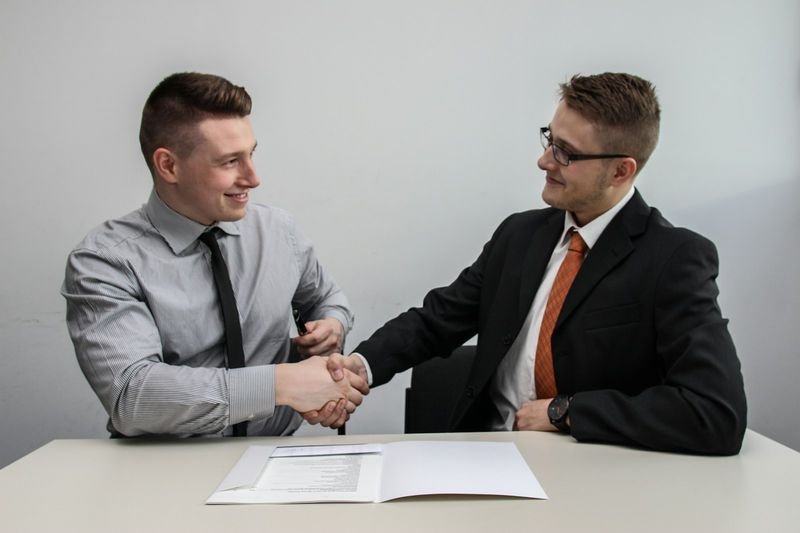
Closing the English interview with a handshake and a clear next step.
Watch: 50+ Phrases for Job Interviews in English
JForrest English breaks down dozens of interview lines with native pronunciation — a useful pairing with the phrases above:
Nguồn
- Michael Page Taiwan — Common Job Interview Questions — Recruiter-side benchmark on what Taiwan hiring panels actually ask.
- EY Taiwan — Interview Tips — Big Four guidance on tone, attire, and structure for English interviews in Taipei.
- Robert Walters — Complete Interview Guide — Cross-market data on phrasing patterns that distinguish stronger candidates.
- BoldVoice — Top English Interview Phrases — Pronunciation-focused reference for ESL speakers.



 Tiếng Việt
  English
  繁體中文
繁體中文  日本語
日本語  한국어
한국어  ไทย
ไทย  Bahasa Indonesia
  Français