

購物英文 40句:逛街、超市、網購都用得上 | Shopping English Phrases
Most Taiwanese English learners can hold a conversation in a classroom but freeze the moment a store clerk says “May I help you?” That one question, simple as it is, sets off a chain reaction — you forget the word for “receipt,” you can’t ask if there’s a sale, and the fitting room attendant is waiting outside saying something you can’t parse. Shopping English is situational. You either learn the phrases for the context, or you default to pointing and nodding. This guide covers the 40 sentences that actually come up.
逛街英文 [Clothes Shopping English]
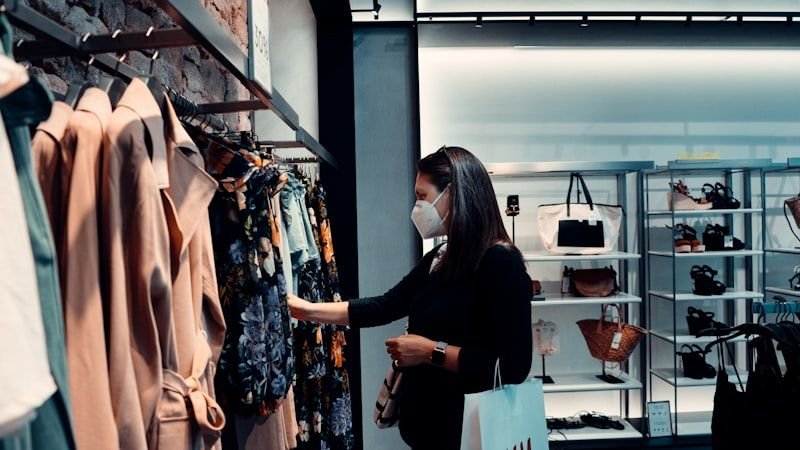
Clothes shopping is where most Taiwanese shoppers hit their first wall. The vocabulary isn’t hard, but the exchanges move fast — a clerk approaches, says something, and you have about three seconds to respond before the awkward pause sets in. Know these phrases before you walk in the door.
When a clerk approaches and asks “May I help you?” the safest response if you’re still browsing is “I’m just looking, thank you.” This is universally understood and completely polite. If you do want help, be specific: “Do you have this in a size medium?” 或者 “Do you have this in a different color?”
Sizes and fit: Asian and Western sizing don’t map cleanly onto each other, so always ask. “What size is this?” works, but a better question is “I’m usually a small in Asian sizing — what would that be here?” Most staff in international stores hear this question regularly. If nothing fits, try: “Do you have anything larger?” 或者 “Do you have the next size up?”
Fitting room phrases: The single most useful phrase in any clothes store is “我可以試穿一下嗎?” (我可以試穿嗎). After that: “Where are the fitting rooms?” When you come out: “It doesn’t fit — do you have the next size up?” 或者 “It fits perfectly. I’ll take it.”
At the register: Taiwan’s QR payment habit won’t always transfer, so check first: “Do you accept [Apple Pay / Line Pay]?” 或者 “我可以用銀行卡付款嗎?” Always ask for a receipt: “我可以要一張收據嗎?” And if something looks discounted, confirm before you pay: “Is this the sale price?”
超市英文 [Supermarket English]
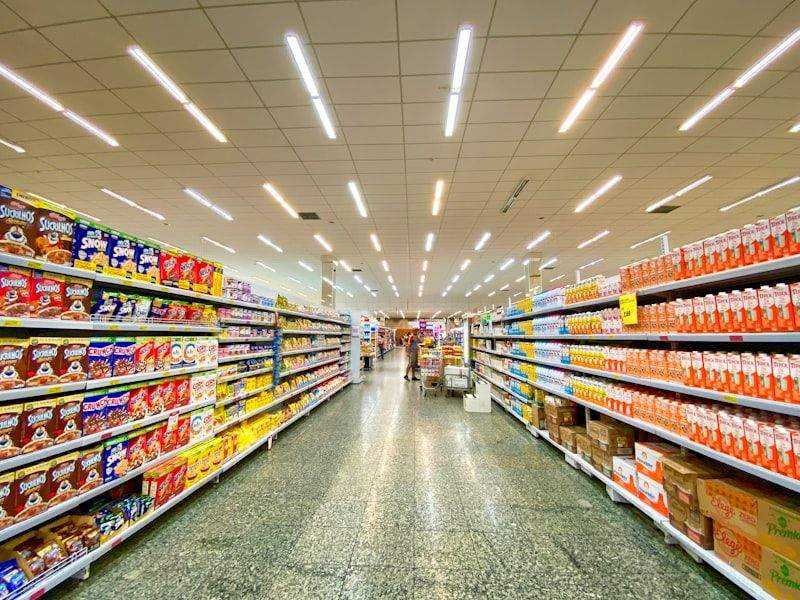
The supermarket is lower-stakes than a clothes store — nobody is hovering — but you still need specific vocabulary when you can’t find something or need to understand product labels. The key word for the long lanes in a supermarket is aisle (走道). When you can’t find something, “Excuse me, which aisle is the bread in?” will get you a pointed finger and a number.
Other useful phrases: “Is this gluten-free?” (無麩質的?), “Do you sell [item] here?”, , 和 “Do you have a smaller / larger size of this?” for packaged goods. For deli counters: “Can I have 200 grams of this, please?” 或者 “Could you slice it thin?”
Measurements: English-language supermarkets outside Taiwan use imperial — ounces (oz), pounds (lbs), and gallons, not grams and liters. One pound is about 450 grams. One gallon is about 3.8 liters. When a clerk asks “How many would you like?” a simple number works: “Two, please” 或者 “Half a pound.”
Checkout phrases: “Do you have a loyalty card?”, “Paper or plastic?” (bag type), “Do you need a bag?”, , 和 “I think this was marked at a different price” — that last one is for when the scanned price doesn’t match the shelf tag. Say it calmly; staff will check without issue.
網購英文 [Online Shopping English]

Online shopping with international platforms means reading English checkout pages and — when things go wrong — writing to English-speaking customer service. A mistranslated message about a tracking number can leave your package in limbo for a week. These are the terms you need exactly right.
| 中文 | 英語 |
|---|---|
| 追蹤號碼 | tracking number |
| 預計到貨日 | estimated delivery date (EDD) |
| 運費 | shipping fee |
| 免運費 | free shipping |
| 促銷代碼 | promo code / coupon code |
| 購物車 | shopping cart |
| 結帳 | checkout |
| 缺貨 | out of stock |
Phrases for customer service chat:
- “My order hasn’t arrived yet. The tracking shows it’s been ‘out for delivery’ for two days.”
- “I received the wrong item. Can you arrange a replacement or refund?”
- “I’d like to apply a promo code — is it too late to add it to my order?”
- “Can I change the delivery address before the item ships?”
- “The item arrived damaged. I have photos — what’s the process for a replacement?”
The last one is important: always mention that you have photos when reporting damage. It speeds up every customer service process significantly.
殺價英文 [Asking for Discounts]

In Western countries, bargaining at retail stores is not standard. Night markets and small independent vendors sometimes negotiate, but walking into a department store and asking for a lower price will get you a polite “no.” That said, specific phrases work in specific contexts — and won’t make you look rude.
- “Is this the best price you can do?” — Works better than “Can you give me a discount?” because it sounds like a genuine question, not a demand.
- “Do you have any current promotions?” — Always worth asking; you’d be surprised how many unadvertised deals exist.
- “Is there a student discount?” — Common at museums, transport, and some retailers.
- “If I buy two, would you offer a better price?” — Works at markets and independent shops.
- “This one has a small defect — could you reduce the price?” — Appropriate at markets; never at brand stores.
- “I saw this for less at [another store]. Can you match that price?” — Price matching is standard at electronics retailers like Best Buy or Harvey Norman.
The rule: bargaining works at open markets, small independent shops, and electronics stores. It does not work at chain retailers, fashion brands, or supermarkets. Knowing which situation you’re in saves everyone time.
退換貨英文 [Returns and Exchanges]

Returns are where English learners struggle most because the conversation involves back-and-forth and specific vocabulary. Before you go to the customer service desk, know four terms: receipt (收據), exchange (換貨), refund (退款), and return policy (退換貨政策).
- “I’d like to return this item.” — 我想退貨。
- “I’d like to exchange this for a different size.”
- “I have my receipt.” / “I don’t have the receipt, but I paid by card — can you look it up?”
- “There’s a defect — look here.” — Point to the problem as you say this.
- “Can I get a refund, or only store credit?”
- “What’s your return policy?”
- “The tag is still on — I haven’t used it.”
If a clerk says something you don’t understand during a return, the phrase “Could you write that down for me?” is completely acceptable and buys you time. Nobody expects a language learner to catch every detail at counter speed. For situations where the complaint is more serious, our guide to Making Complaints in English covers the full range of formal complaint phrases used in English.
5 Mistakes Taiwanese Shoppers Make in English
These errors won’t make you unintelligible, but they mark you as someone who learned from a textbook rather than real experience. Each one has a two-second fix.
1. “I want” instead of “I’d like”
“I want that one” is grammatically fine but sounds blunt in most English-speaking countries. “I’d like that one, please” is the standard register for store interactions. Same meaning, entirely different impression.
2. “How much is the price?”
“Price” already contains the concept of money cost, so “how much is the price” is redundant. Say “這個多少錢?” 或者 “What’s the price?” — not both.
3. Translating 打折 directly
The Chinese discount system runs backwards from English. 打八折 means 80% of the original price — a 20% discount. In English, you say “20% off” 或者 “20% discount”. Saying “80% price” will confuse everyone.
4. “I will buy” when you’re still deciding
In Chinese, 我想買 can be tentative. In English, “I will buy this” sounds like a firm commitment. Use “I’m thinking about it” 或者 “I might get this” when you’re still making up your mind.
5. Forgetting “please” and “thank you”
English-speaking cultures use these more frequently than most Taiwanese learners expect. Adding “please” to every request and “thank you” after every interaction isn’t excessive politeness — it’s the baseline expectation. Skipping it reads as abrupt, even if unintentional.
How to Practice Your Shopping English
The best time to practice is before you’re standing in front of a clerk with a line forming behind you. Three methods that produce real results:
Role-play with a script. Write out a specific shopping scenario — returning shoes, asking for a size up, the color you want is sold out. Practice the whole conversation out loud, including what the clerk might say. The goal is automatic recall under mild social pressure, not perfect pronunciation. For building situational vocabulary across different real-life contexts, see our guide to Situational English: The Vocabulary You Only Remember When You Need It.
Watch authentic shopping conversations. The video below covers essential shopping English vocabulary and phrases in natural spoken English — useful for picking up rhythm, intonation, and how fast the exchanges actually move:
Shadow real transactions. Next time you’re somewhere English is in use — a duty-free store, an international hotel shop, or any airport retail — listen carefully to how the clerk phrases things. Write down any phrase you didn’t recognize. One real exchange teaches more than ten scripted drills.
Understanding when to use formal versus casual language also makes a difference in how you come across. Our guide to Formal vs Informal English covers the 30 key pairs that shift your register in any context — shopping included.
來源
- BBC Learning English — The English We Speak — Real-world British English expressions and everyday vocabulary for practical situations
- Cambridge Dictionary: Shopping Vocabulary — Authoritative definitions and usage examples for all shopping-related English vocabulary
- British Council English — Foundation reference for English communication skills and language learning


 繁體中文
繁體中文  English
  日本語
日本語  한국어
한국어  ไทย
ไทย  Bahasa Indonesia
  Tiếng Việt
  Français