
會議英文: 50+ Meeting Phrases Taiwan Pros Master (2026) | 開會英文用語

Most meeting anxiety comes from not knowing the fixed phrases — not from weak grammar.
Executives spend an average of 23 hours a week in meetings, according to research published in the 哈佛商業評論. For a Taiwanese professional working with an international team, a large slice of those hours now happens in English — and that is exactly where confidence tends to collapse. You know the vocabulary. You wrote the report. But when the call starts and someone says “Let’s kick things off,” the right words vanish. The fix is not more grammar study. It is a ready-made bank of 會議英文 phrases you can pull out on autopilot, which is what this guide gives you.
會議英文速查:一場英文會議的 5 個階段 (The 5 Stages of Meeting English)
Almost every meeting, from a two-person check-in to a formal board review, follows the same arc. Learn the arc and you always know roughly what comes next — and which phrases fit. Here is the map of 會議英文 you will use again and again:
- Opening (開場): greeting, small talk, stating the purpose and agenda.
- Discussing (討論): giving opinions, agreeing, disagreeing politely.
- Managing (管理): interrupting, asking for clarification, keeping order.
- Chairing (主持): moving through the agenda, inviting people to speak, managing time.
- Closing (結束): summarising decisions, assigning action items, ending on time.
You do not need dozens of phrases for each stage. Three or four reliable ones per stage — the kind you can say without thinking — will carry you through 90% of real meetings. The sections below give you those phrases, grouped by stage, with the Chinese meaning so nothing gets lost.
Meeting、Conference、Seminar 差在哪?(Types of Meetings in English)

Before the phrases, get the labels right. Taiwanese speakers often call every work gathering a “meeting,” but English uses different words depending on size and purpose. Using the precise term is a small detail that instantly sounds more professional.
| 英語 | 中文 | What it means |
|---|---|---|
| 會議 | 會議 / 開會 | A general gathering to discuss work — the everyday word. |
| Conference | 大型會議 / 研討會 | A large, often multi-day event with many attendees. |
| Seminar | 研討會 / 講座 | A teaching-focused session led by an expert. |
| Workshop | 工作坊 | A hands-on session where people practise a skill. |
| Stand-up / Huddle | 站立會議 / 短會 | A short, quick daily update, common in tech teams. |
| Catch-up / One-on-one | 一對一會議 | An informal chat between two people. |
A quick rule of thumb: if you are unsure, “meeting” is always safe. Save “conference” for the big annual events and you will never sound off.
開場白:How to Start a Meeting in English (英文會議開場白)

The first two minutes set the tone. A good English 會議英文 opening does three things: welcomes people, states why you are all there, and previews the agenda. Here are the phrases that do the job cleanly.
Welcoming and starting (開場與問候):
- “Thanks everyone for joining. Shall we get started?” — 謝謝大家參加,我們開始吧?
- “Let’s kick things off.” — 我們開始吧。(informal)
- “Now that everyone’s here, let’s begin.” — 大家都到齊了,我們開始。
Stating the purpose and agenda (說明目的與議程):
- “The purpose of today’s meeting is to…” — 今天會議的目的是…
- “There are three items on the agenda.” — 議程上有三個項目。
- “We have about 30 minutes, so let’s keep it focused.” — 我們大約有 30 分鐘,所以請保持專注。
If you are joining rather than leading, a simple “Good to see everyone” plus a short piece of small talk is enough. Notice the video below from Oxford Online English shows how native speakers handle these openings — the phrasing is remarkably fixed, which is good news for learners.
表達意見、同意與反對 (Giving Opinions, Agreeing & Disagreeing)

This is the heart of the meeting, and the part that scares people most. The trick is to soften your language. English business culture leans on hedging — “I think,” “perhaps,” “it might be worth” — far more than Mandarin does. A blunt “You are wrong” that would be normal in Chinese sounds aggressive in English.
Giving your opinion (表達意見):
- “In my opinion, we should…” — 我認為我們應該…
- “From my point of view…” — 就我的觀點來看…
- “I’d suggest that we…” — 我建議我們…
Agreeing (表示同意):
- “That’s a good point.” — 這是個好觀點。
- “I completely agree.” — 我完全同意。
- “You’ve hit the nail on the head.” — 你說到重點了。(idiom)
Disagreeing politely (禮貌地反對):
- “I see your point, but…” — 我了解你的意思,但是…
- “I’m not sure I agree with that.” — 我不太確定我同意這個看法。
- “That’s one option. Another way to look at it is…” — 那是一種選擇,另一種看法是…
Lead your disagreement with agreement — “I see your point, but” — and the other person stays open instead of defensive. This one habit changes how the whole room responds to you.
禮貌打斷、釐清與提問 (Interrupting & Asking for Clarification)
Two things separate confident meeting speakers from nervous ones: they interrupt without apologising ten times, and they ask when they do not understand instead of nodding along. Both have simple formulas.
Interrupting politely (禮貌打斷):
- “Sorry to jump in, but…” — 抱歉插話一下,但是…
- “Can I add something here?” — 我可以補充一點嗎?
- “Just to build on that…” — 就這一點再補充…
Asking for clarification (要求說明):
- “Sorry, could you say that again?” — 抱歉,可以再說一次嗎?
- “Just to make sure I understand, do you mean…?” — 為了確認我的理解,你的意思是…?
- “Could you give an example?” — 可以舉個例子嗎?
Asking “could you say that again?” is not a sign of weak English — native speakers say it constantly. Pretending to understand and getting the task wrong is the real reputation killer.
主持會議:Chairing & Keeping on Track (開會英文用語)
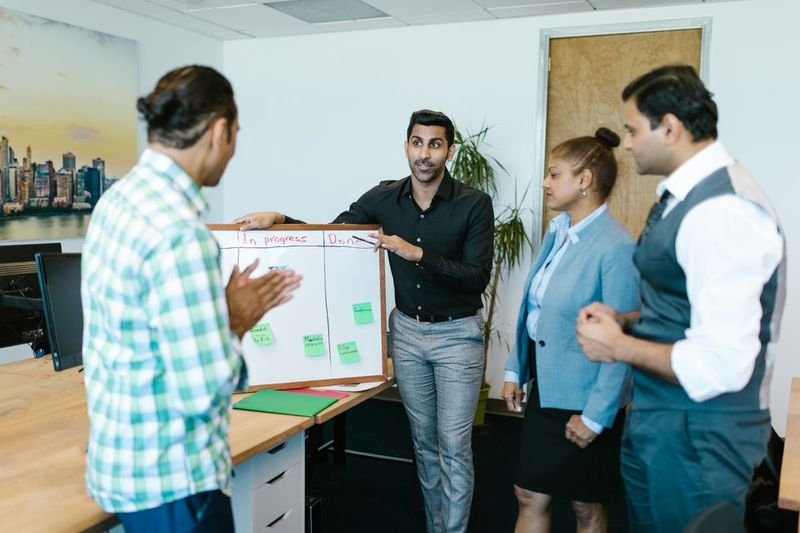
When it is your turn to run the meeting, your job is traffic control: keep people moving through the agenda and stop any one topic from swallowing the clock. These 開會英文 phrases do that without sounding bossy.
Moving through the agenda (推進議程):
- “Let’s move on to the next point.” — 我們進到下一個項目。
- “We’re getting a bit off topic — let’s come back to that later.” — 我們有點離題了,稍後再回來討論。
- “Let’s park that and move forward.” — 這點先擱著,我們繼續。
Inviting people to speak (邀請發言):
- “What are your thoughts, Wei?” — Wei,你的看法是?
- “Does anyone have anything to add?” — 有人要補充嗎?
- “Let’s hear from the marketing team.” — 我們聽聽行銷團隊的意見。
Managing time (掌控時間):
- “We’re running short on time, so let’s be brief.” — 時間不多了,我們簡短一點。
- “Let’s take that offline.” — 這個我們會後再談。
“Let’s take that offline” is a phrase every professional should own — it politely ends a tangent without shutting the person down. If presenting is also part of your role, our guide to 英文簡報用語 (English presentation phrases) pairs perfectly with these.
線上會議英文:Video Call Phrases for Zoom & Teams (線上會議英文)

Remote work made 線上會議英文 (online meeting English) a daily skill. Video calls add a whole layer of phrases you never needed in a conference room — mostly about sound, screens, and connection problems. Get these wrong and the meeting stalls before it starts.
Tech and audio (技術與音訊):
- “You’re on mute.” — 你靜音了。(the single most-used video-call phrase)
- “Can everyone hear me okay?” — 大家聽得到我嗎?
- “Sorry, you’re breaking up.” — 抱歉,你的訊號斷斷續續。
- “I think we lost him for a second.” — 他好像斷線了一下。
Sharing and managing (分享與管理):
- “Let me share my screen.” — 我來分享畫面。
- “Can you see my screen?” — 你看得到我的畫面嗎?
- “Feel free to drop questions in the chat.” — 有問題歡迎打在聊天室。
- “Let’s use the raise-hand feature.” — 我們用舉手功能。
One habit worth stealing: when you finish speaking on a video call, say “That’s all from me” or “Back to you.” Because video hides body language, people cannot tell you are done unless you signal it verbally. The same clarity matters on the phone — our 電話英文 (telephone English) guide covers those spoken-only situations in depth.
結束會議與行動項目 (Closing the Meeting & Action Items)

A meeting without a clear close is a meeting people forget by lunch. Strong endings do three things: summarise what was decided, assign who does what, and confirm the next step. This is where 會議英文 turns talk into results.
Summarising (總結):
- “So, to sum up, we’ve agreed to…” — 所以,總結一下,我們同意…
- “Let me recap the main points.” — 讓我複述一下重點。
Assigning action items (分配行動項目):
- “Wei, can you take the lead on this?” — Wei,這個可以由你負責嗎?
- “I’ll follow up with an email.” — 我會用 email 追蹤。
- “Let’s aim to have this done by Friday.” — 我們目標在星期五前完成。
Ending (結束):
- “Thanks everyone, that’s a wrap.” — 謝謝大家,就到這裡。
- “Let’s schedule a follow-up for next week.” — 我們安排下週再開一次追蹤會議。
Always end by naming the next action and its owner. “I’ll follow up with an email” is the natural bridge — and writing that email well is its own skill, covered in our 商業英文書信 (business email) templates.
英文會議記錄怎麼寫 (How to Write Meeting Minutes)

If you are the one taking 英文會議記錄 (meeting minutes), keep them short and action-focused. Nobody reads a transcript. Good minutes capture four things: decisions, action items, owners, and deadlines. Use these standard headings:
- Attendees (出席者): who was present.
- Agenda (議程): the topics covered.
- Decisions (決議): what was agreed.
- Action items (行動項目): task — owner — deadline.
- Next meeting (下次會議): date and time.
Write action items in a fixed format so nothing is ambiguous: “Wei to send the budget draft by July 25.” Verb first, owner clear, deadline explicit. That single line of English saves a dozen follow-up messages later.
台灣上班族最常犯的 3 個會議英文錯誤 (3 Common Mistakes)
After twenty years teaching English in Taipei, the same three meeting mistakes come up again and again — and none of them are grammar problems.
1. Being too direct. Translating 「這樣不對」 straight into “This is wrong” lands far harder in English than intended. Soften it: “I’m not sure that’s the best approach.” The idea gets across; the relationship survives.
2. Staying silent to avoid mistakes. Many capable professionals say nothing rather than risk an imperfect sentence. But in Western meeting culture, silence reads as “no opinion.” A short, imperfect sentence beats perfect silence every time.
3. Direct translation from Chinese. Phrases like “open the meeting” (should be “start the meeting”) or “discuss about it” (drop “about”) are classic carry-overs. We cover a full list in our guide to Chinglish 常見錯誤 (common Chinglish mistakes).
Fix these three and your English will sound noticeably more natural — often more than another year of vocabulary drilling would achieve.
會議英文常見問題 (FAQ)
How can I sound more confident in English meetings? (如何在英文會議中更有自信?)
Prepare three or four fixed phrases before the meeting — one to open, one to give an opinion, one to disagree, one to close. Having them ready removes the pause where anxiety creeps in.
What do I say when I don’t understand? (聽不懂時該說什麼?)
Say “Sorry, could you say that again?” or “Just to make sure I understand, do you mean…?” Asking is normal and expected — even native speakers do it.
What’s the most useful phrase in a video meeting? (視訊會議最實用的一句是?)
“You’re on mute.” You will use it in almost every online meeting, and it is the fastest way to help a colleague without embarrassing them.
Is my grammar or my phrasing more important? (文法還是用語比較重要?)
Phrasing. In real meetings, knowing the right fixed phrase at the right moment matters far more than perfect tenses. Nobody grades your grammar mid-meeting.
來源
- Harvard Business Review — Stop the Meeting Madness — research on time executives spend in meetings.
- 劍橋字典 — definitions and usage for meeting-related vocabulary.
- Oxford Online English — Attending a Meeting in English — native-speaker phrasing for meetings.





 繁體中文
繁體中文  English
  日本語
日本語  한국어
한국어  ไทย
ไทย  Bahasa Indonesia
  Tiếng Việt
  Français