

Why English Idioms Refuse to Translate | 英文慣用語
本文重點:英文慣用語 (idioms and expressions) 是台灣上班族在職場英文與口說中最容易卡關的部分,因為它們無法逐字翻譯。本文用實際的商業英文情境,說明慣用語背後的邏輯,幫助英文學習者從「背片語」進階到「真正聽懂」,對準備多益或日常職場溝通都有幫助。
You have studied English for fifteen years. You can read a contract, pass a written exam, and write a clear email. Then a colleague on a video call says, “Let’s circle back on that next week — I don’t want to put the cart before the horse,” and suddenly none of your fifteen years seem to help. There is no cart. There is no horse. Why is everyone nodding?
This is the strange wall that idioms and expressions (英文慣用語) put in front of advanced learners. The individual words are easy — you know “cart,” you know “horse” — but the meaning lives somewhere the dictionary cannot reach. For Taiwanese professionals (台灣上班族) who already have a strong grammar foundation, idioms are often the last and most frustrating barrier between “good English” and “natural English.” This guide is not a list to memorize. It is a way of thinking about why idioms behave the way they do, so you can decode the ones you have never heard before.

Why Idioms Break the Translation Habit | 為什麼慣用語不能直譯
Most of us learn a second language by building a bridge: English word on one side, Chinese word on the other. “Apple” connects to 蘋果. “Negotiate” connects to 談判. This bridge works beautifully for most vocabulary, and it is why so many Taiwanese learners excel at reading and exam English. But idioms are designed to break that bridge. An idiom is a phrase whose meaning cannot be predicted from its parts. “Break the bridge” itself is not idiomatic — but “burn your bridges” is, and it has nothing to do with construction.
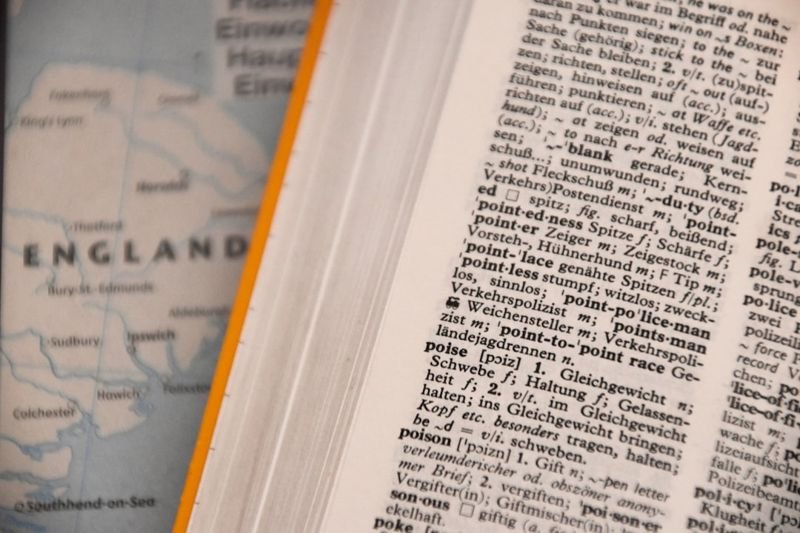
A bilingual dictionary rarely captures what an idiom actually means in use.
When you hear “that’s a ballpark figure,” translating word by word gives you a baseball stadium and a number, which is nonsense. The real meaning — a rough estimate (大概的數字) — comes from American baseball culture, where you might guess the size of a crowd by looking around the park. The lesson is not that you must learn baseball. The lesson is that idioms carry meaning through shared cultural images, not through grammar. The moment you stop trying to translate and start asking “what picture is this phrase painting?”, idioms become far less mysterious.
This shift matters enormously for business English (商業英文). The workplace is one of the most idiom-dense environments in the entire language, because professionals use these phrases as a kind of shorthand — a way to say something quickly and signal that they belong to the group. Understanding them is partly about comprehension and partly about belonging.
The Office Is Built on Idioms | 職場英文充滿慣用語
Consider a single ordinary meeting. Your manager says she wants to “touch base” before the project “ramps up,” warns that the deadline is “tight,” asks the team not to “drop the ball,” and closes by saying she will “loop in” the marketing department and “keep everyone in the loop.” That is five idioms in under a minute, and not one of them can be understood by translating the words directly. Yet to a native speaker, the message is crystal clear: connect with me soon, the work is about to get busy, do not miss anything, and I will keep communication open.
Notice something important here. These are not flashy, colorful idioms like “raining cats and dogs.” They are quiet, almost invisible expressions that working professionals use hundreds of times a week. This is where a lot of exam-focused study (including 多益 / TOEIC preparation) leaves learners exposed: the test rewards formal vocabulary, but the actual meeting room runs on this softer, idiomatic layer of language that textbooks rarely teach directly.
Spatial Idioms: The Hidden Logic | 空間概念的慣用語
Many workplace expressions are built on the idea of physical space, and once you see the pattern, dozens of them suddenly make sense together. “In the loop” and “out of the loop” picture a circle of communication — you are either inside the circle of information or outside it. “On the same page” imagines everyone reading one shared document, meaning you all agree. “Behind schedule” and “ahead of schedule” place time on a line you can move along. “Across the board” sweeps a hand over a whole table, meaning something applies to everything equally.
The value of grouping idioms this way is that you stop memorizing them as random vocabulary and start recognizing the underlying images. When you next hear “let’s take this offline,” you can reason it out: the speaker is using a digital-era spatial metaphor meaning “let’s discuss this privately, not in front of the whole group.” You decoded it without ever having seen it before. That is the skill worth building.

Idioms That Soften the Message | 委婉表達的慣用語
A second large family of workplace idioms exists to make difficult messages gentler. English-speaking business culture, especially American and British, places enormous value on indirectness, and idioms are the main tool for it. When someone says your proposal “needs a bit of work,” they often mean it has serious problems. “Let’s park that idea” is a polite way to reject something for now. “I’ll play devil’s advocate” warns that the speaker is about to disagree on purpose, to test the idea, not because they are hostile.
For Taiwanese professionals, this is a genuinely important cultural decode, not just a language one. The literal words sound mild, but the real message can be a firm no. Learning to hear the softened idiom underneath the polite surface protects you from misreading a rejection as approval — a mistake that can cost a deal or a deadline.
A Method for Decoding Any Idiom | 破解慣用語的方法
Because you cannot possibly memorize every idiom — English has thousands, and new ones appear constantly — the only sustainable strategy is a decoding method you can apply in real time. When an unfamiliar expression lands in a conversation, work through three quick questions instead of freezing.

Idioms make the most sense in the context they are actually spoken.
First, ask what literal picture the words create. “Bite the bullet” makes you imagine clamping down on something hard and painful — which points toward the real meaning: doing something unpleasant that you have been avoiding. Second, read the emotional tone of the speaker and the situation. Even if the picture is unclear, the speaker’s face, voice, and the moment usually tell you whether the idiom is positive, negative, or neutral. Third, listen to what comes immediately before and after. Context is the strongest clue of all — “we need to bite the bullet and cut the budget” makes the meaning almost impossible to miss, even on first hearing.
This three-question habit — picture, tone, context — does something a vocabulary list never can. It turns idioms from a memory problem into a reasoning problem, and reasoning is a skill you already have. Over time, you will catch yourself understanding expressions you have never formally studied, simply because you have learned how the system works.
Why Input Beats Memorization | 大量輸入勝過死背
The fastest way to internalize idioms is not flashcards but exposure to real, natural English in contexts you care about. If you work in technology, watch product launches and listen to engineering podcasts. If you work in finance, follow business news in English. Idioms stick when they arrive wrapped in a situation you understand and find interesting, because your brain files the phrase together with the scene where you heard it. The next time the same scene appears, the idiom comes back automatically.
This is also why working with a tutor or an English teacher (英文家教) who can explain the cultural background of an expression is so valuable. A good teacher does not just give you the Chinese equivalent — they give you the image and the social situation behind the phrase, which is exactly the information you need to use it correctly yourself. The goal is not to collect idioms like stamps, but to understand the logic well enough to produce them naturally.
When to Use Idioms — and When Not To | 何時該用慣用語
Understanding idioms and producing them are two different skills, and they should be developed in that order. Your first priority is comprehension: you need to understand idioms when others use them, because that is happening constantly. Production — using idioms yourself — should come more slowly and carefully. A misused idiom can sound stranger than no idiom at all. Saying someone “kicked the bucket” (a slang phrase meaning they died) in a serious business context would be a memorable mistake.
A safe rule for professional settings is to start with the quiet, common workplace idioms — “touch base,” “on the same page,” “in the loop” — because these are low-risk and universally understood. Save the colorful, regional, or slangy expressions until you have heard them used naturally many times and feel confident about their tone. In writing, especially formal business email (商業英文電子郵件), lean toward fewer idioms and clearer direct language; idioms shine most in speech and casual conversation (英文口說).

There is also a real reward waiting on the other side of this effort. The moment you use a workplace idiom correctly and naturally, something shifts in how colleagues hear you. You stop sounding like someone who learned English and start sounding like someone who lives in it. For professionals building careers in international companies, that shift is not cosmetic — it changes how seriously your ideas are taken in the room.
Building Idioms Into Your Routine | 把慣用語融入日常
The most practical approach is to keep a small running note of idioms you actually encounter at work, rather than studying a generic list someone else made. When a colleague uses an expression you did not know, write it down with the exact situation it appeared in. Once a week, review your note and try to use one or two of the safest phrases in a real conversation. Because every idiom on your list came from your own working life, every one of them is guaranteed to be relevant to you — which is more than any textbook can promise.
Over a few months, this personal collection becomes a precise map of the idiomatic English your specific industry and team actually use. That focus is what turns idioms from an endless, intimidating ocean into a manageable, knowable set of tools — the difference between drowning in expressions and speaking the real language of your workplace.

From Translation to Intuition | 從翻譯到語感
The journey with idioms and expressions mirrors the larger journey of mastering English itself. In the beginning, you translate everything, word by word, from English to Chinese and back. With idioms, that bridge collapses on purpose — and the collapse is actually a gift, because it forces you to stop translating and start understanding directly. You learn to read the picture, feel the tone, and use the context, all without detouring through your first language.

Real conversations build the instinct no translation app can teach.
That is the real destination for any serious English learner: not a bigger pile of memorized phrases, but a working intuition for how the language carries meaning. Idioms, the very things that frustrate advanced learners the most, turn out to be the fastest road there. Stop trying to translate them. Start trying to see them. The horse and the cart will finally make sense.
Sources | 參考資料
- Cambridge Dictionary — idiom definitions and example sentences
- Merriam-Webster Dictionary — American idiom usage
- British Council LearnEnglish — idioms and expressions resources
- Recommended reading: English idioms for business (Amazon search)
Looking for free ESL worksheets for your classroom? Browse our free worksheet library →
Are you a teacher? Find lesson resources and worksheets at TahricTeaches.com.






 繁體中文
繁體中文  English
  日本語
日本語  한국어
한국어  ไทย
ไทย  Bahasa Indonesia
  Tiếng Việt
  Français