
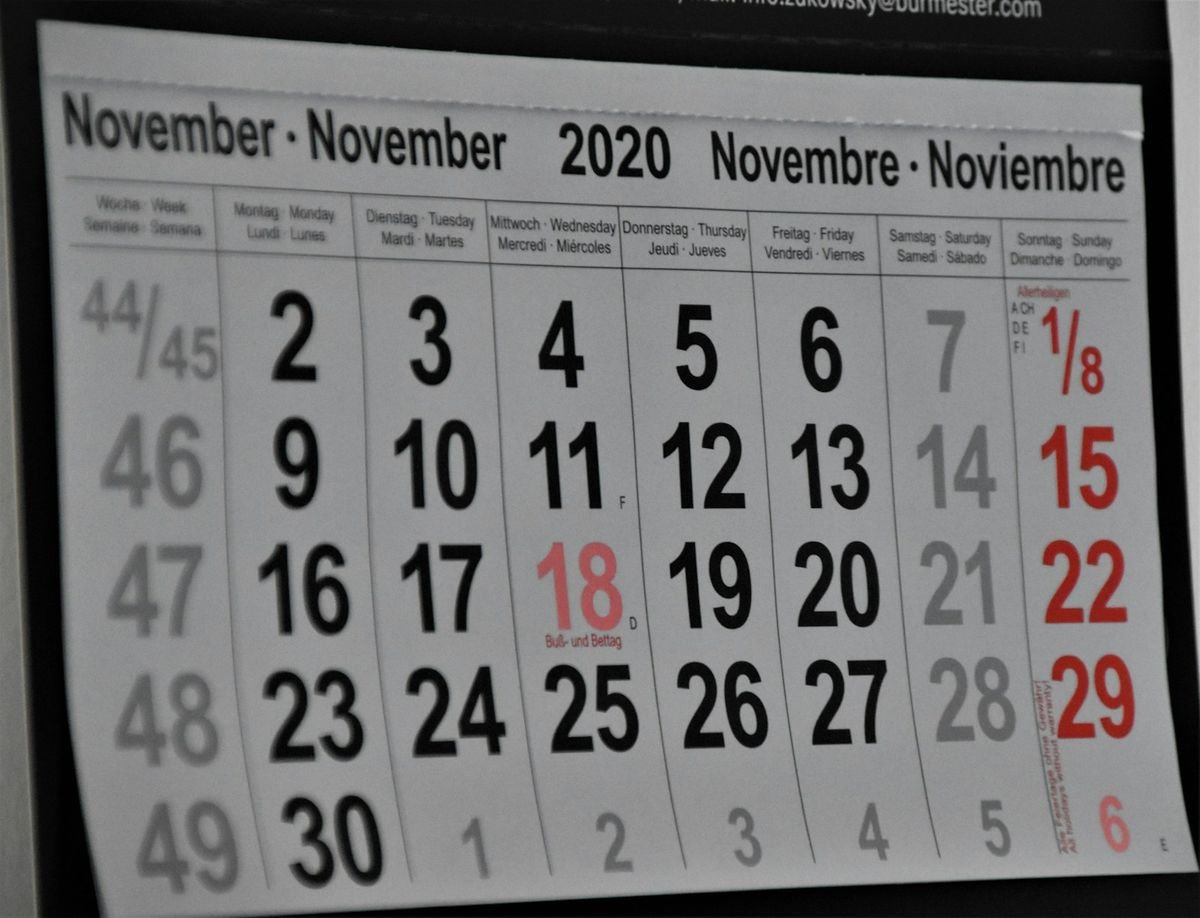
月份英文全攻略:12個月、星期與日期完整對照表 | Months in English
Most students in Taiwan can recite January through December, then freeze the moment they have to use it. They spell September as “Septober,” misread 10/06 as October 6th when an American means June 10th, or write “in 5th May” on a work email. 月份英文 is not just twelve vocabulary words — it is a full system covering spelling, abbreviations, pronunciation, ordinal numbers, and prepositions. This guide lays out that system with complete reference tables: the 12 months, the days of the week, how to write dates, and when to use in, on, or at. Get these right and you will book flights, fill in a résumé, and schedule calls with overseas clients without a single slip.

Once you know 月份英文, reading any English calendar becomes effortless.
月份英文:12個月完整對照表 (Months in English)
This table is the heart of 月份英文, so start here. Remember one hard rule first: in English, the names of months and days always begin with a capital letter, regardless of their position in the sentence. Writing “january” or “monday” in formal writing reads as a spelling error. The chart below pairs the Chinese, the full spelling, the standard abbreviation, and a simple pronunciation guide. Read it aloud three times before moving on.
| 月份 | 英文 (Month) | 縮寫 | 發音 (Say it like) |
|---|---|---|---|
| 一月 | January | Jan. | JAN-yoo-air-ee |
| 二月 | February | Feb. | FEB-roo-air-ee |
| 三月 | March | Mar. | march |
| 四月 | April | Apr. | AY-pruhl |
| 五月 | May | May | may |
| 六月 | June | Jun. | joon |
| 七月 | July | Jul. | juh-LYE |
| 八月 | August | Aug. | AW-guhst |
| 九月 | September | Sep. / Sept. | sep-TEM-ber |
| 十月 | October | Oct. | ok-TOH-ber |
| 十一月 | November | Nov. | noh-VEM-ber |
| 十二月 | December | Dec. | dih-SEM-ber |
Two pronunciation mistakes show up constantly. The first is February: that middle “r” gets dropped, but the correct sound keeps it — “FEB-roo,” not “Feb-yoo.” The second is January, where the stress lands hard on the first syllable and everything after it stays light; do not punch every syllable evenly. Treat March, May, and June as your confidence-builders. They are short, they sound the way they look, and nailing them early makes the longer names feel manageable.
英文月份縮寫怎麼寫 (Month Abbreviations)
The rule for 英文月份縮寫 (month abbreviations) is refreshingly simple: take the first three letters and add a period. January becomes Jan., October becomes Oct. Three exceptions are worth memorizing, because they are exactly what tests and forms love to catch.
- May, June, and July are already short, so in formal writing they are usually spelled out in full rather than abbreviated.
- September has two accepted forms: both Sep. and Sept. are correct, though news style and American English lean toward Sept.
- Keep the period after the abbreviation in American English — write “Jan.” not “Jan” (British style sometimes drops it).
Where do abbreviations actually appear? Plane tickets, passports, credit-card expiry dates, spreadsheets, and calendar apps. When you apply for a US visa or fill in an English form in Taiwan, your birth month almost always needs the abbreviation, so writing Jan.–Dec. correctly is an easy win. One bonus: month abbreviations and day abbreviations (Mon., Tue., and so on) follow the same logic, so learning one teaches you both.
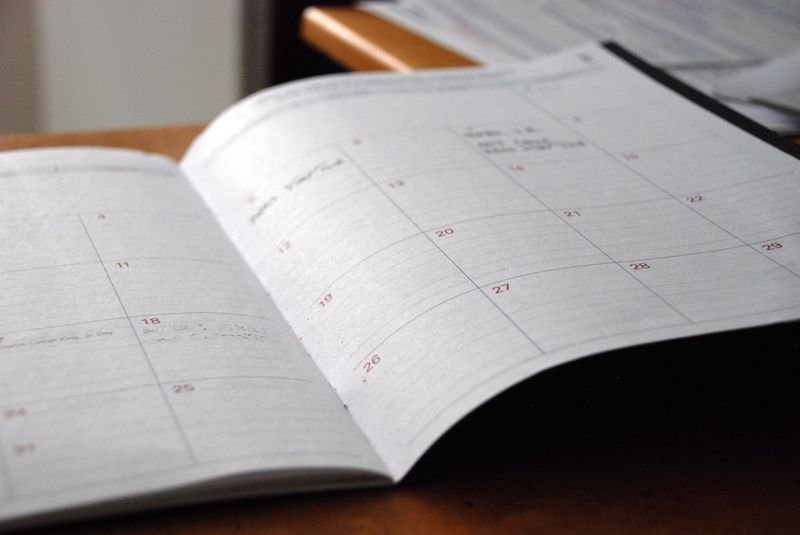
Writing month abbreviations in an English planner is the most natural way to drill them.
The Story Behind the Month Names — and a Memory Trick
The hardest part of learning 月份英文 is the stretch from September to December. Here is a piece of trivia that will fix them in your memory for good: the roots of those four words are the Latin numbers for seven, eight, nine, and ten — sept, oct, nov, dec. So why are the numbers off? Because the old Roman calendar had only ten months. Later, the emperors Julius Caesar and Augustus inserted July (named for Julius) and August (named for Augustus), pushing the back half of the year two slots later. That is why October literally means “the eighth” yet lands in tenth place.
Once you know that story, you can do the math instead of memorizing blindly. See “oct” (think octopus, octagon — eight) and add two for October. See “dec” (think decade — ten) and add two for December. Linking an unfamiliar word to a root you already know beats brute-force repetition every time. Grouping by season helps too: spring runs March–May, summer June–August, autumn September–November, and winter December–February.

Grouping the twelve months into seasons — autumn is September–November — gives memory a visual hook.
星期英文:一週七天 (Days of the Week)
星期英文 (the days of the week) follow the same capitalization rule as the months. The seven days are Monday, Tuesday, Wednesday, Thursday, Friday, Saturday, and Sunday. The classic spelling trap is Wednesday: the “d” is silent, so it sounds like “WENZ-day,” but that “d” must never be left out when you write it.
| 星期 | 英文 (Day) | 縮寫 | 發音 (Say it like) |
|---|---|---|---|
| 星期一 | Monday | Mon. | MUN-day |
| 星期二 | Tuesday | Tue. / Tues. | TYOOZ-day |
| 星期三 | Wednesday | Wed. | WENZ-day |
| 星期四 | Thursday | Thu. / Thurs. | THURZ-day |
| 星期五 | Friday | Fri. | FRY-day |
| 星期六 | Saturday | Sat. | SAT-er-day |
| 星期日 | Sunday | Sun. | SUN-day |
Two everyday expressions are worth banking. “Weekday” means Monday through Friday — the working days — while “weekend” covers Saturday and Sunday. The most natural way to ask what day it is sounds like “What day is it today?” and the answer is simply “It’s Tuesday.” There is no need to tack “today” on the end a second time.

Western weekly planners often label weekdays M / T / W / TH / F — reading those abbreviations is a practical skill.
日期英文怎麼說、怎麼寫 (How to Say & Write Dates)
This is the section of 月份英文 that trips up the most people and matters the most. When you say a date in English, you use ordinal numbers — first, second, third — not one, two, three. So the 5th is spoken as “the fifth” and the 21st as “the twenty-first.” Even though you often write just the digit (5), you must add the ordinal when you say it out loud.
The key difference is that American and British formats are not the same, and this is exactly where Taiwanese readers get tangled up:
- American: month / day / year, month first. Example: March 5, 2026, said as “March fifth, twenty twenty-six.”
- British: day / month / year, day first. Example: 5 March 2026, said as “the fifth of March, twenty twenty-six.”
This means the all-numeral date 03/05/2026 is March 5th in the US but May 3rd in the UK. The safest move on any international email is to spell the month out: write “5 March 2026” or “March 5, 2026” and no one can misread it. The year/month/day order Taiwanese readers are used to (2026/03/05) is rare in international settings, so for formal documents, switch to one of the two formats above.

Practicing English dates in a journal makes ordinals and formats automatic.
in / on / at:日期與時間的介系詞 (Prepositions)
Once the months and dates are solid, the next hurdle is prepositions. Using the wrong one is the clearest giveaway of a Taiwanese learner — for example, saying “in May 5th” instead of “on May 5th.” Remember the principle of going from big to small: the larger the time span, the more you reach for “in”; the smaller and more exact it gets, the more you use “at.”
- in + month, year, or season: in May, in 2026, in summer.
- on + a specific day, date, or weekday: on Monday, on March 5th, on my birthday.
- at + a clock time: at 3 o’clock, at noon, at night.
So “I was born on May 5th” is correct, not “in May 5th,” because the moment you name a specific date you need “on.” To lock the prepositions down for good, read our full guide to in / on / at for time and place, which fills in the time and location rules side by side.

Business calendar apps run entirely on English months and days — learning while you use them sticks best.
西元年份英文怎麼唸 (Saying the Year)
Years follow a fixed pattern just like the months, yet learners in Taiwan often read each digit one by one, which sounds unnatural. The standard approach is to split a four-digit year into two pairs — the first two digits and the last two. So 1999 is “nineteen ninety-nine” and 1985 is “nineteen eighty-five.”
The years 2000 to 2009 are the exception, usually read as “two thousand” or “two thousand and one.” From 2010 onward, the two-pair method returns: 2026 can be “twenty twenty-six” or “two thousand twenty-six,” with the first being more common and crisper in daily speech. Combine this with the ordinals and months above, and you can say a full date smoothly — for instance, “Monday, March fifth, twenty twenty-six.”

2026 is read “twenty twenty-six,” which sounds far more natural than reading each digit.
5 Date and Month Mistakes Taiwanese Learners Make Most
Memorizing 月份英文 is not enough on its own — the real gap-closer is avoiding these frequent errors. After more than twenty years of teaching, these five are the ones almost every student in Taiwan has made:
- Not capitalizing months and days. Writing “next monday in june” looks amateur in a formal email; Monday and June both need capitals.
- Wrong preposition. “in May 5th” should be “on May 5th” — once you name a date, use “on.”
- Dropping the ordinal. Saying “May five” is wrong; say “May fifth.”
- Mixing American and British formats. When 06/07 could be June 7th or July 6th, spell the month out to be safe.
- Misspelling Wednesday and February. These two are spelling killers — the silent “d” and “r” are barely pronounced, but you can never leave them out in writing.
常見問題 FAQ
Q: Do months always have to be capitalized in English?
Yes. Months and days are proper nouns in English, so the first letter is always capitalized, whether at the start of a sentence or in the middle. This differs from Chinese and is the detail Taiwanese learners most often overlook.
Q: Why doesn’t May have an abbreviation?
Because May is only three letters long — it is already short enough that abbreviating it serves no purpose. For the same reason, June and July are usually written out in formal text.
Q: What date is 03/04/2026, exactly?
It depends on the format. American style reads month/day (March 4th); British style reads day/month (April 3rd). To avoid confusion in international communication, spell the month out, as in “4 March 2026.”
Q: How do I ask “what’s the date” versus “what day is it”?
Ask for the date with “What’s the date today?” and ask for the weekday with “What day is it today?” The two questions have different structures, so do not mix them up.
Drill the reference tables, the ordinal rules, and the in/on/at prepositions in this guide and 月份英文 graduates from “vocabulary you memorize” to “English you actually use.” The next step is to put dates into your real life: write your planner in English, switch your phone calendar to English, and say a full English date out loud the next time you make plans. To keep building the foundation, read our preposition guide and our travel English phrases next — both pay off the moment you book a flight or a hotel.
Sources(資料來源)
- Cambridge Dictionary — Dates — authoritative reference on British and American date formats.
- British Council — Prepositions of time (in, on, at) — official teaching on time prepositions.
- BBC Learning English — pronunciation examples for months, days, and dates.
- Wikipedia — Month — background on the origin of month names and the Roman calendar.
Looking for free ESL worksheets for your classroom? Browse our free worksheet library →
Are you a teacher? Find lesson resources and worksheets at TahricTeaches.com.






 English
  繁體中文
繁體中文  日本語
日本語  한국어
한국어  ไทย
ไทย  Bahasa Indonesia
  Tiếng Việt
  Français