

English Self Introduction: 1-Minute Script (2026) | 英文自我介紹範例
Eight seconds. That’s roughly how long a hiring manager at a Taipei foreign-capital firm spends deciding whether your 英文自我介紹 sounds rehearsed, vague, or actually ready for the role. The cost of getting it wrong isn’t subtle — it’s the gap between a second interview and a polite “We’ll be in touch.” This guide gives Taiwan professionals the 7-part structure that recruiters expect, opener phrases that don’t sound translated, a copy-ready 1-minute interview script, and the small fixes most candidates skip.

Confidence reads in the voice before the words. Slow your pace and let the first sentence breathe.
Why 英文自我介紹 Trips Up Most Taiwan Pros
Most 英文自我介紹 attempts fail for the same reason: they’re translated from a Chinese draft word-for-word. The result is grammatically clean and emotionally flat. “I am an engineer who likes to learn new things and challenge myself” tells a recruiter nothing they can use. The fix is to think in English from the first sentence: one concrete fact, one clear role, and one specific reason you’re in the room today.
There’s also a pacing problem unique to Taiwan-trained English speakers. The reflex is to compress 60 seconds of content into 35 by speaking faster, on the theory that speed shows fluency. It signals the opposite. Recruiters at companies like TSMC, ASE, and the larger Taipei branches of foreign banks consistently report that a calm 90-second answer reads as more senior than a rushed 45-second one — even when the rushed version contains more information.
The third issue is what you talk Về. School-trained scripts focus on hobbies, family, hometown. Modern interview self introductions skip all three. Your hometown matters if it connects to the role; otherwise it’s filler the interviewer mentally edits out.
The 7-Part Structure for English Self Introduction | 英文自我介紹黃金結構
Every strong 英文自我介紹 follows the same seven beats. Memorize the structure, not a script — that way you can adapt on the fly when the interviewer changes the question.
- Name + current role + company — one sentence, no apologies.
- One headline accomplishment — pick one number you can defend if asked.
- Specific skill that maps to this role — name the skill the job ad asked for.
- Why this company, why this team — show you read past the careers page.
- What you want to do next — a forward sentence, not a backward one.
- A soft handoff — “happy to dig into any of that” beats “thank you.”
- Stop talking — the most underrated step. Stop on purpose.
Steps 1 through 3 cover the first 30 seconds. Steps 4 and 5 fill the next 25. The handoff and pause take five. That’s the math behind a clean 60-second answer.

A 90-second team intro at the start of a kickoff meeting tells the room who you are and why you’re in it.
How Long Should an English Interview Self Introduction Be? | 英文面試自我介紹要多久?
Sixty to ninety seconds for an in-person or video interview. Thirty seconds for a networking event. Fifteen seconds for an elevator-style introduction with a senior leader you didn’t expect to meet. Anything past two minutes loses the room — interviewers stop tracking content and start tracking the clock.
Context shifts the target. A Taipei tech firm hiring for a senior role usually expects the full 90 seconds. A startup hiring junior staff often prefers 30. Foreign banks and consultancies tend to want 60 with a tight close. The cleanest rule of thumb: if the recruiter is taking notes, they expect more detail. If they’re nodding politely, wrap and pivot.
For a written 英文自我介紹 — common in scholarship applications and exchange programs — count words, not seconds. 150 words is the sweet spot. 200 is the ceiling.
What to Say in a 1-Minute Self Introduction | 1分鐘自我介紹要說什麼?
A 60-second 英文自我介紹 is built like a tight pitch, not a speech. Here’s the timing breakdown that consistently lands in interviews at firms across Xinyi and Nangang:
- Seconds 0–10: Name, current title, and company. Optionally add years of experience if it’s a senior role.
- Seconds 10–25: One headline accomplishment with a specific number. Revenue saved, users gained, hours cut.
- Seconds 25–45: A skill or piece of experience that directly maps to the job description.
- Seconds 45–55: Why this company, this team, this role — be specific, name something only an insider would know.
- Seconds 55–60: A soft handoff that invites the next question.
One number does more than three vague claims. “I cut our monthly close from twelve days to seven” is worth more than “I have strong analytical skills and a passion for finance.”
Self Introduction English Simple? Openers That Don’t Sound Translated | 自我介紹英文簡單開頭句
The opener is the only sentence the interviewer hears clearly — the rest gets filtered through their note-taking. Pick one of these by context, then commit to it. Practice the first line out loud until it stops feeling stiff.
For a formal job interview:
- Thanks for the time today. I’ll keep this to about a minute — I’m [name], currently a [role] at [company].
- Good morning. I’m [name] — a [role] with [X] years of experience in [field].
- Happy to be here. I’m [name], and I lead [team / function] at [company].
For a networking event or industry meetup:
- Hi, I’m [name] — I run [function] at [company]. What brings you here today?
- Great to meet you. I work on [problem / product] at [company].
- Hi — I’m [name], based here in Taipei, working in [field].
For a new team or kickoff meeting:
- Quick intro before we dive in — I’m [name], joining the [team] team this quarter.
- I’ll keep this brief — I’m [name], and I’ll be working with [person] on [project].
None of these start with “Hello everyone, my name is…” That phrasing reads as memorized. It’s not wrong — it’s just instantly recognizable as a script, and the interviewer’s attention drops a notch before you finish.

Networking events reward speakers who can compress their story into 30 seconds without sounding rehearsed.
Self Introduction at Work in English | 自我介紹工作 英文:職場版範例
Workplace 英文自我介紹 is shorter and warmer than the interview version. Three contexts cover most situations: joining a new team, meeting a client, and presenting in a cross-functional kickoff.
Joining a new team (30 seconds): “Hi everyone, I’m [name] — I joined the [team] team last week from [previous company / department]. My background is in [area], and I’ll mostly be working on [current project] with [colleague]. Looking forward to getting to know all of you.”
Meeting a client for the first time (20 seconds): “Nice to finally meet you in person. I’m [name], your point of contact at [company] for the [project] account. I’ve been with the team for [X] years and I’ve been looking forward to this conversation.”
Cross-functional kickoff (45 seconds): Lead with the team and the role first, not the name. “From the engineering side, I’m [name] — I’ll be the technical lead on this project. Quick context: we’ve shipped two similar integrations this year, and I’ll be the person to flag any architecture trade-offs early.” For the phrases that follow your intro in these meetings, our guide to workplace English office phrases for Taiwan pros covers the next 30 seconds of the conversation.
Sample 1-Minute English Self Introduction Script | 英文面試自我介紹範例
Đây là bản đầy đủ 英文自我介紹範例 for a mid-level marketing role at a foreign-capital firm in Taipei. Read it out loud once — pacing matters more than vocabulary.
“Thanks for the time today. I’ll keep this to about a minute. I’m Jenny Lin — currently a senior marketing manager at a B2B SaaS company in Neihu, with seven years across content and demand generation.
The work I’m proudest of from the last role was rebuilding our content engine. We grew organic traffic from 8,000 to 47,000 monthly visitors over eighteen months, and that pipeline became the largest source of qualified leads — about 40% of total signups by the end of last year.
What’s pulling me toward this role is the international expansion focus. I’ve spent the last two years working with our Singapore and Tokyo teams on localized content, and your job description mentioned a similar mandate for the APAC region. That’s the kind of problem I want to be solving for the next chapter.
Happy to dig into any part of that — or to start wherever you’d like.”
Word count: 158. Spoken aloud at natural pace, it lands at 58 seconds. The number (8,000 to 47,000), the specific cities (Singapore, Tokyo), and the soft handoff at the end are what separate this from a generic answer.
Watch the Pros: A Recruiter Breakdown of “Tell Me About Yourself”
This breakdown from a Taipei-based English coach walks through the exact golden formula used in foreign-company interviews. The opening 90 seconds map closely to the 7-part structure above.
Common 英文自我介紹 Mistakes and the Fix
The same five mistakes appear in almost every coaching session at every Taipei English school. Most of them are easy to fix once you notice them.
- Starting with “Hello everyone, my name is…” — too obviously memorized. Lead with a context line instead.
- Listing hobbies the interviewer didn’t ask about. Save hobbies for the “anything else we should know” question at the end, and only if they connect to the role.
- Apologizing for your English. “Sorry, my English is not very good” is the single most common opener — and it’s the worst. The interviewer is going to evaluate your English no matter what. Apologizing primes them to find problems.
- Ending with “That’s all, thank you.” Final sentences anchor the impression. End on a forward sentence — what you want to do next — or a soft invitation to ask the first question.
- Using “etc.” in spoken English. It reads fine in writing. Out loud, it sounds like you ran out of ideas. Either name the third item or stop at two.
One more, less common but worth flagging: don’t translate Chinese chengyu directly. “I’m a person who can do many tasks at once” beats “I am a Jack of all trades” in 2026 — the idiom carries an implied negative (“master of none”) that most non-native speakers don’t intend.

Write your script. Cut it in half. Then practise it out loud — that gap closes a lot of nerves.
After the 英文自我介紹: What Comes Next
Cái 英文自我介紹 sets the table. The next 10 to 15 minutes of conversation are where the interview is actually decided, so prepare for the three follow-ups that almost always come next: “Walk me through your resume,” “Why are you leaving your current role,” and “Why this company specifically.” Each one has its own 60-second structure, and rehearsing them as a block — intro plus three follow-ups — is more useful than rehearsing the intro alone.

Your resume tells the past. Your 英文自我介紹 tells them why the past matters for this role.
For the email exchange that usually follows the interview, see our guide to 8 scenario-specific self-introduction scripts (for networking, Zoom, and business meetings), or our guide to business email English for Taiwan pros. And if your role involves international clients, the 50 TOEIC words to hit 800+ guide covers the vocabulary recruiters expect at the senior level.
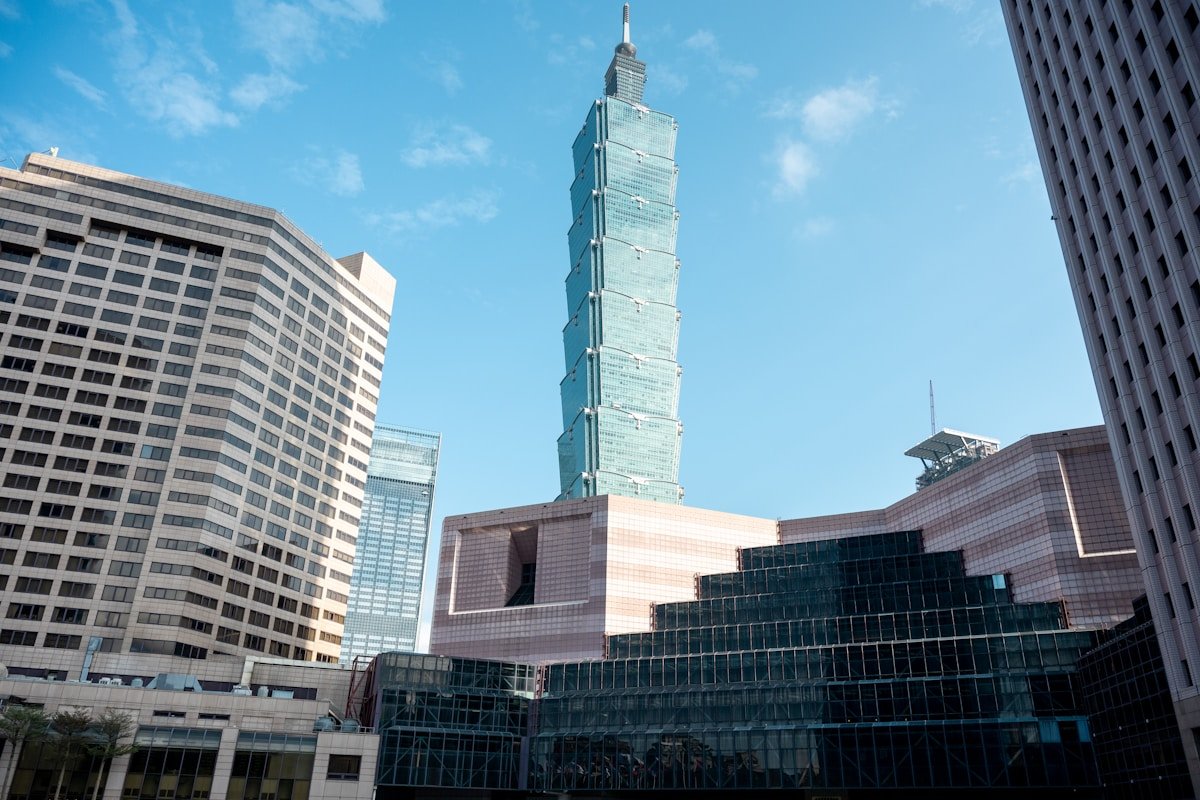
Xinyi and Nangang are stacked with foreign-capital firms where English self introductions decide the next move.
Final Practice: Three Drills That Actually Work
Reading the script is the easy part. These three drills are what move the practice from page to performance:
Record yourself on your phone. Listen back at 1.0x speed. The first listen will be uncomfortable; the second is where you hear the filler words. Cut every “um,” “you know,” and “kind of” before the third take.
Time yourself against a stopwatch. Aim for 58 to 62 seconds. If you finish in 45, you’re rushing. If you hit 75, trim a clause — usually the third sentence has one extra qualifier you can drop.
Run it past someone who doesn’t speak Chinese. A native English speaker will catch the translated phrasings you can’t hear. If you don’t have access to one, online conversation platforms like italki or Cambly are cheap insurance the week before a real interview. For a deeper breakdown of British Council’s framework, see their official guide to introducing yourself in English.

Self introductions in front of a group follow the same structure as one-on-one — just slower and louder.
The One Sentence Worth Stealing
Most candidates leave the room remembered for either their best line or their worst. Make sure you have one line you’ve stress-tested — a single sentence that captures what you do, the result you’ve produced, and where you want to go next. Twenty words is enough. Practice that sentence until it sounds boring to you. To the interviewer, it’ll sound effortless. That’s the goal of every 英文自我介紹 worth memorizing.
Nguồn
- British Council Learn English — Introducing Yourself — official audio and script frameworks for English self introduction.
- Harvard Business Review — A Simple Way to Introduce Yourself — the present-past-future structure for professional introductions.
- Cambridge Dictionary — Introduction — pronunciation and usage reference for opener vocabulary.
- BBC Learning English — The English We Speak — natural conversational phrasing for openers and small talk.
Looking for free ESL worksheets for your classroom? Browse our free worksheet library →
Are you a teacher? Find lesson resources and worksheets at TahricTeaches.com.
Need help ranking on Google? RankOnRepeat manages your entire blog — keyword research, writing, and publishing — so your business shows up when customers search. See how it works →






 Tiếng Việt
  English
  繁體中文
繁體中文  日本語
日本語  한국어
한국어  ไทย
ไทย  Bahasa Indonesia
  Français