

英文形容詞順序 | Adjective Order in English: The OSASCOMP Rule
“A beautiful little old rectangular green French silver knife.” Read that sentence again. Something about it sounds completely natural — the adjectives line up in a sequence that native English speakers follow without ever being taught the rule. Now try “a silver French green rectangular old little beautiful knife.” Every native speaker’s brain immediately flags something as wrong. This is adjective order in English — one of the grammar rules that operates almost entirely below the surface.

Studying English adjective order rules with the OSASCOMP framework
What Is Adjective Order? | 什麼是英文形容詞順序?
When you describe a noun using multiple adjectives in English, there is a fixed sequence those adjectives must follow. Unlike Chinese (中文), where adjective placement is more flexible and context-driven, English adjective order follows strict internal logic. Native speakers absorb this rule unconsciously, but learners — especially those whose first language is Mandarin — often stack adjectives in the wrong sequence without noticing.
The classic example comes from linguistics writer Mark Forsyth: “a lovely little old rectangular green French silver whittling knife.” That single noun phrase contains seven adjectives, all in a mandatory sequence. Swap any two and something sounds immediately wrong — even to a five-year-old who can’t explain why.
The reason this happens: English speakers have internalized a hierarchy of adjective categories. That hierarchy is what we’re about to map out.

Taiwan English learners studying adjective grammar — understanding OSASCOMP order
The OSASCOMP Rule | 英文形容詞的8大類別
The most widely used framework for English adjective order is OSASCOMP: Opinion, Size, Age, Shape, Color, Origin, Material, Purpose. Here’s what each category includes:
| Category | 類別 | Chinese | 中文說明 | Examples | 例詞 |
|---|---|---|
| Opinion | 觀點 | 主觀評價 | beautiful, ugly, strange, lovely, awful |
| Size | 大小 | 大小尺寸 | big, small, tiny, enormous, tall, long |
| Age | 年齡/年代 | 年份時代 | old, young, new, ancient, modern |
| Shape | 形狀 | 幾何形狀 | round, square, flat, rectangular, oval |
| Color | 顏色 | 顏色色彩 | red, blue, pale yellow, dark green |
| Origin | 來源 | 國籍/來源 | French, Japanese, Taiwanese, American |
| Material | 材料 | 製作材料 | wooden, plastic, cotton, leather, golden |
| Purpose | 用途 | 功能用途 | sleeping (bag), running (shoes), cooking (oil) |
So the full sequence is: Opinion → Size → Age → Shape → Color → Origin → Material → Purpose
Try this sentence aloud: “a gorgeous [O] little [S] antique [A] oval [SH] yellow [C] Chinese [OR] porcelain [M] tea [P] cup.” Sounds odd because it packs all eight categories — but the order itself is correct.

Color category adjectives in OSASCOMP — size before color in English grammar
How Adjective Order Works in Real Sentences | 實際句子示範
The good news: in real conversation, you almost never stack more than two or three adjectives before a noun. The seven-adjective knife example is a linguistics teaching tool, not normal speech. Here is how adjective order actually appears in everyday English:
Two adjectives (most common):
- a big red bag ✓ (not “a red big bag”)
- a beautiful young woman ✓
- an old wooden chair ✓
- a lovely small garden ✓
Three adjectives (occasional):
- a lovely small yellow bird ✓ [Opinion-Size-Color]
- a big old Japanese car ✓ [Size-Age-Origin]
- some thick black leather boots ✓ [Size-Color-Material]
Notice the pattern: when you only use two adjectives, you just need to know which category comes first. Size before Color is the most common daily combination — “a big red bag” is something you hear fifty times more often than “a big old Chinese wooden chest.”
Why Chinese Speakers Get This Wrong | 中文母語者的形容詞錯誤
In Mandarin, multiple adjectives before a noun all connect through 的 (de), and the ordering is considerably more flexible than in English. This flexibility is actually a feature of Mandarin — but it creates a transfer error when speaking English.

English grammar notebook practice — adjective order exercises for Taiwan ESL learners
The most common mistake for Taiwan learners: putting Color before Size.
- ❌ “She was wearing a red big dress.”
- ✓ “She was wearing a big red dress.”
Size always comes before Color in English. Remembering just that single rule eliminates probably 60% of adjective order errors for Mandarin speakers.
The second most common mistake: putting Opinion after other adjectives.
- ❌ “I bought a wooden old beautiful wardrobe.”
- ✓ “I bought a beautiful old wooden wardrobe.”
Opinion (subjective evaluation) always comes first in English adjective chains. This is counterintuitive for Chinese speakers because in Mandarin, it is natural to state the objective facts first and deliver the subjective evaluation last. English reverses that completely.
Three Pairs Every Taiwan Learner Should Know First | 最重要的三組形容詞組合
You do not need to memorize all eight OSASCOMP categories on day one. Start with these three pairs, and you will handle 80% of everyday adjective-order situations correctly:
1. Opinion before Size | 觀點在大小前面
- a lovely big house (not “a big lovely house”)
- a strange little 貓
- a beautiful large painting
2. Size before Color | 大小在顏色前面
- a small green frog (not “a green small frog”)
- a big white cloud
- a tall dark tree
3. Color before Origin | 顏色在來源前面
- a dark green American car (not “an American dark green car”)
- a pale yellow Chinese dress
- a blue Italian sports car

Group of students practising English adjective order in conversation
The Purpose Category — Often Overlooked | 常被忽略的「用途」類別
Many learners are never taught the final category: Purpose. These adjectives describe what the noun is for, and they always come last — closest to the noun itself.
- a sleeping bag (not “a bag for sleeping”)
- a swimming pool
- a running track
- a writing desk
- a shopping bag
Native speakers hear “a big red shopping bag” and process it instantly. The purpose adjective locks into position right before the noun, always. In Taiwan, a common Chinglish error is “I have a class-going bag” (influenced by Chinese compound structures). The correct English is “I have a school bag” or simply “my bag for school.”
Oxford Online English: Adjective Order Video | 影片講解

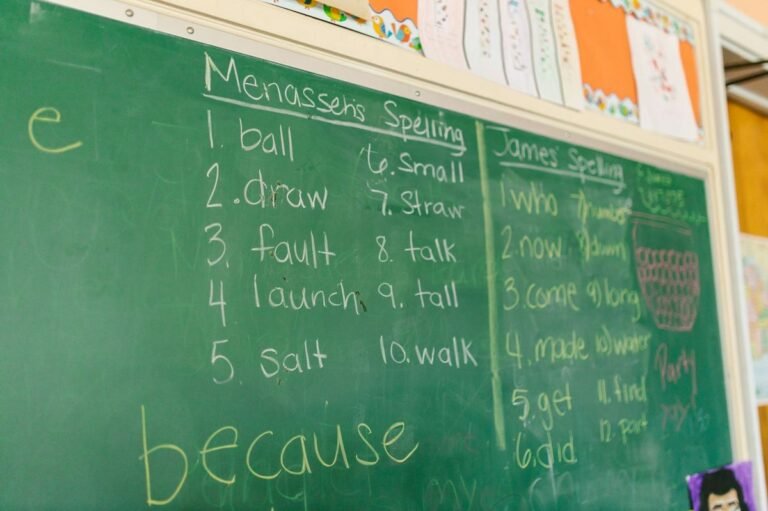
English classroom for adjective order lesson — Taiwan ESL students
Practice: Put These in the Right Order | 形容詞排列練習
Try these before checking the answers below. Rearrange the adjectives so they follow the correct English order:
- Italian / small / a / red / sports / car
- wooden / beautiful / round / a / old / table
- plastic / cheap / big / a / green / box
- wool / thick / a / grey / beautiful / coat
- new / expensive / a / red / running / pair of shoes
Answers:
- a small red Italian sports car [Size-Color-Origin-Purpose]
- a beautiful old round wooden table [Opinion-Age-Shape-Material]
- a big cheap green plastic box [Size-Opinion-Color-Material]
- a beautiful thick grey wool coat [Opinion-Size-Color-Material]
- an expensive new red running pair of shoes [Opinion-Age-Color-Purpose]

Handwriting English adjective order exercises in a notebook for practice
How to Remember OSASCOMP | 記憶技巧
The acronym OSASCOMP is one tool. Here is a mnemonic sentence that makes the sequence stick:
“Only Snakes Are Sadly Cold On Mountain Paths.”
(Opinion – Size – Age – Shape – Color – Origin – Material – Purpose)
A second approach used by experienced ESL teachers: stop trying to memorize the full chart, and start with native speaker exposure. Reading English novels and watching English films means you hear correct adjective order thousands of times. Your brain starts to recognize what sounds right without running through the acronym consciously. Deliberate practice with two-adjective combinations each week accelerates this. When a phrase sounds awkward to you, there is a good chance the adjectives are out of order — trust that developing instinct.
The single rule that gets Taiwan learners 80% of the way there, fast: Opinion first, then Size, then Color. Everything else can be built on top of that foundation over time.
Sources | 參考資料
- Oxford Online English — Adjective Order in English — Full grammar guide with examples and video lesson by Oxford Online English
- BBC Learning English — Adjectives and order — BBC’s official explanation of English adjective order with interactive exercises
- Cambridge Grammar — Adjective Order — Cambridge University Press authoritative guide to adjective sequencing in British and American English





 繁體中文
繁體中文  English
  日本語
日本語  한국어
한국어  ไทย
ไทย  Bahasa Indonesia
  Tiếng Việt
  Français