Airport English Vocabulary: 50+ Must-Know Phrases | 機場英文
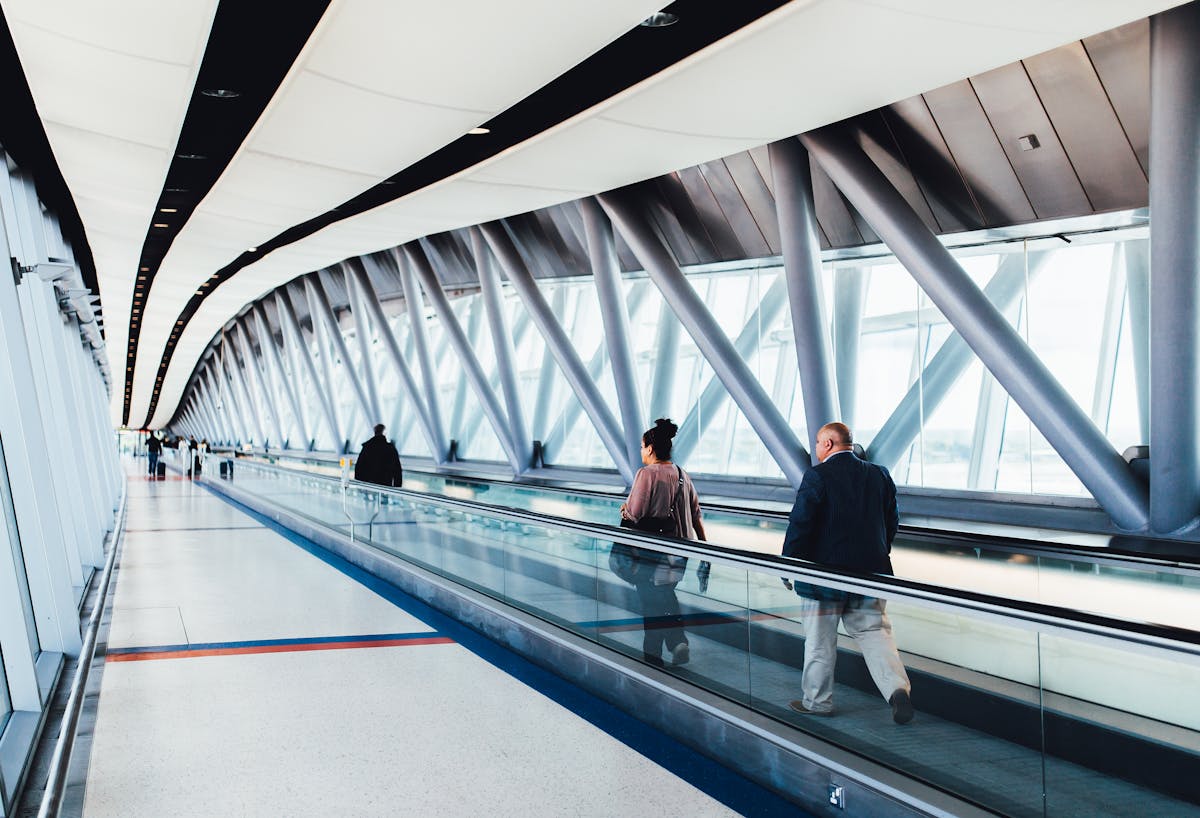
Airport English vocabulary is the single most useful skill you can learn before your next international trip (出國旅行). Whether you’re flying from Taoyuan (桃園機場) to Tokyo, Los Angeles, or London, you’ll need the right English phrases for every step — from check-in (報到) to security (安檢), boarding (登機), talking to flight attendants (空服員), and even going through customs (海關). This guide covers 50+ must-know airport English (機場英文) phrases organized by each stage of your journey, so you can travel abroad with confidence.Many Taiwanese travelers (台灣旅客) feel anxious about using English at the airport. The good news? Airport English follows predictable patterns. Staff ask the same questions, signs (指示牌) use the same words, and announcements (廣播) follow the same structure every time. Master these key vocabulary words (關鍵字彙) and common phrases (常用句型) once and you’ll feel comfortable in any airport worldwide.
Check-in and Seat Assignment Airport English (報到英文)
Your airport experience starts at the check-in counter (報到櫃台). Many airlines (航空公司) now offer online check-in (線上報到) or self-service kiosks (自助報到機), but when you approach the counter, ground staff (地勤人員) will typically ask these questions:
- “May I see your passport and booking confirmation?” — Have your passport (護照) and booking confirmation (訂位確認) ready on your phone or printed out.
- “How many bags are you checking in?” — “Checking in” means handing bags (行李) to the airline for the cargo hold, not your carry-on (手提行李).
- “Do you have a seat preference?” (座位偏好) — This is your chance to request a specific seat.
Here are the best responses to use at check-in:
- “I’d like a window seat, please.” — A window seat (靠窗座位) is great for sleeping and views.
- “Can I have an aisle seat?” — An aisle seat (走道座位) gives easy access to the lavatory and overhead bins (上方置物箱).
- “I have two bags to check in.” (我有兩件托運行李)
- “Is there an extra charge for overweight luggage?” (超重行李) — Airlines charge steep fees for bags over the weight limit.
Essential check-in vocabulary:
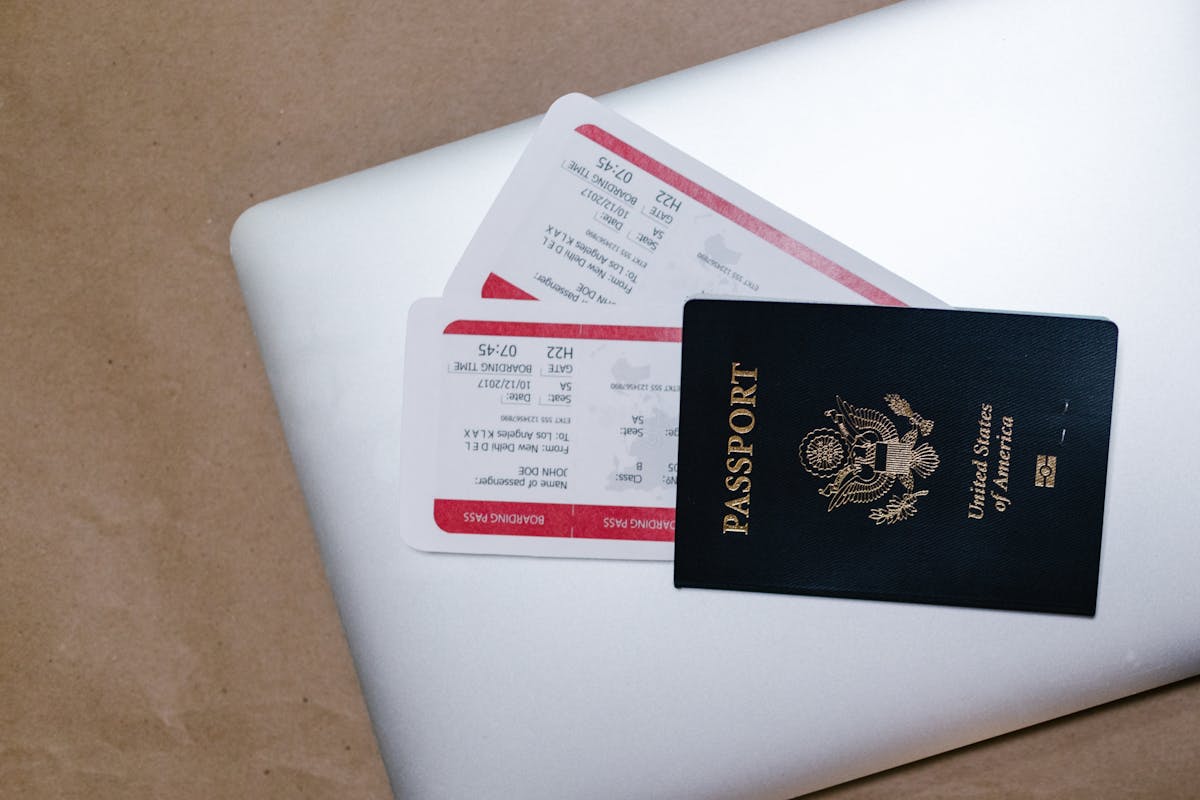
- Boarding pass (登機證) — your ticket to get on the plane
- Carry-on luggage / Hand luggage (手提行李) — bags you bring into the cabin
- Checked baggage (托運行李) — bags stored in the cargo hold
- Baggage allowance (行李限額) — the weight/number of bags permitted
- Excess baggage fee (超額行李費) — the penalty for going over the limit
Pro tip: The International Air Transport Association (IATA) sets standard carry-on dimensions, but each airline has its own rules. Always check your airline’s baggage policy before packing.
Going Through Airport Security in English (安檢英文)
After check-in, you’ll pass through security screening (安全檢查). You’ll send your bags through an X-ray machine (X光機) and walk through a metal detector (金屬探測器) or body scanner (全身掃描儀). Security officers (安檢人員) commonly say:
- “Please place your belongings in the tray.” (托盤) — Put your wallet, phone, and keys in the plastic tray.
- “Remove your laptop from your bag.” (筆電) — Laptops and large electronics must be scanned separately.
- “Take off your belt and shoes.” (皮帶和鞋子) — Especially common at U.S. airports.
- “Do you have any liquids in your bag?” (液體)
- “Step through the scanner, please.” (掃描儀)
Remember the 3-1-1 liquids rule (液體規定): each container must be 100ml (3.4 oz) or less, all containers fit inside one clear zip-lock bag (透明夾鏈袋), and you’re allowed one bag per person. If there’s a problem, security might say:
- “This exceeds the liquid limit. You’ll need to discard it.”
- “I need to inspect your bag.” — Stay calm — random bag inspections are routine.
Duty-Free Shopping and the Departure Lounge (免稅店英文)
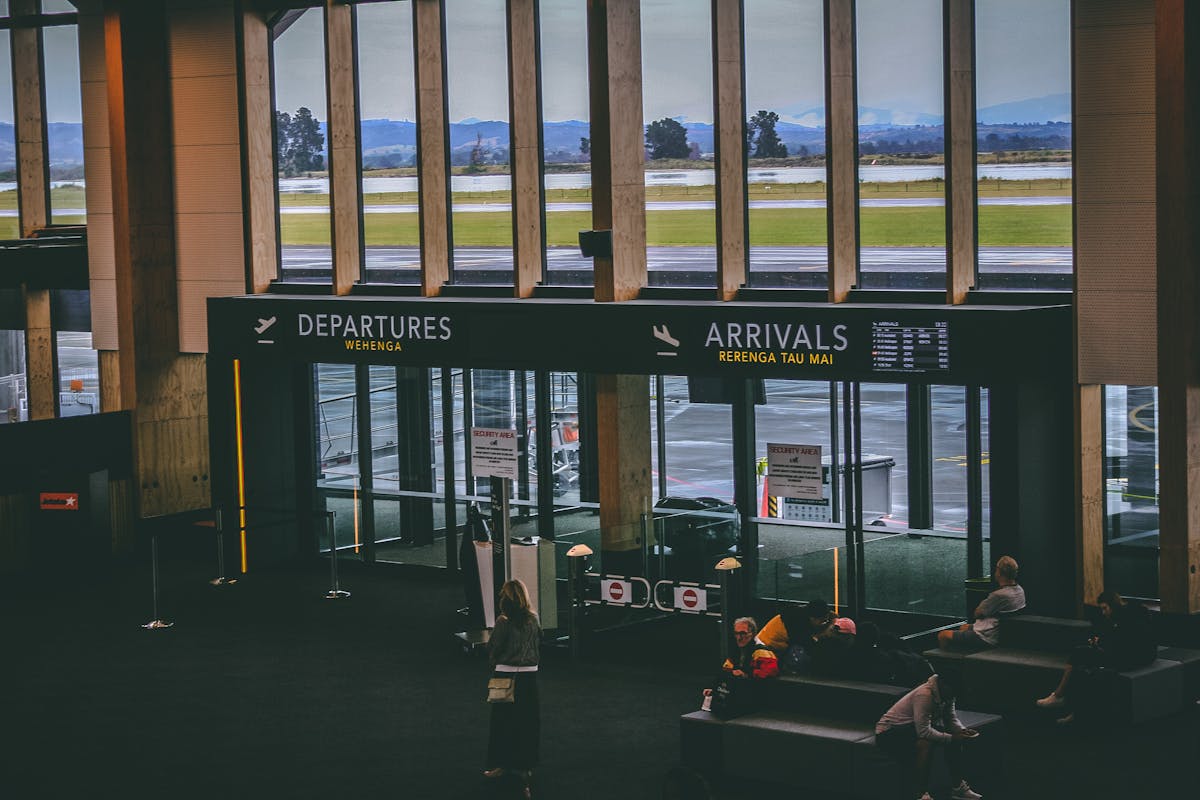
Once past security, you enter the airside area (管制區) with duty-free shops (免稅商店), restaurants (餐廳), cafés, and the departure lounge (候機室). Useful shopping phrases include:
- “Is this tax-free?” (免稅嗎)
- “Can I pay in US dollars?” (付美金)
- “Do you accept credit cards?” (信用卡)
- “How much is this in local currency?” (當地貨幣)
Need to find your boarding gate (登機門)? Ask:
- “Excuse me, where is Gate B12?” (登機門在哪裡)
- “How far is it to Gate C5?” (還有多遠)
- “Is there a shuttle to Terminal 2?” (航廈接駁車) — Large airports often have inter-terminal shuttles or trains.
Boarding Announcements: Airport English Listening (登機廣播英文)
Boarding announcements (登機廣播) are one of the trickiest parts of airport English — they’re fast, echoey (有回音), and blended with background noise. Here are the most common announcements you’ll hear:
- “Flight CI-123 to Tokyo is now boarding at Gate A7.”
- “We are now inviting passengers in rows 25 through 35 to board.”
- “This is the final boarding call for flight BR-456.” — “Final call” (最後登機廣播) means you need to run!
- “Attention passengers: Flight JL-789 has been delayed.”
- “The departure gate for flight AA-100 has been changed to Gate D3.” — Gate changes happen frequently, so keep checking the departure board.
If you can’t understand an announcement, walk to the gate service desk and ask:
- “Has boarding started for flight CI-123?”
- “Is this flight on time?”
- “What time will we start boarding?”
On the Airplane: English Phrases for In-Flight (飛機上英文)
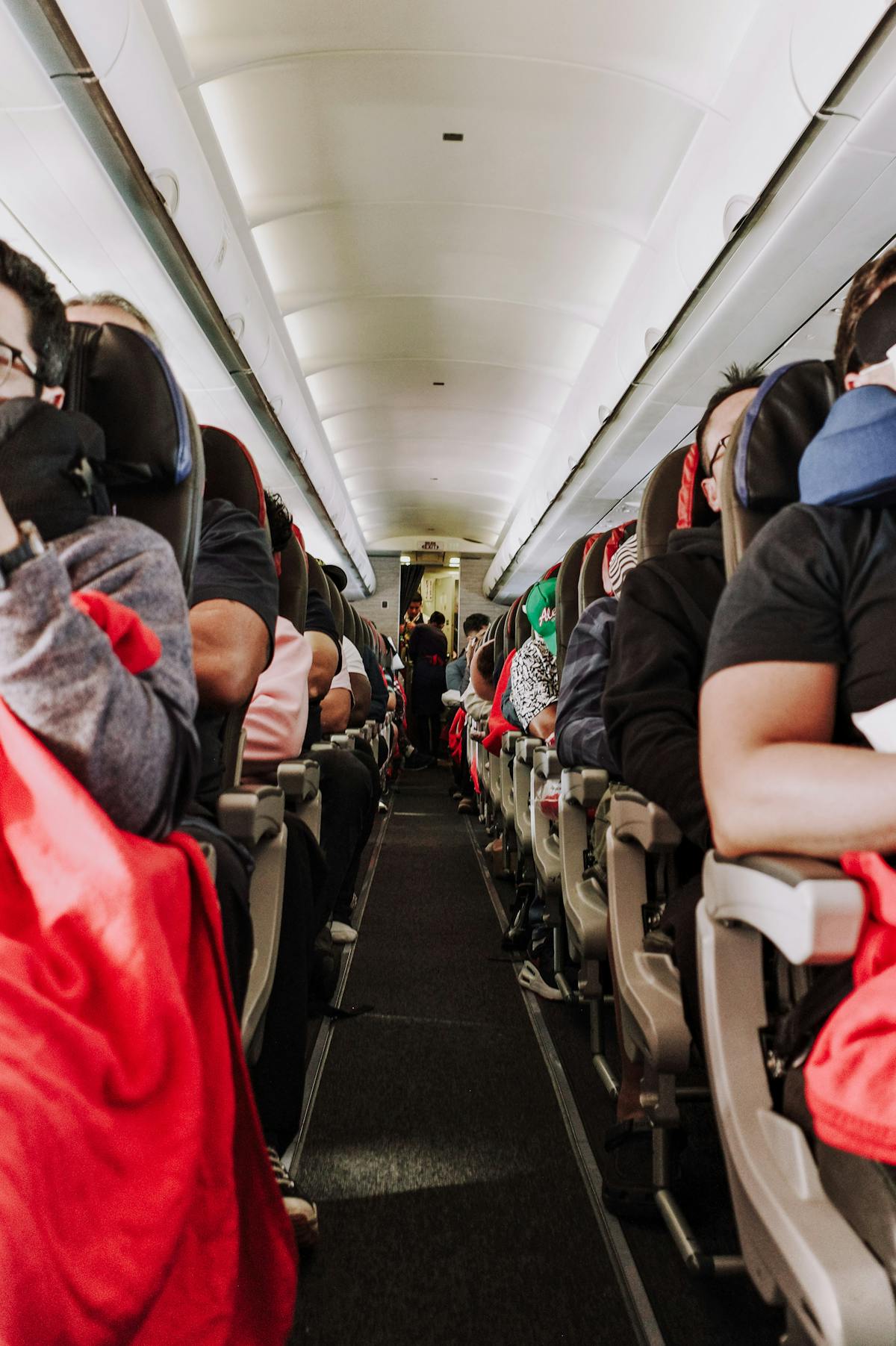
Once you board, you’ll interact with flight attendants (空服員) for everything from finding your seat to ordering meals (餐飲服務). Here are the phrases organized by situation:
Finding your seat and stowing luggage:
- “Excuse me, I think you’re in my seat.” — Check the row number on the overhead panel and your boarding pass.
- “Could you help me put this in the overhead bin?” — Flight attendants are happy to help with heavy bags.
Meal service phrases:
- “Chicken or beef?” (雞肉還是牛肉) — The classic in-flight question you’ll hear on almost every flight.
- “Can I have some water, please?” (請給我水)
- “I ordered a vegetarian meal.” (素食餐) — Special meals (特殊餐點) must be pre-ordered, usually 24-48 hours before departure.
- “Do you have any snacks?” (零食)
Other in-flight requests:
- “Could I get a blanket?” (毯子)
- “Where is the lavatory?” — “Lavatory” is the formal word for the airplane bathroom (飛機洗手間).
- “How much longer until we land?” (降落)
- “I’m feeling a bit airsick.” (暈機) — Flight attendants can bring you an airsickness bag and water.
If you need help at any time, press the call button (呼叫按鈕) above your seat. The flight attendant will come over and ask “How can I help you?”
For a great visual walkthrough of real airport conversations, watch this helpful video:
Connecting Flights and Transit English (轉機英文)
If your itinerary includes a connecting flight (轉機), you’ll need these additional phrases:
- “Where is the transfer desk?” (轉機服務台)
- “I have a connecting flight to London. Where should I go?” (轉機航班)
- “Will my luggage be transferred automatically?” — If your bags are “through-checked” (行李直掛), they go straight to your final destination.
- “My connection is tight. Can you help me get to Gate E15 quickly?” — Staff can sometimes arrange cart transport or priority access.
Key transit vocabulary:
- Layover — a waiting period between flights, typically a few hours
- Stopover — a longer break, usually over 24 hours
- Direct flight (直飛) — no stops between origin and destination
- Transit lounge (轉機候機室) — a waiting area for connecting passengers
- Through-checked (行李直掛) — luggage goes to your final destination without you picking it up at the connection
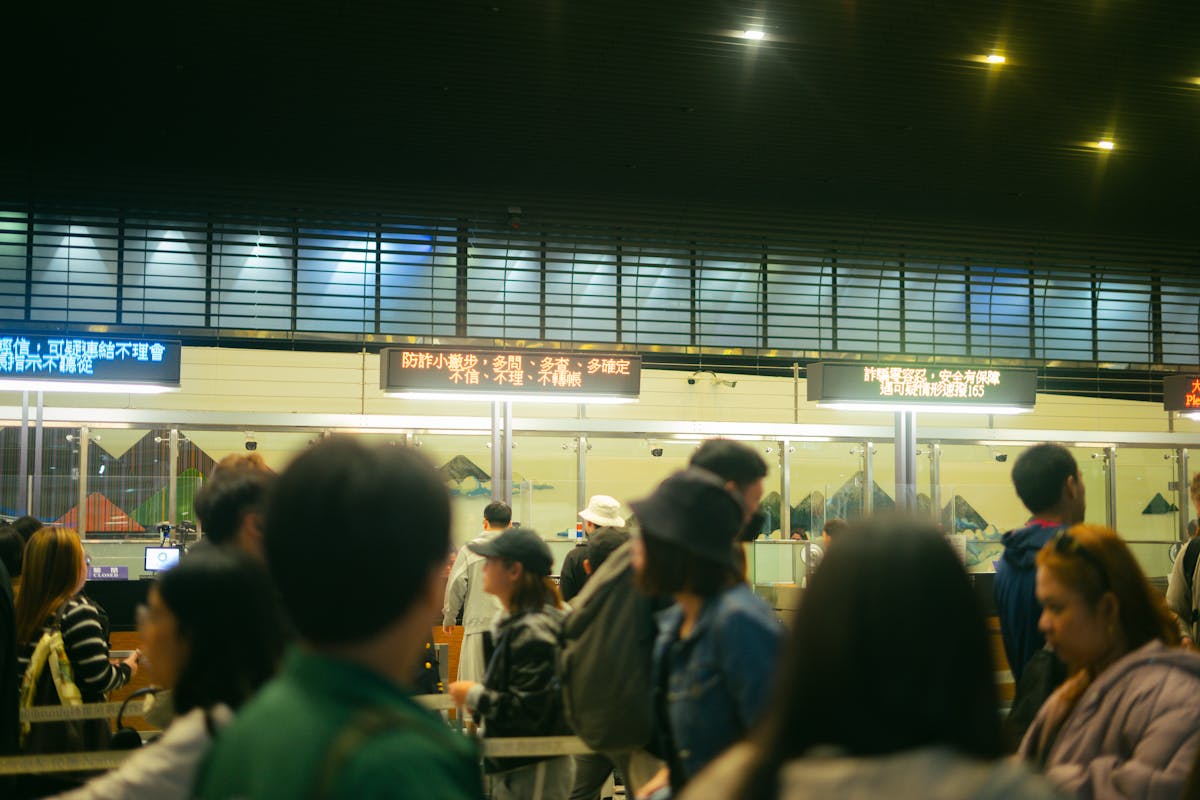
Immigration and Customs English (入境海關英文)
Arriving at your destination (目的地) means passing through immigration (入境審查) and customs (海關). Many travelers feel nervous about this step, but immigration officers (海關人員) ask very standard questions. Keep your answers short, polite, and clear.
Common immigration questions and answers:
- “What is the purpose of your visit?” (此行目的) → “I’m here for sightseeing / on vacation / for business.” (觀光/度假/出差)
- “How long will you be staying?” (待多久) → “I’ll be here for ten days.”
- “Where will you be staying?” (住哪裡) → “I’m staying at the Hilton Hotel in downtown.”
- “Do you have a return ticket?” (回程機票) → “Yes, here it is.” — Show the confirmation on your phone.
Common customs questions:
- “Do you have anything to declare?” (需要申報嗎) → “No, nothing to declare.” or “Yes, I have some gifts.” (禮物)
- “Are you carrying any food, plants, or animal products?” (食物、植物或動物製品)
- “Please open this bag.” (請打開包包)
If you don’t understand something, these two rescue phrases work every time: “Could you repeat that, please?” and “Could you speak more slowly?” Immigration officers are used to working with non-native speakers and won’t mind repeating themselves.
Want to sound more natural in English conversations? Check out our guide on spoken English and how to sound more natural — these tips work just as well at the airport.
Baggage Claim English and Handling Problems (行李提取英文)
After clearing customs, head to the baggage carousel (行李轉盤) to collect your checked bags. Most of the time this goes smoothly, but occasionally luggage gets delayed (行李延誤) or lost (行李遺失). Here’s what to say:
- “Excuse me, my luggage hasn’t come out yet.” (行李還沒出來)
- “I think my bag is missing.” (行李不見了)
- “Where is the lost luggage office?” (遺失行李辦公室)
- “Here is my baggage claim tag.” — This small sticker (行李條) on your boarding pass is your proof of checked bags.
- “My suitcase is damaged. Who should I talk to?”
Need a luggage trolley? Ask: “Where can I find a luggage cart?” In some airports, carts require a coin deposit.
Airport Transportation and Ground Transit English (機場交通英文)
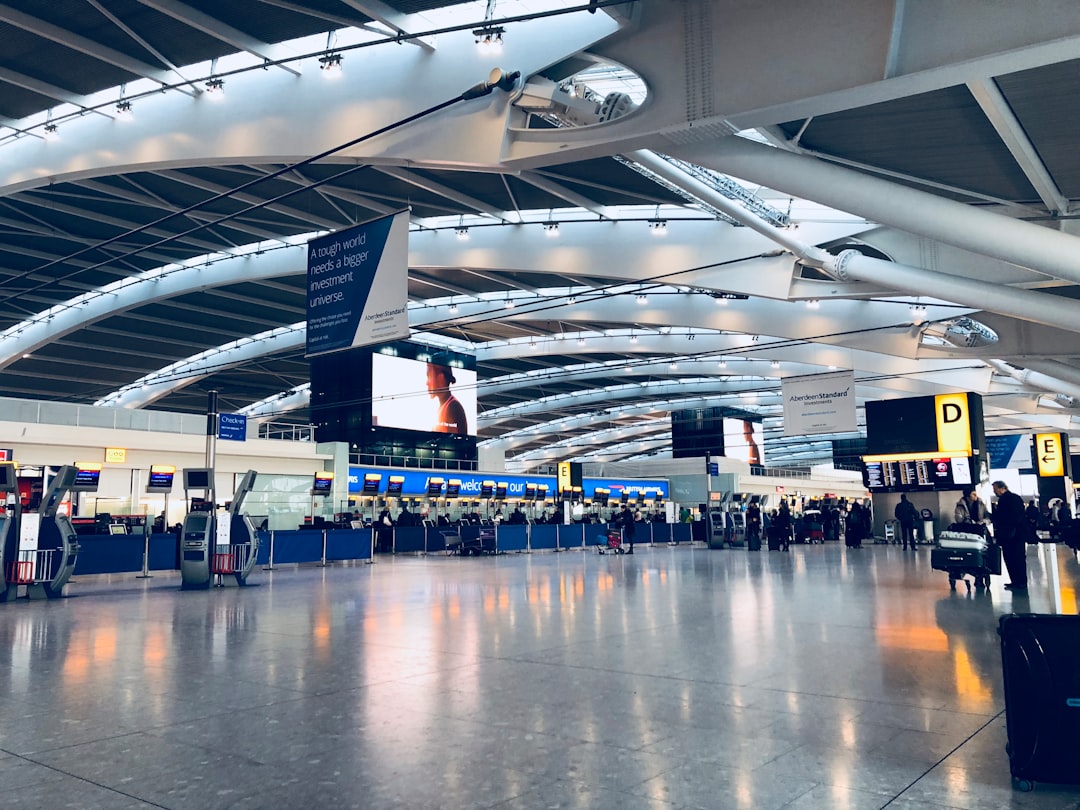
Once you’ve collected your bags, you’ll need ground transportation (機場交通/機場接送) to reach your hotel (飯店) or the city center (市中心). Different airports offer different options — trains, buses, taxis (計程車), and ride-sharing services (共乘服務).
Asking about transportation options:
- “How do I get to the city center from here?” (怎麼去市中心)
- “Where is the taxi stand?” — The taxi stand (計程車招呼站) is usually right outside the arrivals hall.
- “Is there a train or metro to downtown?”
- “How much does the airport shuttle cost?”
- “Where can I rent a car?”
Taking a taxi — useful phrases:
- “Could you take me to this address, please?” (到這個地址) — Showing the address on your phone is the easiest approach.
- “How long will it take to get there?” (要多久)
- “Can you use the meter, please?” (跳錶) — Always ask for the meter to avoid being overcharged.
- “Keep the change.” (不用找了) — A common way to tip (小費) your driver.
- “Can I get a receipt?” (收據)
Ground transportation vocabulary:
- Airport shuttle (機場接駁巴士) — a bus that runs between the airport and key locations
- Taxi stand / Taxi rank (計程車招呼站) — the designated taxi pick-up area
- Ride-sharing (共乘服務) — services like Uber and Grab
- Airport express (機場快線) — a direct train to the city
- Pick-up area (接機區) — where private cars and ride-shares collect passengers
- Drop-off zone (下客區) — where cars stop to let passengers out at departures
At many airports, ride-hailing apps like Uber require you to go to a designated pick-up point. Look for signs reading “Ride App Pick-Up” near the arrivals exit.
Airport Emergencies and Flight Disruptions (機場緊急狀況英文)
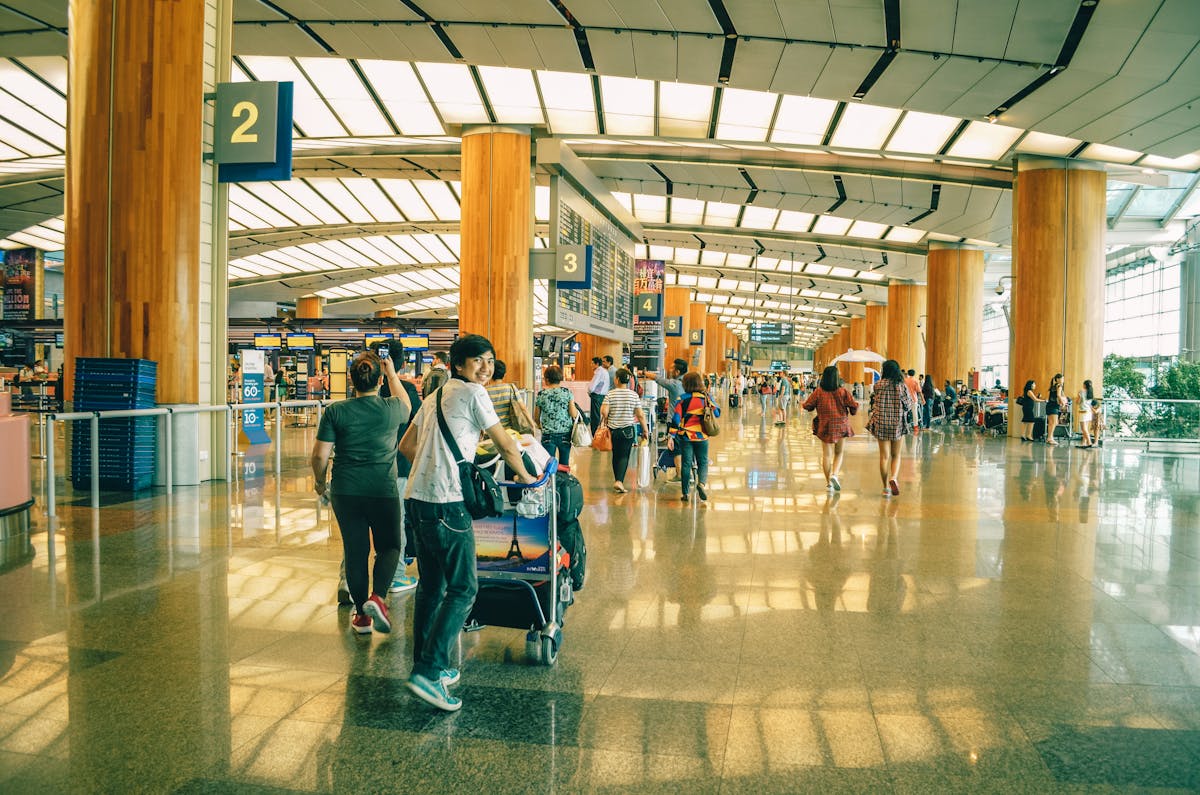
Hopefully you’ll never need these, but knowing emergency airport English (緊急狀況英文) gives you real peace of mind:
- “I missed my flight. What are my options?” (錯過航班)
- “My flight has been cancelled. Can you rebook me?” (航班取消/重新訂位)
- “I lost my passport. Where is the embassy?” (大使館)
- “I need medical assistance.” (醫療協助)
- “Is there a currency exchange nearby?” (換匯)
When flights get delayed or cancelled, airlines usually offer alternatives. Ask:
- “Will you provide accommodation?” (住宿) — For overnight delays, airlines often cover hotel costs.
- “Can I get a meal voucher?” (餐券)
- “When is the next available flight?” (下一班航班)
Knowing some business English phrases can also help you communicate more assertively when dealing with airline staff during disruptions.
5 Practical Tips for Practicing Airport English (練習方法)
Reading this article is a great start, but practice (練習) turns knowledge into confidence (自信). Here are five proven methods:
- Role-play (角色扮演) with a friend: One person plays the ground staff, the other plays the traveler. Practice check-in, security, and immigration dialogues out loud.
- Watch YouTube videos (看影片): Search “airport English conversation” or “travel English” and shadow (跟讀複述) the speakers.
- Switch your airline app to English: Get familiar with words like “check-in,” “boarding pass,” and “flight status” (航班狀態) by using them daily on your phone.
- Make flashcards (單字卡): Write key vocabulary on sticky notes (便利貼) and review them every day for a week before your trip.
- Speak up when you travel (大膽開口): Don’t worry about mistakes! Airport staff communicate with travelers from every country — they’re patient with imperfect English.
Brushing up on your English grammar will also help your airport conversations flow more smoothly.
Remember: you don’t need perfect English at the airport. You just need the right phrases (實用句型) at the right time. Save this guide, review it before your next flight (航班), and your travel experience (旅行體驗) will be noticeably smoother. Keep building your English skills one step at a time — every trip is a chance to practice!
Sources
- IATA Baggage Standards — International Air Transport Association guidelines for carry-on and checked luggage
- BBC Learning English — Free English learning resources for all levels
- British Council Learn English — Vocabulary and grammar exercises for English learners
Looking for free ESL worksheets for your classroom? Browse our free worksheet library →
Are you a teacher? Find lesson resources and worksheets at TahricTeaches.com.




 English
  繁體中文
繁體中文  日本語
日本語  한국어
한국어  ไทย
ไทย  Bahasa Indonesia
  Tiếng Việt
  Français