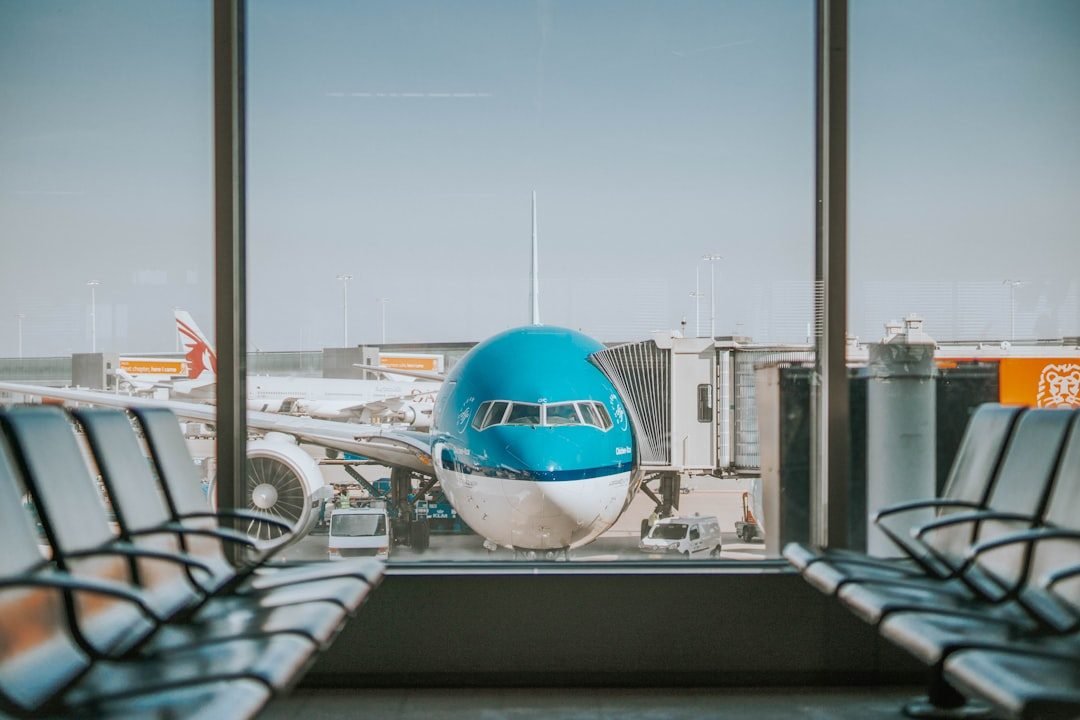
旅遊英文:7 大情境必備會話懶人包|Travel English Phrases (2026)
A check-in agent asks, “Did you pack these bags yourself?” and a surprising number of Taiwanese travelers freeze — not because the words are hard, but because that exact sentence never showed up in any textbook. Travel English fails people in the gaps between situations, not in the vocabulary. The fix is simple: stop memorizing word lists and start memorizing situations. This guide walks through the seven moments where you will actually open your mouth abroad, with the real lines you need for each. By the end you will see that travel needs far less English than you think — it just needs the right English.
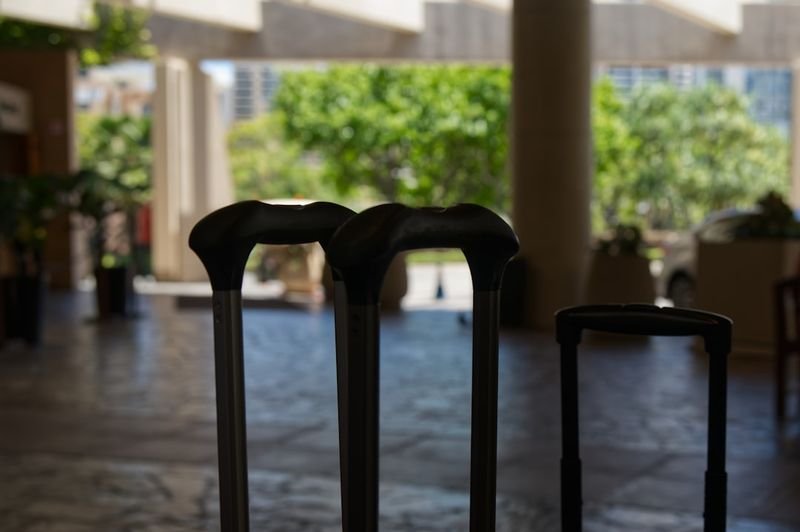
The English starts the moment your bags hit the floor.
Why 100 Sentences Are Enough(為什麼旅遊英文只要 100 句就夠)
A tourist speaks nothing like a businessperson. You are not debating, negotiating a contract, or writing a report. You are asking questions and listening to answers — and the same questions come up over and over. That repetition is why nearly every travel-English guide from Taiwanese platforms like VoiceTube and AmazingTalker lands at around 100 sentences. It is not a coincidence; it is the natural size of a traveler’s vocabulary.
Here is the part most guides skip: the place where Taiwanese travelers actually get stuck is rarely asking the question. It is understanding the answer that comes back. So in every section below, you will find both the lines you say and the replies you are likely to hear. And before anything else, burn one rescue line into memory: “Sorry, could you say that more slowly?“(不好意思,可以說慢一點嗎?). It works in all seven situations, and no native speaker will think you are rude for using it. Honestly, that one sentence will save you more trips than any grammar rule.
Airport Check-in & Boarding(機場報到與登機英文|機場英文)
The airport has the highest density of English on the whole trip, and that scares people. The good news is that counter staff repeat the same handful of lines every single day, and the process never changes. At check-in you are really doing three things: finding the counter, checking a bag, and confirming your gate. Master those and the rest is small talk.
These are the lines that do the heavy lifting:
- Where is the check-in counter for [airline]? — 請問〇〇航空的報到櫃檯在哪?
- I’d like a window seat, please. — 我想要靠窗的位子。(走道是 aisle seat)
- I have one bag to check in. — 我有一件行李要託運。
- Is this within the carry-on limit? — 這個有超過手提行李的限制嗎?
- What’s the boarding gate and time? — 登機門和登機時間是?
The agent will probably ask you a couple of standard security questions: “Did you pack your bags yourself?” and “Any liquids or batteries in your carry-on?” A simple “Yes” or “No” is all they want — these are routine, not an interrogation. The trickier part is the boarding announcements over the speakers. You do not need to catch every word, only the keywords: boarding(登機), final call(最後登機呼叫), and gate change(登機門更改). The second you hear your flight number next to “final call,” it is time to run.
Customs & Immigration(海關與入境英文|海關英文)
“海關英文” gets close to three thousand searches a month in Taiwan, and the reason is obvious: this is one of the few situations where giving the wrong answer can actually cause problems. The reassuring truth is that immigration officers ask only a handful of questions. Prepare your answers in advance and you clear the desk in about thirty seconds.
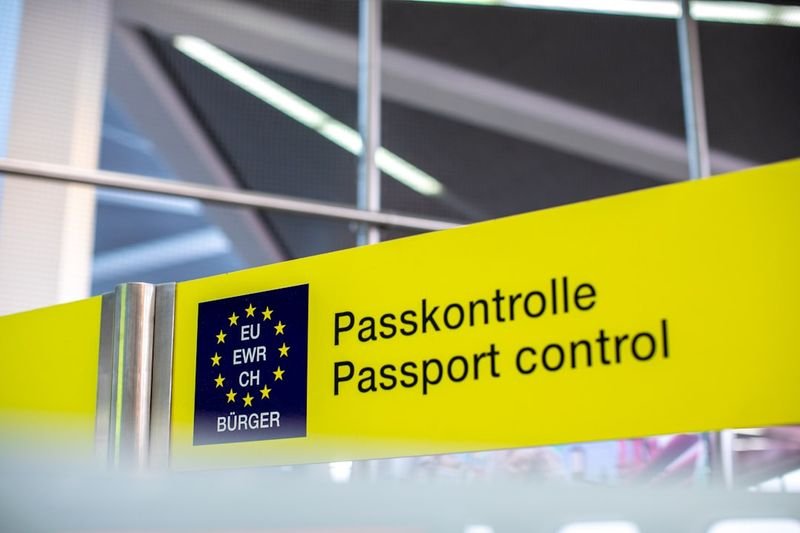
At passport control, a few rehearsed lines move you through fast.
Memorize the officer’s three most common questions and a ready reply for each:
- What’s the purpose of your visit? — 你來這裡的目的是? → answer “Sightseeing.” or “Just traveling.“
- How long will you stay? — 你會待多久? → “About a week.“
- Where will you be staying? — 你住哪裡? → “At a hotel in [city].“
The only thing you usually need to say on your own is about declaring goods: “I have nothing to declare.“(我沒有東西要申報). If you are carrying over the limit on alcohol, cigarettes, or cash, saying “I’d like to declare this” is the safe move — honesty costs you a minute, hiding it costs you a fine. One classic mistake from Taiwanese travelers: translating 玩 directly and saying “I came here to play.” It sounds odd to an officer. The natural words are sightseeing ou vacation.
Hotel & Accommodation(飯店住宿英文|飯店英文)
The hotel front desk is often the first place you string together a full English sentence, but the staff are trained and usually speak at a friendly pace. Three moments matter here: checking in, asking for something, and checking out. Get comfortable with those and a hotel stay runs itself.
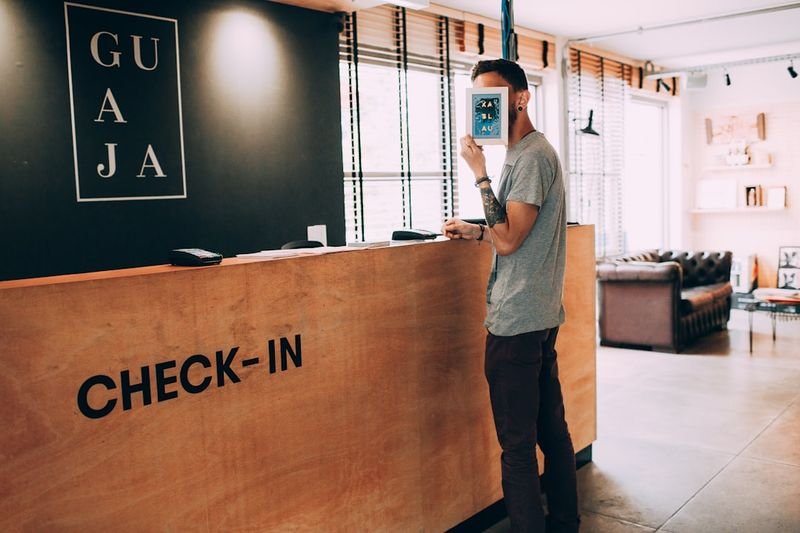
Hotel check-in is where most travelers use their first full English sentences.
The phrases that cover almost every interaction:
- I have a reservation under [your name]. — 我用〇〇的名字訂了房。
- What time is check-out? — 退房時間是幾點?
- Is breakfast included? — 有含早餐嗎?
- Could I have a wake-up call at 7? — 可以幫我設七點的 morning call 嗎?
- The air conditioning isn’t working. — 冷氣壞了。(swap in Wi-Fi or hot water)
- Can I leave my luggage here after check-out? — 退房後可以寄放行李嗎?
Watch out for one very common piece of Chinglish here. Taiwanese learners often say “I want to open the air conditioner,” but in English you turn on an appliance — you never “open” it. That direct-translation trap shows up everywhere abroad, and we break down a whole list of them in our guide to English collocation mistakes from Chinese. It is worth a five-minute read before you fly.
Restaurant & Ordering(餐廳點餐英文|點餐英文)
Ordering food makes a lot of people nervous, yet it is probably the easiest situation of them all — because the whole thing follows four fixed steps: get seated, look at the menu, order, and pay. The sentences barely change from one restaurant to the next, anywhere in the world.

Ordering in English is mostly the same five sentences, everywhere you go.
From the door to the bill:
- A table for two, please. — 兩位,謝謝。
- Could we see the menu? — 可以給我們菜單嗎?
- What do you recommend? — 你推薦什麼?(the rescue line when nothing looks familiar)
- I’ll have the [dish]. — 我要〇〇。(more natural and polite than “I want”)
- Can I get this without [ingredient]? — 這個可以不要加〇〇嗎?(essential for allergies)
- Could we get the check, please? — 可以結帳嗎?(British English: the bill)
The server will likely come over and ask, “Are you ready to order?” If you are not, just say, “Could we have a few more minutes?” One thing to settle before you go: tipping. The United States generally expects 15–20%, while Japan and Taiwan expect nothing at all, so check the local norm to avoid either overpaying or causing offense. If a fast-talking server is hard to follow, the fix is more listening practice — our guide to English listening methods is built for exactly that.
Transport & Taxis(交通與計程車英文|交通英文)
Getting around is less about speaking well and more about two things: making your destination crystal clear, and confirming the price before you commit. Save the address or a landmark on your phone first — showing a screen removes half the communication problem in one move.
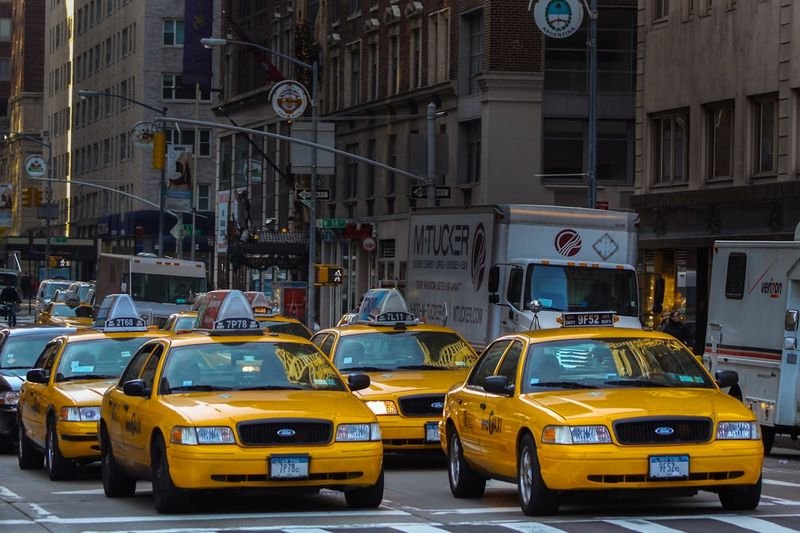
Telling a driver where you want to go is its own small skill.
- Take me to this address, please. — 請載我到這個地址。(just show the screen)
- How much is it to [place]? — 到〇〇大概多少錢?
- Do you use the meter? — 你有跳表嗎?(the line that prevents being overcharged)
- Which platform for the train to [city]? — 往〇〇的火車在哪個月台?
- Does this bus stop at [place]? — 這班公車有到〇〇嗎?
- Could you let me know when we get there? — 到的時候可以提醒我嗎?
Pick up a few subway keywords while you are at it: single ticket(單程票), day pass(一日票), transfer(轉乘), and last train(末班車). In a lot of cities a day pass is cheaper than buying single rides all day, so a quick “Is there a day pass?” can quietly save you real money. The drivers and station staff hear these questions hundreds of times a week — you will not surprise anyone.
Asking for Directions(問路與迷路時的英文|問路英文)
The hard part of asking for directions is not the question — it is decoding the answer. Someone fires back a rapid string of lefts, rights, and blocks, and your brain goes blank halfway through. The trick is to ask, then immediately repeat the directions back in your own words to confirm before you walk off.

When you’re lost, the question matters less than understanding the answer.
- Excuse me, how do I get to [place]? — 不好意思,請問怎麼去〇〇?
- Is it within walking distance? — 走路到得了嗎?
- Could you show me on the map? — 可以在地圖上指給我看嗎?(the most reliable line of all)
- So, I go straight and turn left? — 所以是直走再左轉對嗎?(repeat to confirm)
To understand the reply, get comfortable with a small set of direction words: go straight(直走), turn left/right(左/右轉), next to(在……旁邊), across from(在……對面), and two blocks away(兩個街區外). The moment you hear “block,” you know they are counting street segments. And if it all falls apart, pull up a map and say, “Could you show me?” — pointing at a screen is the closest thing to a guaranteed win in any language.
Shopping & Currency Exchange(購物與換匯英文|換匯英文)
Shopping and money lines are short, but they touch your wallet, so they are worth knowing cold. The priorities are asking the price, bargaining where it is acceptable, and confirming the exchange rate and any fees before you hand over cash.
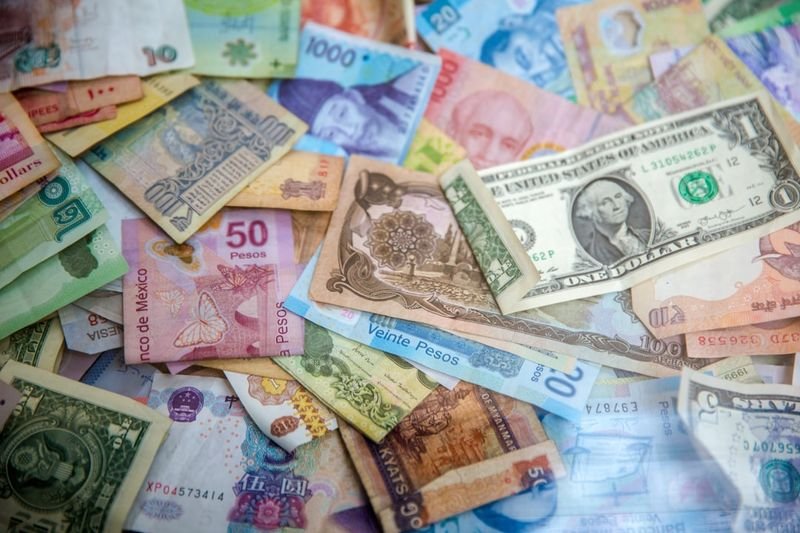
Currency exchange and shopping have a short, predictable script.
- How much is this? — 這個多少錢?
- Can I try this on? — 可以試穿嗎?
- Do you take credit cards? — 可以刷卡嗎?
- Can I get a tax refund? — 可以退稅嗎?(the line that saves tourists real money)
- What’s the exchange rate today? — 今天匯率多少?
- Is there a commission fee? — 有手續費嗎?
Always ask about the commission fee when changing money — some booths advertise a beautiful rate and then claw it back in fees. In a market, “Can you do a better price?” tends to work better than hard haggling, and it stays polite. Tax refunds are common for tourists across Europe and Japan, so look for the Tax Free sign, ask at the register, and you will recover a chunk of what you spent.
Travel Vocabulary Cheat Sheet(旅遊英文單字總整理)
Here is the core vocabulary from every section above, pulled into one table. Scan it before you leave, and the words will already feel familiar when you land.
| Situation | Anglais | Chine |
|---|---|---|
| Airport 機場 | boarding pass | 登機證 |
| Airport 機場 | carry-on / checked baggage | 手提 / 託運行李 |
| Customs 海關 | declare | 申報 |
| Customs 海關 | passport control | 護照查驗 |
| Hotel 飯店 | reservation | 訂房 |
| Hotel 飯店 | check-in / check-out | 入住 / 退房 |
| Restaurant 餐廳 | the check / the bill | 帳單 |
| Restaurant 餐廳 | tip | 小費 |
| Transport 交通 | round trip / one way | 來回 / 單程 |
| Transport 交通 | plate-forme | 月台 |
| Directions 問路 | intersection | 十字路口 |
| Shopping 購物 | tax refund | 退稅 |
| Exchange 換匯 | exchange rate | 匯率 |
5 Mistakes Taiwanese Travelers Make(台灣人最常說錯的 5 個旅遊英文)
Here is my honest take: for most Taiwanese travelers, the English barrier is not “I don’t know the words.” It is translating Chinese word-for-word into English. These five slips trip people up abroad more than anything else, and every one is a quick fix.
- “Open the light / air conditioner.” You turn on an appliance — never “open” it. This is the single most common Chinglish error abroad.
- Saying “Give me money” at the table. To pay, you ask for the check, please. “Give me money” is what a tip sounds like in reverse — it confuses servers.
- Asking “How to go to…?” The correct question is How do I get to…?. “How to” cannot stand alone as a question.
- Calling sightseeing “play.” Adults go sightseeing ou travel; “play” is what children do. At customs especially, use sightseeing.
- Nodding and saying “yes” when you didn’t understand. This is the dangerous one. If you are lost, say Sorry, I don’t understand. Nobody will judge you, and you avoid agreeing to something you didn’t mean.
My advice? Instead of spending three months trying to polish your accent to sound native, spend three days killing these five mistakes. The payoff is immediate. The goal of travel English is successful communication, not a perfect score on a test.
Video: 130 Travel English Sentences in Context(影片教學)
If you want to hear the pronunciation while you learn, this video runs through 130 must-know sightseeing sentences on a loop. Half an hour a day in the week before your trip is a great way to train your ear.
Your Pre-Trip Checklist(出國前的最後一步)
Pick three lines from each of the seven situations, drop them into your phone’s notes, and review them once in the departure lounge before you board. That beats cramming vocabulary the night before by a mile, because almost every moment that trips you up abroad lives somewhere in this guide. Next time you fly, don’t worry about whether your English is good enough — carry this list and speak up with confidence. The best parts of travel tend to show up right after you work up the nerve to say your first English sentence out loud. And if you want to build a stronger foundation underneath all of this, browse more of our English learning articles and stack one small win at a time.
Sources(資料來源)
- British Council — LearnEnglish — Free situational English conversation and listening practice.
- Dictionnaire de Cambridge — The authority for checking natural word collocations and usage.
- VoiceTube — 旅遊英文 100 句懶人包 — A Taiwan-focused reference for travel English by situation.
Looking for free ESL worksheets for your classroom? Browse our free worksheet library →
Are you a teacher? Find lesson resources and worksheets at TahricTeaches.com.




 Français
  English
  繁體中文
繁體中文  日本語
日本語  한국어
한국어  ไทย
ไทย  Bahasa Indonesia
  Tiếng Việt