

Phone English Phrases: 40 Essential Lines for Work | 電話英文 (2026)
Roughly 70% of the Taiwanese office workers I’ve taught say the phone is the single scariest part of using English at work — scarier than meetings, scarier than email. There’s no body language, no time to look up a word, and the caller often speaks fast. The good news: business calls are surprisingly formulaic. The same twenty or thirty phone English phrases cover the vast majority of calls you’ll ever take. Learn those, rehearse them out loud, and the panic fades. This guide gives you 40 of them, grouped by the exact moment you’ll need each one, plus a full sample call and the five mistakes I hear most often from speakers in Taipei.
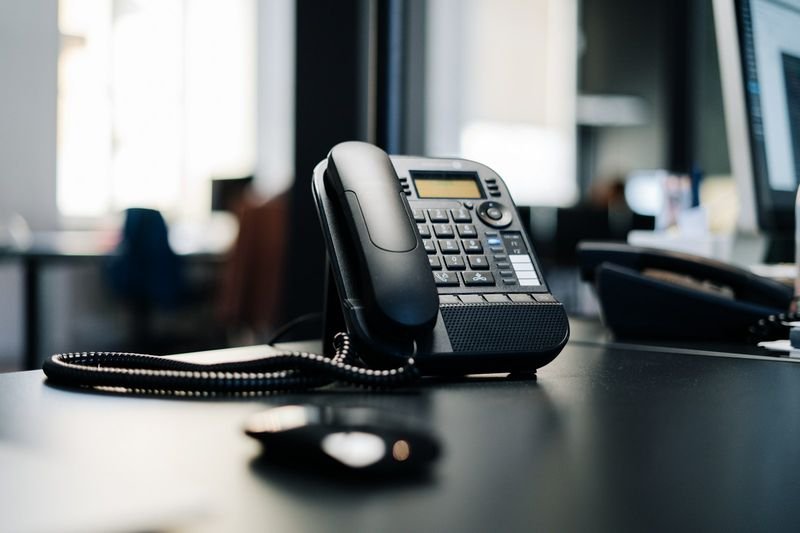
The office phone still rings — and the right phone English phrases keep you calm when it does.
Why Phone English Phrases Feel Harder Than Talking in Person (電話英文為什麼更難)
Take away the face and you take away about half of what makes English easy to follow. On a call you lose lip movement, facial expression, and gesture — the exact cues that help you guess an unfamiliar word. You’re also working under time pressure: silence on a phone line feels much longer and more awkward than a pause across a desk. That’s why memorising a small bank of phone English phrases works so well. When your mouth already knows what to say for “answer the call” or “put someone on hold,” your brain is free to actually listen to the caller instead of scrambling for words.
There’s a mild opinion I’ll defend here: fluency is the wrong goal for the phone. Clarity is the goal. A slow, clear “One moment, please — I’ll check for you” beats a fast, mumbled sentence every single time. Callers don’t grade your grammar. They just want to be understood and helped.
Answering the Phone in English (接電話的第一句)

Answering the phone in English: lead with your company name, then your own name.
Your opening line does two jobs — it tells the caller they reached the right place, and it sets a professional tone in under three seconds. The standard structure is company name, then your name, then an offer to help. Pick one of these and make it automatic:
- “Good morning, ABC Trading. This is Amy speaking. How can I help you?”
- “Thank you for calling ABC Trading. Amy speaking.”
- “Hello, Sales Department. This is Amy. How may I help you?”
- “ABC Trading, good afternoon. How can I direct your call?”
For internal calls between colleagues you can drop the company name and simply say “Hi, this is Amy from Sales.” Notice that “How may I help you?” sounds a touch more formal than “How can I help you?” — both are correct, so match the tone of your workplace.
Asking Who’s Calling and Why (詢問來電者身分)
Before you transfer anyone or hand over information, you need to know who you’re talking to. The trick is doing it politely — a blunt “Who are you?” sounds rude in English even though the direct translation feels normal in Chinese. Soften it:
- “May I ask who’s calling, please?”
- “Could I take your name, please?”
- “And which company are you calling from?”
- “May I ask what this is regarding?”
That last phrase — “what this is regarding” — is your polite way of asking “why are you calling?” It buys you time to decide whether to transfer the call or take a message. If you don’t catch the name, don’t pretend you did. “Sorry, could you spell that for me?” is completely professional and far better than transferring a call to the wrong person.
Transferring a Call and Asking Someone to Hold (轉接與請稍候)
Transferring cleanly is one of the most-used phone English skills in any office.
Transferring feels risky because you’re juggling two things at once: keeping the caller happy and getting them to the right person. Announce what you’re doing before you do it, so the caller isn’t left wondering if they’ve been cut off. These are the workhorses:
- “One moment, please. I’ll put you through to Mr. Chen.”
- “Let me transfer you to the right department.”
- “Could you hold the line for a moment, please?”
- “Thanks for waiting. I’m connecting you now.”
If the person they want is unavailable, say so clearly and offer a next step in the same breath: “I’m afraid Mr. Chen is in a meeting right now. Can I take a message, or would you like his voicemail?” Giving the caller a choice keeps you in control of the conversation instead of leaving an awkward gap.
Taking and Leaving Messages (留言與傳話)

Always repeat names and numbers back to the caller to confirm every detail.
Messages are where small mistakes turn into big problems — a wrong digit in a phone number or a misspelled name can cost a deal. Whether you’re taking a message or leaving one, the golden rule is to confirm everything by repeating it back. Use these:
- “Can I take a message?”
- “Could you tell him that Amy from ABC called?”
- “Let me read that back to you: 0912-345-678, is that right?”
- “I’ll make sure she gets the message.”
When you leave a message yourself, keep it short and end with a clear action: “Hi, this is Amy from ABC Trading. Could you please call me back at 02-1234-5678? Thank you.” State your name and number slowly — the person writing it down is under the same pressure you feel when the roles are reversed.
When You Can’t Hear or Don’t Understand (聽不清楚怎麼辦)
This is the moment learners fear most, and it’s also the most solvable. Pretending you understood is the worst option — it leads to wrong orders and lost information. Asking someone to repeat themselves is normal, native speakers do it constantly, and there’s a polite phrase for every version of the problem:
- “Sorry, I didn’t catch that. Could you say it again?”
- “Could you speak up a little? The line is bad.”
- “Would you mind speaking more slowly, please?”
- “I think we have a poor connection — can I call you back?”
One skill worth practising on its own: spelling out names and email addresses using the phonetic alphabet. When a name is hard to hear, native speakers say “B as in Bravo, D as in Delta.” Learning the NATO phonetic alphabet takes an afternoon and instantly makes you sound like a seasoned professional on the phone. It’s the same system airlines and hotels use worldwide.
Handling Difficult or Angry Callers (處理不好應付的來電)

Practising tricky calls with a colleague builds confidence before a real complaint comes in.
An upset caller is a language test and an emotional test at the same time. Your goal isn’t to win the argument — it’s to lower the temperature and move toward a solution. English has a set of “de-escalation” phrases that signal you’re on the caller’s side without necessarily admitting fault:
- “I understand your concern, and I’m sorry for the trouble.”
- “Let me see what I can do to help.”
- “I’ll look into this right away and get back to you.”
- “I completely understand. Let’s sort this out together.”
Never say “That’s not my problem” or “You have to…” — both sound aggressive in English and will make things worse. If you genuinely can’t solve the issue, hand it off gracefully: “This is best handled by our support team. May I transfer you, or take your number so they can call you back?”
Ending the Call Professionally (禮貌地結束通話)
The last ten seconds shape how the caller remembers the whole conversation. A rushed goodbye undoes a great call, while a warm close leaves a good impression even after a difficult one. Wrap up by confirming any next steps, then thank them:
- “Is there anything else I can help you with?”
- “Great — I’ll send that over by email this afternoon.”
- “Thanks for calling. Have a great day.”
- “It was nice speaking with you. Take care.”
Resist the urge to hang up the second business is done. A quick “Thanks for your patience” or “Talk to you soon” costs one second and makes you sound genuinely professional rather than transactional.
A Full Sample Phone Call in English (完整電話對話範例)

Short sentences and a steady pace do more for clarity than a big vocabulary.
Here’s how the phrases fit together in a realistic call. Notice how short each line is — real business calls are rarely made of long, complicated sentences.
Amy: “Good morning, ABC Trading. This is Amy speaking. How can I help you?”
Caller: “Hi, this is David Lin from Global Tech. Could I speak to Mr. Chen, please?”
Amy: “May I ask what this is regarding?”
Caller: “It’s about our order from last week.”
Amy: “Of course. One moment, please — I’ll put you through to Mr. Chen… I’m sorry, he’s on another call right now. Can I take a message?”
Caller: “Sure. Could you ask him to call me back at 02-8765-4321?”
Amy: “Let me read that back: 02-8765-4321. Is that correct?”
Caller: “That’s right.”
Amy: “Great, I’ll make sure he gets the message. Is there anything else I can help you with?”
Caller: “No, that’s all. Thank you.”
Amy: “Thanks for calling, Mr. Lin. Have a good day.”
Read that dialogue out loud three times. Say it once as Amy, once as the caller, then again as Amy. Speaking the phrases — not just reading them — is what moves them from your notebook into your mouth. If you’re also preparing for interviews, the same read-aloud method works for our guide to the entretien d'embauche en anglais.
5 Mistakes Taiwanese Speakers Make on English Calls (台灣人常犯的5個錯誤)
After two decades of teaching in Taipei, the same handful of habits trip people up on the phone again and again. None of them are about grammar — they’re about instinct. Here’s what to watch for, and what to do instead:
| Common habit (常見習慣) | Say this instead (改成這樣說) |
|---|---|
| “Who are you?” (too direct) | “May I ask who’s calling?” |
| “Wait.” (sounds like an order) | “One moment, please.” |
| “What?” when you mishear | “Sorry, could you repeat that?” |
| “I don’t know.” (dead end) | “Let me find out for you.” |
| Hanging up with no closing line | “Thanks for calling. Have a good day.” |
The pattern behind all five: English phone etiquette rewards softeners like “please,” “may I,” and “sorry.” Chinese phone culture is often more direct, and that directness, translated word-for-word, can land as cold or rude in English. Adding one softening word fixes almost every case. If you enjoy this kind of nuance, our breakdown of business idioms for the workplace covers more of the unwritten rules.
How to Practise Phone English Phrases This Week (本週如何練習)
Knowing the phrases and being able to produce them under pressure are two different things. Give yourself a week of tiny drills. Record a voicemail greeting for yourself in English and listen back — you’ll hear exactly where you rush. Call an English-speaking hotline, such as an airline or a hotel booking line, and practise a real, low-stakes exchange. Or rehearse the sample dialogue above with a study partner, swapping roles each round. Fifteen minutes a day for a week does more than a whole textbook chapter. For structured speaking practice tied to a test, our Guide de préparation au TOEIC includes a listening-and-speaking routine that transfers directly to the phone.
Foire aux questions (常見問題)

A warm final line leaves the caller with a good impression of you and your company.
How do I answer the phone politely in English?
Lead with your company name, then your own name, then an offer to help: “Good morning, ABC Trading. This is Amy speaking. How can I help you?” That single line covers you for almost any incoming business call.
What do I say when I can’t understand the caller?
Ask them to repeat or slow down — it’s completely normal. “Sorry, I didn’t catch that. Could you say it again, please?” or “Would you mind speaking a little more slowly?” No native speaker will judge you for it.
How do I ask someone to hold in English?
“One moment, please” or “Could you hold the line for a moment?” Always tell the caller what’s happening before you mute or transfer them, so the silence doesn’t feel like a dropped call.
How can I sound more confident on English calls?
Slow down and use short sentences. Confidence on the phone comes from having your opening and closing lines memorised, so your attention is free to listen. Rehearse the sample dialogue above out loud until it feels automatic.
Watch: Telephone English in Action
Sources
- FluentU — 58 Common Phrases for Business Telephone Calls in English — reference list of standard business call phrases.
- Business English Pod — Telephone English lessons — audio lessons on answering, transferring, and ending calls.
- NATO Phonetic Alphabet (ICAO) — the standard spelling alphabet used for clarifying names and codes on calls.
Looking for free ESL worksheets for your classroom? Browse our free worksheet library →
Are you a teacher? Find lesson resources and worksheets at TahricTeaches.com.






 Français
  English
  繁體中文
繁體中文  日本語
日本語  한국어
한국어  ไทย
ไทย  Bahasa Indonesia
  Tiếng Việt