
Presentation English: 35 Phrases for Taiwan Pros (2026) | 簡報英文必備句型
The first 30 seconds of a presentation in English decide whether the room listens or starts checking Slack. For Taiwan professionals presenting to head office in Singapore, a sales prospect in California, or a hybrid Zoom room of regional leads, the words you reach for in those 30 seconds — and again at the close — matter as much as the slides themselves. Presentation English isn’t about sounding like a TED speaker. It’s about having ready-made phrases that signal structure, confidence, and respect for the audience’s time.
This guide gives you 35 presentation English phrases (簡報英文必備句型), grouped by where they fit in your talk: opening, self-intro, signposting, data, questions, and close. Memorise the categories that scare you most, write them on flashcards, and rehearse them out loud — not silently in your head.
Why Presentation English Matters for Taiwan Professionals | 為什麼簡報英文這麼重要
Walk into any Taipei office tower at 10 a.m. and you’ll hear the same thing in three or four languages: a quarterly review, a new product pitch, an internal training. English is the lingua franca of most of those meetings — not because anyone in the room is a native speaker, but because the slide deck has to travel to Tokyo, Seoul, and Sydney by Friday. Strong presentation English (簡報英文) is the single fastest way to be taken seriously beyond Taiwan’s borders.
The honest truth is that most Taiwanese presenters lose the room not on grammar but on transitions. A presenter who uses one clear signposting phrase between each section — “Let’s move on to…”, “That brings me to…” — sounds twice as senior as someone with perfect vocabulary and zero structure. Phrases are scaffolding, not decoration.

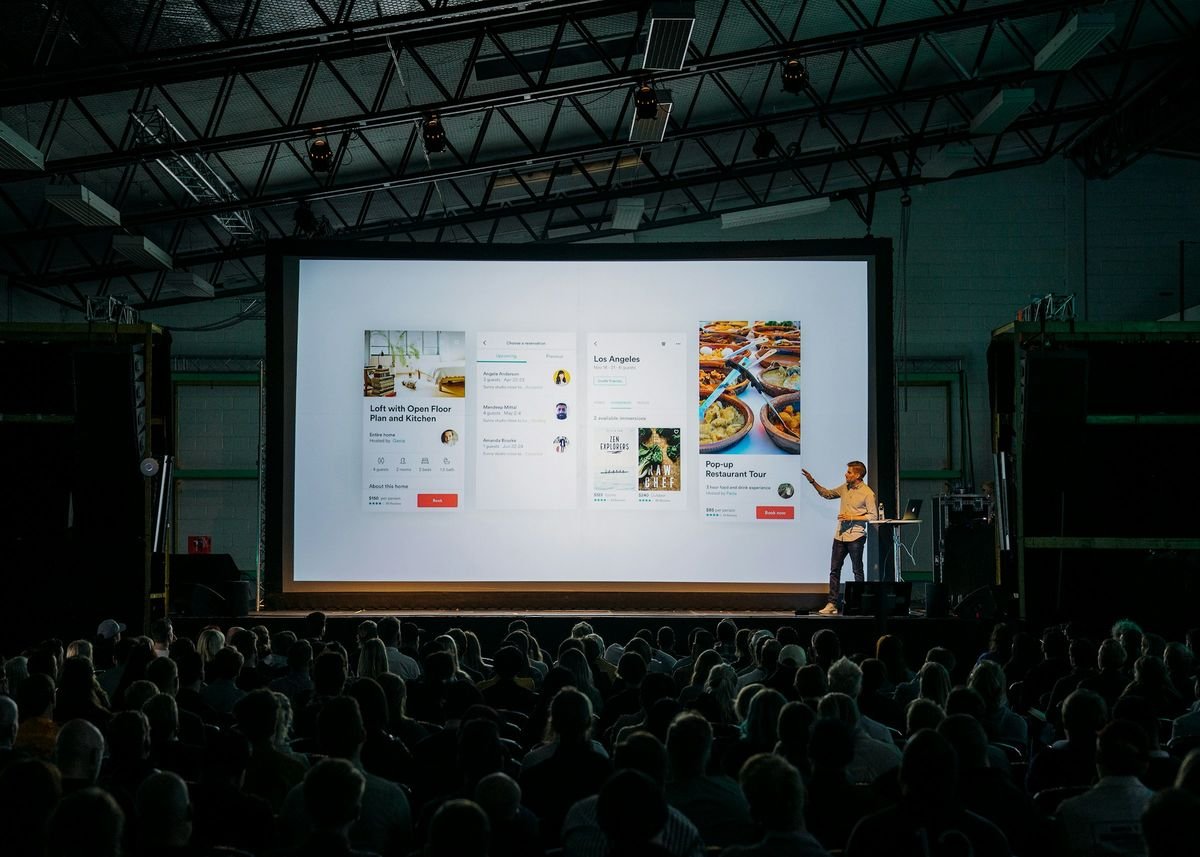
A clear opening sets the tone for the whole presentation.
6 Opening Phrases | 簡報開場必備句型
Your first 30 seconds set the mood, the volume, and the audience’s expectation of how organised you are. Skip the throat-clearing (“um, okay, so…”) and start with a phrase that commits. Practice these openers until they feel boring — boring is the point. You want the audience focused on your message, not your nerves.
- “Good morning, everyone. Thanks for making time today.” — 大家早安,感謝撥空出席。Warm, professional, works in person or on Zoom.
- “I’d like to start by thanking you all for coming.” — 一開始想先謝謝大家的出席。Slightly more formal; good for client meetings or external audiences.
- “Before we dive in, a quick housekeeping note…” — 在開始之前,先說明幾件小事。Use this to flag Q&A timing, slide handouts, or recording.
- “Let me kick things off with a quick story.” — 我先以一個小故事開場。Storytelling opens engage 30% better than data-led openings, according to Harvard Business Review.
- “By the end of this session, you’ll walk away with three things.” — 簡報結束時,你會帶走三個重點。Frames the entire talk; the audience now knows what to listen for.
- “I’m going to keep this tight — 15 minutes, then questions.” — 我會控制在15分鐘以內,後續開放提問。Promising a time budget signals respect and competence.
Skip generic questions like “How is everyone today?” That phrase is the verbal equivalent of awkward small talk and the room can smell it.
4 Self-Introduction and Topic Phrases | 自我介紹與主題介紹
The audience needs to know who you are and why they should listen to you on this topic — in under 20 seconds. Don’t read your job title off the slide; tell them why your title matters to them.
- “I’m [Name], and I lead [team/function] at [company].” — 我是…,負責…。Crisp, no fluff.
- “For the past [X] years, I’ve been working on…” — 過去X年來,我一直在做…。Establishes credibility through experience, not titles.
- “Today I’d like to talk to you about [topic].” — 今天我想跟各位分享的是…。Classic, clean topic framing.
- “My goal today is to convince you that…” — 我今天的目標是說服各位…。Bold and specific — perfect when you’re pitching a decision, not just informing.
If you need a longer opening, our 1-minute English self-introduction script walks through the full structure step by step.

Your slides carry the visuals — your phrases carry the structure.
8 Signposting and Transition Phrases | 段落轉換用語
This is where 90% of presentations break down. Without signposts, the audience can’t tell when one idea ends and the next begins. With them, even a so-so deck feels well-organised. Treat presentation transitions as road signs: short, frequent, unmissable.
- “Let’s move on to the next point.” — 接下來,我們進入下一個重點。The workhorse transition. Use it without apology.
- “That brings me to my second point…” — 這就帶到我的第二個重點…。Connects naturally to the previous idea.
- “Building on that…” — 接續這個想法…。Signals that the new point depends on the previous one.
- “On the other hand…” — 另一方面…。Introduces a contrast or counterpoint cleanly.
- “To put that into context…” — 換個角度來看…。Used when adding background or comparison.
- “As I mentioned earlier…” — 如同我剛才提到的…。Callbacks help the audience track the through-line.
- “Let me give you a concrete example.” — 我舉個具體的例子。Stops the abstract drift and re-engages the room.
- “Now, here’s where it gets interesting.” — 接下來才是重點。A confident, slightly conversational transition that wakes people up.
5 Phrases for Presenting Data | 介紹圖表與數據
Data slides are where Taiwanese presenters often over-explain — reading every cell of the table out loud — or under-explain, flipping past a chart in five seconds. The right phrases force you to tell the audience what the data means, not just what it shows.

Don’t read every number — tell the audience what the data means.
- “As you can see from this chart…” — 各位從這張圖可以看到…。Standard opener for any visual.
- “The key takeaway here is…” — 這裡最關鍵的結論是…。Forces you to spell out the insight, not bury it.
- “If we compare X to Y, we notice that…” — 如果比較X和Y,會發現…。Frames comparative analysis cleanly.
- “This represents a [percentage] increase year-on-year.” — 這代表年增長百分之…。Specific, quantitative, hard to argue with.
- “What’s particularly striking is…” — 特別值得注意的是…。Signals “the audience should remember this number.”
Here’s a clean walkthrough from Your Favorite English Teacher on Amy Joy’s channel — 20 must-know presentation phrases delivered slowly enough for ESL learners to copy:
4 Phrases for Mid-Presentation Questions | 簡報中應對提問
Someone interrupts. You have two seconds to decide whether to answer now, defer, or bridge. Native presenters use four little phrases on autopilot. So should you.
- “That’s a great question — let me come back to that in a moment.” — 這個問題很好,我等等回答你。Defers gracefully without dismissing the asker.
- “I’d actually like to park that for the Q&A at the end.” — 我想留到最後的問答時間再回應。Polite gatekeeping when you’re running short on time.
- “To clarify what you’re asking…” — 為了確認你的問題…。Buys thinking time and avoids answering the wrong thing.
- “That’s outside the scope of today, but happy to follow up after.” — 這超出今天的範圍,會後再跟你討論。Useful for tangents that would derail the talk.

Plan your Q&A phrases the same way you plan your opening — in advance.
8 Closing and Q&A Phrases | 簡報結尾與問答
Audiences remember the last 30 seconds more than the middle 15 minutes. Yet most Taiwanese presenters drift into a quiet “okay, so… that’s it” and let the talk evaporate. The phrases below give you a strong, memorable close — and a smooth handover to questions.
- “To wrap up, here are the three takeaways…” — 總結一下,三個重點是…。Numbered recap. Always works.
- “Let me leave you with one final thought.” — 最後想留給各位一個想法。Powerful before a quote, a stat, or a call to action.
- “If you remember nothing else from today, remember this…” — 如果今天只能記住一件事,請記住這個…。Punchy, memorable, used by senior leaders.
- “I’d like to leave plenty of time for your questions.” — 我希望保留充分的時間給各位提問。Signals confidence — you’re not running out the clock.
- “Thank you for your attention — I’d love to hear your thoughts.” — 謝謝大家的聆聽,期待聽到各位的想法。Polished close that invites engagement.
- “Who’d like to kick us off with the first question?” — 誰想開始第一個問題?Friendlier than the awkward silence that follows “Any questions?”
- “Great question — could you tell me a bit more about what you mean?” — 好問題,可以再多說明一下嗎?Buys thinking time and signals respect.
- “I don’t have that data with me, but I’ll follow up by email today.” — 我手上沒有那個資料,今天會用email跟你說明。Far better than guessing or stalling.
5 Quick Tips Taiwan Pros Should Memorise | 給台灣專業人士的五個快速提醒
Phrases are the floor, not the ceiling. These five habits separate good presenters from forgettable ones.
Slow down on numbers. Native English listeners parse spoken numbers more slowly than written ones. When you say “three point four million New Taiwan dollars,” pause after each chunk. Speed kills comprehension.
Stress the keyword, not the article. English is stress-timed — say “We grew thirty percent” not “We grew thirty percent.” The wrong stress changes the meaning. This is the single biggest fix for sounding native.
Don’t translate idioms from Mandarin. “Add oil” (加油) doesn’t land in English. Substitute “Let’s push through” or “Let’s go for it.” Direct calques sound charming the first time and confused the second.
Build in micro-pauses after transitions. A one-second silence after “Let’s move on to the next point” gives the audience time to mentally reset. Beginners rush past this gap and lose people.
Record yourself once. Phone voice memo, three minutes, your actual opening. Play it back. You’ll hear filler words, dropped final consonants, and rushed sections you didn’t notice live. Most Taiwan professionals skip this step and wonder why they plateau.

Rehearsing with a colleague beats rehearsing alone — they catch what you can’t hear.
Try This 30-Day Presentation English Practice Plan | 30天簡報英文練習計畫
You don’t fix presentation English by reading a list once. You fix it by drilling the phrases until they show up automatically when your heart rate spikes. Here’s the plan we recommend to ESL students preparing for international meetings.
Week 1 — Memorisation. Pick 10 phrases from this article that match scenarios you actually face. Write them on flashcards (English on one side, Chinese on the other). Drill twice a day, three minutes each.
Week 2 — Shadowing. Watch one English presentation a day on YouTube — TED Talks, product launches, conference keynotes. Pause every 30 seconds and repeat the presenter’s exact phrasing and rhythm. Don’t translate. Imitate.
Week 3 — Rehearsal. Take a deck you’ve already presented in Chinese and rebuild the first three minutes in English. Use at least eight phrases from this list. Record yourself once a day for a week and review the recording the next morning.
Week 4 — Live reps. Volunteer to give a short English update at work — even a five-minute team standup counts. The compound interest from low-stakes reps is faster than any classroom drill.
Four weeks of focused reps beats four years of half-hearted study.
For broader vocabulary that supports your presentation English, our breakdowns on 30 workplace English phrases for Taiwan pros and on English presentation skills for confidence are worth bookmarking. Use them as companion drills during weeks 2 and 3.

Team rehearsals catch the small phrases that ruin big moments.
Nguồn
- Talaera — 101 Must-Know Transition Phrases for Engaging Presentations — in-depth transition phrase reference
- Learning English with Oxford — Useful Phrases for Giving a Presentation in English — Oxford University Press ESL resource
- Toastmasters International — Public Speaking Tips — authority on presentation delivery
- Harvard Business Review — How to Give a Killer Presentation — TED curator Chris Anderson on talk structure
Looking for free ESL worksheets for your classroom? Browse our free worksheet library →
Are you a teacher? Find lesson resources and worksheets at TahricTeaches.com.




 Tiếng Việt
  English
  繁體中文
繁體中文  日本語
日本語  한국어
한국어  ไทย
ไทย  Bahasa Indonesia
  Français